01Facts
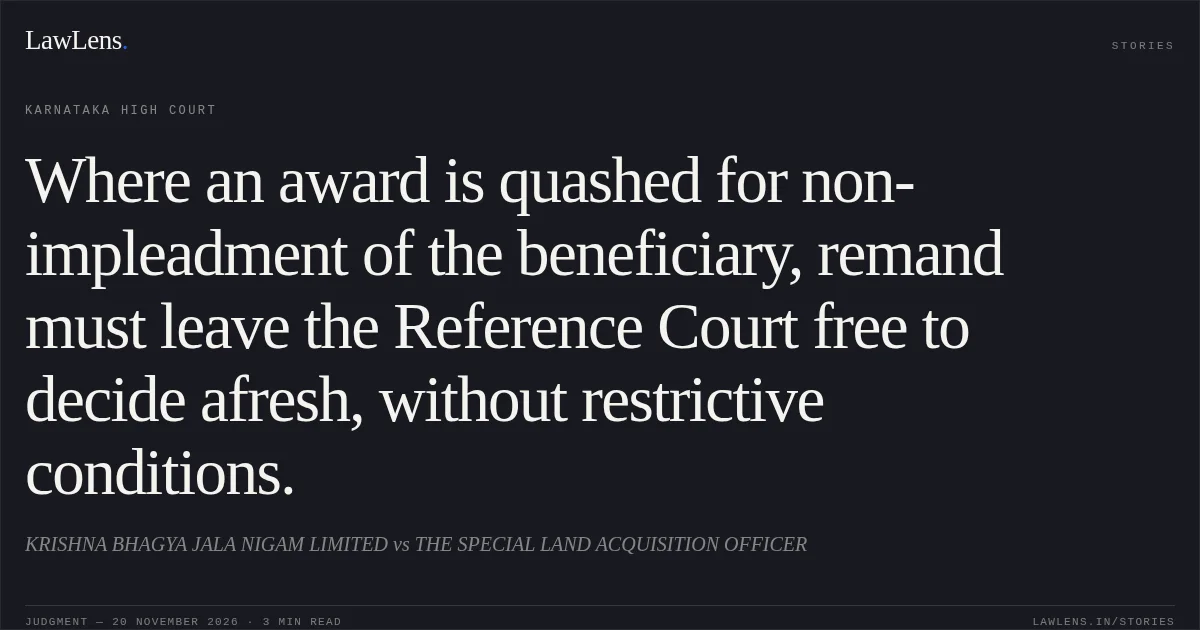
The appellant, Krishna Bhagya Jala Nigam Ltd. (KBJNL), is the beneficiary for whose benefit the private respondents' lands were acquired.
pp. 2–3 · ¶ 3KBJNL was not impleaded before the Reference Court, which passed an award in favour of the landowners.
pp. 2–3 · ¶ 3KBJNL challenged the award in W.P. No. 108648/2025 (LA-RES).
p. 3 · ¶ 3By order dated 16.06.2026, the learned Single Judge quashed the award and remitted the matter to the Reference Court, subject to nine operative conditions.
p. 3 · ¶ 3Conditions (iii) (impleadment of the beneficiary) and (iv)–(ix) (leave to file objections and cross-examine; directions on enhanced compensation in similar cases; a 25% deposit requirement; and time limits) were imposed.
pp. 4–7, quoted orderKBJNL appealed only against Conditions 4 to 9.
p. 2, prayer · p. 3 · ¶ 3In a connected batch (W.A. No. 100590/2026 and W.A. No. 100503/2026, arising from W.P. Nos. 109687/2025 and 109600/2025), a Division Bench, following W.A. No. 100475/2026 (order dated 06.08.2026), set aside Conditions (iv)–(ix) and left the Reference Court free to decide the reference in accordance with law.
pp. 4–9 · ¶ 4 (quoted order) · ¶ 5–7 (quoted order)Unserved respondents were not given notice in the present appeal.
p. 2 · ¶ 202Issues
i.1. Whether Conditions 4 to 9 imposed by the learned Single Judge, which regulate the Reference Court's procedure, deposits, and timelines on remand, are legally sustainable when the writ petition was founded solely on the legal infirmity of an award passed without the beneficiary being impleaded.
p. 3 · ¶ 3 · p. 4 · ¶ 4 · pp. 8–9, quoted paras. 7–8ii.2. Whether the matter can be finally disposed of without issuing notice to the unserved private respondents, given the safeguard of notice by the Reference Court.
p. 2 · ¶ 2 · p. 10 · ¶ 6 · p. 11 · ¶ 703Law Applied
The appeal was filed under the Karnataka High Court Act, 1961 (s. 4).
p. 2Where a writ petition rests solely on the legal ground that an award passed in the beneficiary's absence is unsustainable, the Reference Court must be given a free hand to decide the reference in accordance with law, and the writ court may not impose conditions that restrict the Reference Court's discretion over how the reference is decided.
pp. 4–9 · ¶ 5 (quoted order) · p. 8, quoted para. 7The remand directions (impleadment and setting aside the award) survive, while the procedural and financial conditions are set aside, and the Reference Court should expedite disposal with liberty to the claimants to seek directions for undue delay.
pp. 8–9, quoted paras. 8–9, 12The Reference Court is to issue notice to unserved parties on re-hearing.
p. 11 · ¶ 7 · p. 10 · ¶ 6Provisions in the judgment · 1 · Linked ones open on LawLens
KARNATAKA HIGH COURT ACT, 1961 Section 4
04Reasoning
The Division Bench treated the controversy as identical to the matters decided in W.A. No. 100475/2026 and its connected matters, which were heard on the same common judgment of the learned Single Judge.
pp. 3–4 · ¶ 4 · p. 10 · ¶ 6The appellant's writ petition was confined to the legal defect of the beneficiary's non-impleadment. Once that defect was accepted, the remand and impleadment directions (i)–(iii) were a sufficient and legitimate response.
p. 8, quoted para. 8Conditions 4 to 9 went beyond that legal foundation. They directed the Reference Court on evidence, cross-examination, enhanced compensation in similar cases, deposits, and timelines, and so curtailed the discretion the Reference Court must exercise in deciding the reference.
pp. 8–9, quoted para. 7On notice, the Court adopted the approach taken in the connected matters: the unserved respondents need not be served at the appellate stage because the Reference Court is directed to issue notice to them on remand, and that safeguard protects their interests.
p. 2 · ¶ 2 · p. 10 · ¶ 6The Court saw no reason to treat KBJNL's appeal differently from the connected matters.
p. 10 · ¶ 605Holding
The Court answered Issue 1 by holding that Conditions 4 to 9 cannot stand.
pp. 10–11 · ¶ 6–7The Court answered Issue 2 by holding that the appeal may be disposed of without notice to the unserved respondents.
pp. 10–11 · ¶ 6–7The writ appeal is disposed of in terms of W.A. No. 100590/2026 and connected matters. The parties are directed to appear before the Reference Court on 16.12.2026 without further notice. The Reference Court is directed to issue notice to the unserved parties and proceed with the reference in accordance with law. Pending I.As. are disposed of. The single-judge directions (i)–(iii), which were not challenged, are not disturbed.
p. 11 · ¶ 7–8 · p. 3 · ¶ 3 · p. 8, quoted para. 8Original Court PDF
KRISHNA BHAGYA JALA NIGAM LIMITEDvsTHE SPECIAL LAND ACQUISITION OFFICER
Click to open original judgment
Original judgment, available to read, download and summarize on LawLens.in