Facts
The appellants were prosecuted in connection with Wazirganj P.S. Case No. 515 of 2021, based on the victim’s mother’s allegation that, on 20 November 2021, the appellants took her minor daughter towards a Rahar field and kidnapped her.
Source reference: para. 4–7The FIR was initially registered under Sections 363/34 IPC and Section 8 of the POCSO Act; after investigation, charges were framed under Sections 376-DB and 366 IPC and Section 6 of the POCSO Act.
Source reference: para. 4–7The prosecution examined six witnesses, including the victim’s mother, relatives, a village witness, the doctor, and the Investigating Officer.
Source reference: para. 8The defence relied, inter alia, on a counter-case, Wazirganj P.S. Case No. 514 of 2021, alleging that the appellants had themselves been assaulted by members of the prosecution party during the same occurrence.
Source reference: para. 19–20The trial court convicted the appellants and sentenced them to seven years’ rigorous imprisonment under Section 366 IPC and life imprisonment under Section 6 of the POCSO Act, with the sentences to run concurrently.
Source reference: para. 3Issues
Whether the prosecution proved beyond reasonable doubt that the appellants kidnapped the minor victim with the intention of committing rape, thereby attracting Sections 366 and 376-DB IPC and Section 6 of the POCSO Act?
Source reference: para. 11–12, 30–32Whether the contradictions among the prosecution witnesses and the medical evidence rendered the prosecution case unreliable and unsafe for sustaining the conviction?
Source reference: para. 21–31Whether the appellants were entitled to the benefit of doubt in view of the counter-case and the surrounding local dispute between the parties?
Source reference: para. 19–20, 30–32Law Applied
The Court applied Sections 366 and 376-DB of the Indian Penal Code and Section 6 of the Protection of Children from Sexual Offences Act, which criminalise kidnapping for the purpose of illicit intercourse/aggravated penetrative sexual assault against a child and prescribe the applicable punishment.
Source reference: no citationThe Court further applied the criminal-law principle that the prosecution must establish guilt beyond reasonable doubt and that material contradictions, unreliable testimony, and evidence creating a reasonable doubt must operate in favour of the accused.
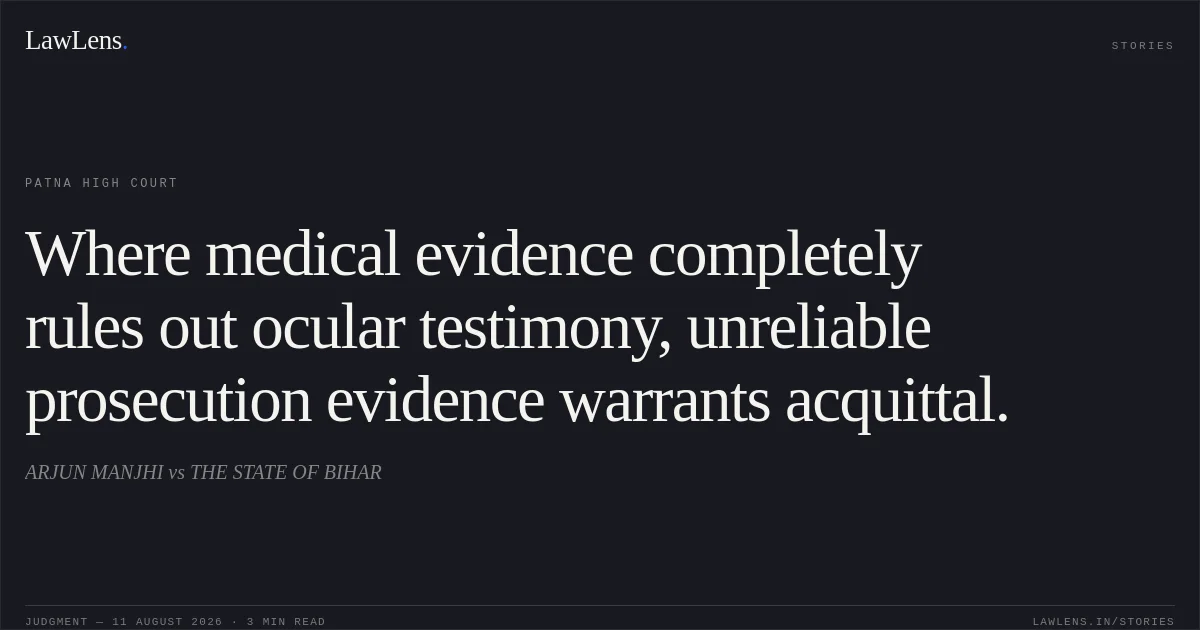
Source reference: no citationRelying on Abdul Sayeed v. State of Madhya Pradesh, (2010) 10 SCC 259, the Court reiterated that although ocular evidence ordinarily has greater evidentiary value than medical evidence, medical evidence may discredit ocular testimony where it makes the testimony improbable; if it completely rules out the possibility of the ocular version being true, the ocular evidence may be rejected.
Source reference: para. 24Reasoning
The Court found that the prosecution evidence was materially inconsistent regarding the occurrence, the recovery of the victim, and the alleged disclosure by the victim.
Source reference: para. 21, 28The mother stated that the victim was found by a police constable and taken to the police station, whereas PW-5 gave a different account, claiming that villagers found and brought her home.
Source reference: para. 21, 28PW-2 and PW-3 claimed that the victim disclosed that the appellants had raped her, but the Investigating Officer testified that neither witness had made such a statement during investigation, materially contradicting their depositions.
Source reference: para. 26The medical examination found no injuries, an intact hymen, no bleeding or laceration, no evidence of recent sexual intercourse, and no spermatozoa in the vaginal swab; although the doctor stated that rape could not be denied, the Court held that the medical evidence completely ruled out the ocular version relied upon by the prosecution.
Source reference: para. 22–24The existence of the counter-case, the appellants’ injuries, and the admitted local hostility and election-related dispute further weakened the prosecution case and made false implication reasonably possible.
Source reference: para. 19–21, 29–30Accordingly, the Court held that the witnesses were not wholly reliable and that the prosecution story did not inspire confidence.
Source reference: para. 30–32Holding
The High Court held that the prosecution failed to prove the charges under Sections 376-DB and 366 IPC and Section 6 of the POCSO Act beyond reasonable doubt.
The conviction judgment dated 9 May 2023 and the sentencing order dated 19 May 2023 were set aside, and both appellants were acquitted by extending the benefit of doubt.
Source reference: para. 33As the appellants were in custody, the Court directed that they be released forthwith unless required in any other case.
Source reference: para. 34The appeal was accordingly allowed.
Source reference: para. 35Acts & Sections Cited
13 provisions across 3 statutes referred to in this judgment. Each provision opens on LawLens.
Indian Penal Code, 18607
Code of Criminal Procedure, 19733
Original Court PDF
ARJUN MANJHIvsTHE STATE OF BIHAR
Click to open original judgment
Original judgment, available to read, download and summarize on LawLens.in