Facts
The respondent-assessee, an individual, filed a revised return for assessment year 2021–2022 declaring total income of ₹16,13,860. His return was selected for scrutiny on the ground that substantial purchases had been made from parties who were non-filers, had filed non-business returns, or had reported turnover discrepancies in their GST returns, suggesting possible bogus purchases.
Source reference: para. 8During assessment, the Assessing Officer issued notices under Section 133(6) of the Income-tax Act to the suppliers. As no responses were received, the Assessing Officer concluded that the purchases were sham or unverifiable.
Source reference: para. 9An addition of ₹12,73,85,064 was consequently made under Section 69C read with Section 115BBE, and the assessment was completed at ₹12,89,98,924.
Source reference: para. 10The Commissioner of Income Tax (Appeals) upheld the assessment order.
Source reference: para. 13On further appeal, the Income Tax Appellate Tribunal deleted the addition after finding that the assessee had produced books of account, purchase invoices, banking payment details and other supporting documents.
Source reference: para. 14The Revenue challenged the Tribunal’s decision before the High Court.
Source reference: no citationIssues
Whether the Tribunal was justified in deleting the addition of ₹12,73,85,064 under Section 69C read with Section 115BBE despite the Revenue’s contention that the suppliers were non-existent, untraceable or had not confirmed the transactions?
Source reference: para. 2(i)Whether rejection of the assessee’s books of account under Section 145(3) was a prerequisite for invoking Section 69C in respect of alleged unexplained purchases?
Source reference: para. 2(ii)Whether the Tribunal erred in disregarding departmental verification reports, alleged cancellation or suspension of suppliers’ GST registrations, and the absence of stock-register or transportation evidence merely because the corresponding sales were accepted?
Source reference: para. 2(iii)Whether the Tribunal’s conclusion that purchases could not be disallowed in their entirety merely because suppliers were untraceable was contrary to binding precedent?
Source reference: para. 2(iv)Whether the Tribunal’s finding that the addition was based on presumption rather than tangible material raised a substantial question of law warranting interference under the High Court’s appellate jurisdiction?
Source reference: para. 2(v)Law Applied
The Court considered Section 69C of the Income-tax Act, which permits addition of unexplained expenditure where the assessee cannot satisfactorily explain the source of expenditure, read with Section 115BBE concerning the tax treatment of certain unexplained income or expenditure.
Source reference: paras. 10, 12It also considered Section 145(3), under which the Assessing Officer may reject the books of account where their correctness or completeness is not satisfactory.
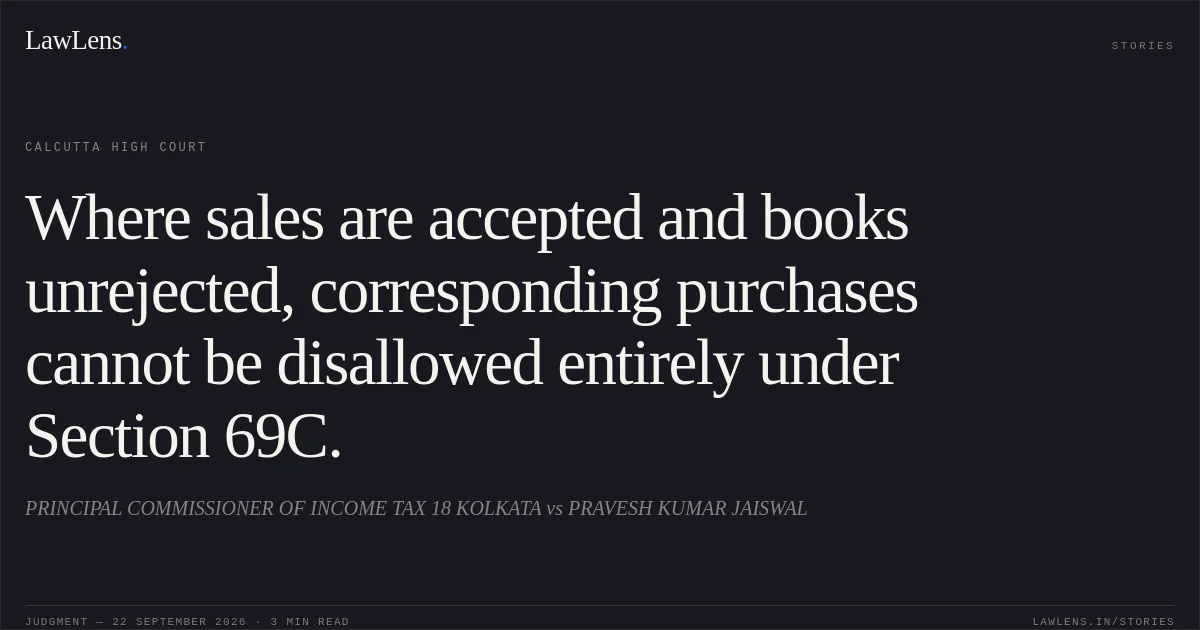
Source reference: paras. 17–20Relying on Principal Commissioner of Income Tax v. Nitin Ramdeoji Lohia, [2022] 145 taxmann.com 546 (Bombay), the Court held that if purchases were wholly bogus, corresponding sales would also ordinarily be incapable of being completed; therefore, where sales are accepted, the purchases cannot automatically be treated as wholly bogus, though they may involve purchases from allegedly non-genuine parties.
Source reference: para. 22The Court further reiterated that the Income Tax Appellate Tribunal is the final fact-finding authority and that interference in an appeal under the High Court’s jurisdiction requires a substantial question of law.
Source reference: para. 23Reasoning
The High Court examined the Tribunal’s finding that the assessee had produced books of account, purchase invoices, banking records and other supporting material, while the Assessing Officer’s conclusion rested principally on the suppliers’ failure to respond to notices under Section 133(6) and alleged GST-registration irregularities.
Source reference: paras. 14–15The Court considered these circumstances insufficient to displace the assessee’s documentary evidence, particularly because the books of account had not been rejected under Section 145(3) and the corresponding sales had not been questioned.
Source reference: paras. 16–20Applying the reasoning in Nitin Ramdeoji Lohia, the Court held that acceptance of the sales materially undermined the Revenue’s case for treating the entire purchases as bogus, since the purchases were connected with the completed sales.
Source reference: para. 22The Tribunal’s conclusion that the addition was based on presumption and not tangible material was therefore treated as a factual determination supported by the record. Since the Revenue’s objections essentially sought reappreciation of evidence, the Court held that they did not give rise to any substantial question of law.
Source reference: para. 23Holding
The High Court answered the proposed questions against the Revenue, holding that the Tribunal had correctly deleted the addition of ₹12,73,85,064.
The Court found that the Tribunal had properly relied on the assessee’s books, invoices, banking records, acceptance of sales and the absence of rejection of the books under Section 145(3).
Source reference: paras. 15–20It held that the Revenue’s challenges raised only questions of fact and disclosed no substantial question of law.
Source reference: para. 23The appeal was accordingly dismissed, with no order as to costs.
Source reference: paras. 24–25Acts & Sections Cited
7 provisions across 1 statute referred to in this judgment. Linked provisions open on LawLens.
Income Tax Act, 19617
Original Court PDF
PRINCIPAL COMMISSIONER OF INCOME TAX 18 KOLKATAvsPRAVESH KUMAR JAISWAL
Click to open original judgment
Original judgment, available to read, download and summarize on LawLens.in