01Facts
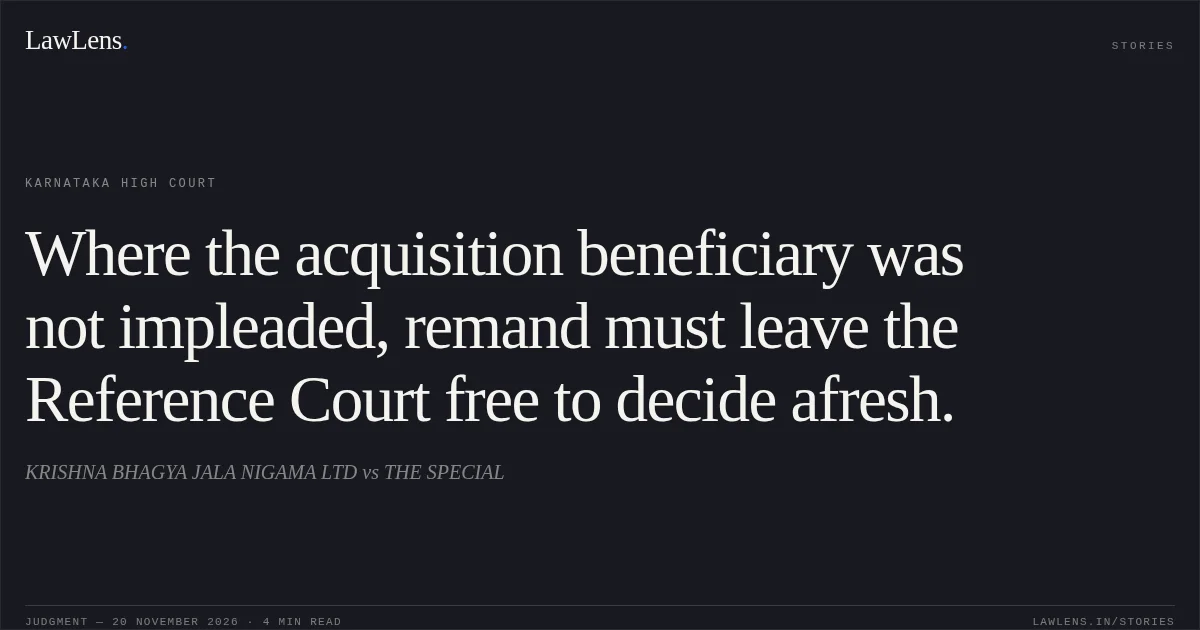
The appellant, Krishna Bhagya Jala Nigam Ltd. (KBJNL), is the beneficiary for whose benefit private lands were acquired.
It was not impleaded before the Reference Court, which passed an award enhancing compensation.
¶ 3KBJNL challenged the award in W.P. No. 108214/2025.
¶ 3On 16.06.2026, the learned Single Judge quashed the award, remitted the matter to the Reference Court with a direction to implead KBJNL, and imposed Conditions 4 to 9.
¶ 3Those conditions permitted KBJNL to file objections and cross-examine claimants; required the Reference Court to call for information on whether enhanced compensation had been paid for similarly placed lands; prescribed timelines for disposal (six months or one year, depending on that information); and required KBJNL to deposit 25% of the awarded amount within two months, failing which claimants could seek relief.
¶ 3KBJNL filed the present writ appeal under Section 4 of the Karnataka High Court Act, 1961, challenging only Conditions 4 to 9.
¶ 3Respondents 1 and 2 (SLAO and State) were represented; Respondent 3 (claimant) had not been served.
¶ 2A co-ordinate Bench, in Writ Appeal Nos. 100590/2026 and 100503/2026, disposed of similar appeals on 06.08.2026 by following W.A. No. 100475/2026 and setting aside the same conditions.
¶ 4Counsel for KBJNL and the AAG sought a similar order.
¶ 502Issues
i.1. Whether Conditions 4 to 9 imposed by the learned Single Judge, which regulate the Reference Court's procedure, timelines, evidence-gathering, and require a 25% deposit, are sustainable when the writ petition's only ground was the legal invalidity of an award passed without the beneficiary's participation.
¶ 3 · ¶ 5 (quoting W.A. No. 100475/2026, paras 7-8)ii.2. Whether notice must be served on the unserved private respondent before the writ appeal is decided.
¶ 2 · ¶ 403Law Applied
The judgment cites no statutory provisions and no reported precedents; the legal framework is drawn from the co-ordinate Bench decision in W.A. No. 100475/2026 (06.08.2026), as reproduced.
¶ 5Where a writ petition rests solely on the legal contention that a judgment and award passed in the beneficiary's absence is unsustainable, the Reference Court must be given a free hand to decide the reference in accordance with law, and the writ court may not impose conditions that restrict the Reference Court's discretion over how the reference is to be decided.
¶ 5 (quoting W.A. No. 100475/2026, paras 7-8)The writ appeal itself is maintainable under Section 4 of the Karnataka High Court Act, 1961.
¶ 3The safeguard principle, under which a writ appeal may be finally heard without notice to unserved respondents where their interests are protected by directions, is applied from the co-ordinate Bench's reasoning.
¶ 2 · ¶ 5 (quoting W.A. No. 100475/2026, paras 9-12)No statutory provision on Reference Court procedure or the deposit requirement is cited.
Provisions in the judgment · 1 · Linked ones open on LawLens
KARNATAKA HIGH COURT ACT, 1961 Section 4
04Reasoning
The Court followed its co-ordinate Bench rather than revisiting the question.
¶ 4 · ¶ 5The Single Judge had accepted that the award was legally unsustainable because the beneficiary was not impleaded, and that ground alone justified remand and impleadment.
¶ 3 · ¶ 5 (quoting W.A. No. 100475/2026, para 7)Conditions 4 to 9, however, went further by prescribing how the Reference Court should weigh evidence, what information it must gather, and how quickly it must decide, and by imposing a financial deposit.
¶ 3The Court held that these conditions restricted the Reference Court's discretion beyond what the legal defect warranted.
¶ 5 (quoting W.A. No. 100475/2026, para 7)Directions I to III (quashing, remand, and impleadment) were affirmed; the observations and directions in Conditions iv to ix were set aside.
¶ 5 (quoting W.A. No. 100475/2026, para 8)Because the claimant had not been served, the Court relied on the safeguard that the Reference Court would issue notice and the parties would appear on a fixed date.
¶ 2 · ¶ 705Holding
Both issues were resolved in favour of the appellant. Conditions 4 to 9 of the Single Judge's order are not sustainable and are set aside, by express reference to the co-ordinate Bench's order, which the Court adopted.
¶ 6-7The Reference Court must decide the reference afresh in accordance with law, free of the imposed conditions, and notice to unserved parties is to be issued by the Reference Court.
¶ 7The writ appeal is disposed of on those terms; the parties are directed to appear before the Reference Court on 16.12.2026, the Reference Court is to issue notice to unserved respondents, and all pending I.As. are disposed of.
¶ 7-8The judgment does not expressly restate that Conditions 4 to 9 are set aside in its own operative paragraph; that result follows from its adoption of W.A. No. 100590/2026 and connected matters, which set aside Conditions iv to ix.
¶ 6-7Accordingly, the 25% deposit requirement (Condition viii) also falls by implication.
¶ 5 (quoting W.A. No. 100475/2026, para 8)Original Court PDF
KRISHNA BHAGYA JALA NIGAMA LTDvsTHE SPECIAL
Click to open original judgment
Original judgment, available to read, download and summarize on LawLens.in