01Facts
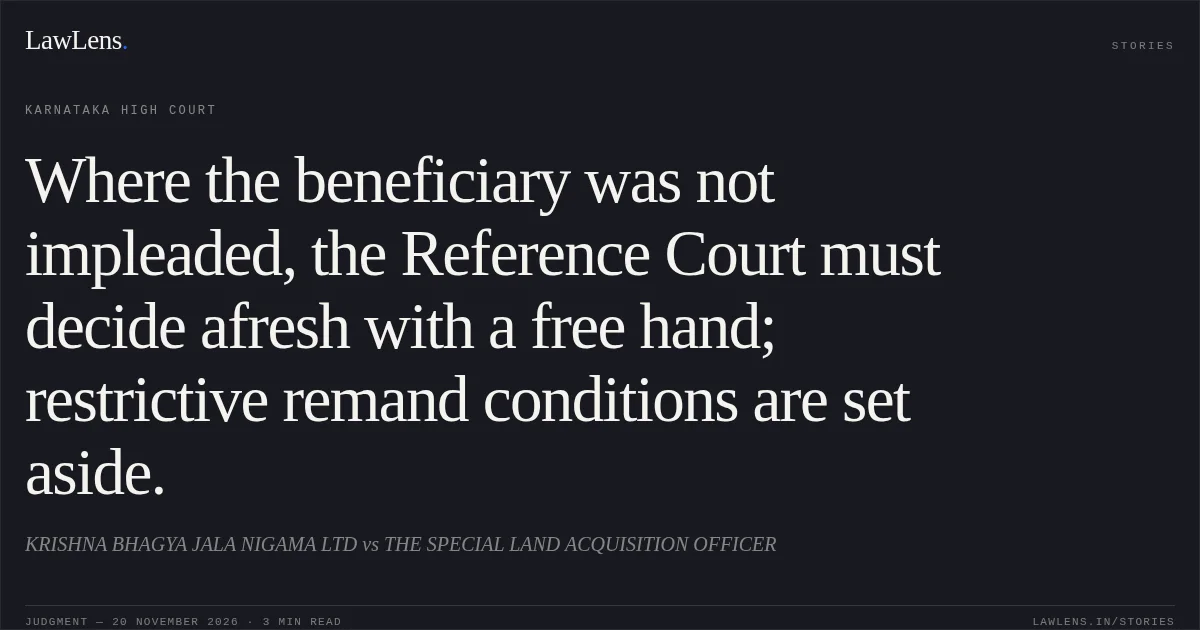
The appellant, Krishna Bhagya Jala Nigama Ltd. (the beneficiary for whose benefit private lands were acquired), was not made a party before the Reference Court, which passed an award in the land owners' reference.
¶ 3 · pp. 4–5The appellant challenged the award in W.P. No. 108009/2025.
¶ 3 · pp. 4–5On 16.06.2026, the learned Single Judge set aside the award and remitted the matter to the Reference Court, subject to conditions (Nos. 4–9).
¶ 3 · pp. 5–6 · order quoted at para. 4 · pp. 6–8The conditions permitted the beneficiary to file objections, cross-examine and lead evidence; required the Reference Court to examine whether similarly placed lands had received enhanced compensation; fixed time limits for disposal (six months/one year); and required the beneficiary to deposit 25% of the award amount.
¶ 3 · pp. 5–6 · order quoted at para. 4 · pp. 6–8Aggrieved by Conditions 4–9, the appellant filed the present appeal under Section 4 of the Karnataka High Court Act, 1961.
p. 3Notice was not served on several private respondents (Respondents 3–14).
pp. 1–3 · ¶ 2 · p. 402Issues
i.1. Whether the conditions (Nos. 4–9) imposed by the learned Single Judge, while remitting the reference to the Reference Court, were sustainable where they restricted the Reference Court's discretion in deciding the reference.
¶ 3 · p. 5 · ¶ 4 · pp. 5–11 · ¶ 6 · p. 11ii.2. Whether the appeal could be finally heard without issuing notice to the unserved private respondents.
¶ 2 · p. 4 · ¶ 4 · p. 503Law Applied
The Court relied on Section 4 of the Karnataka High Court Act, 1961, as the basis for the writ appeal.
p. 3The Reference Court must be given a free hand to decide the matter in accordance with law; where a writ petition rests solely on the legal ground that an award passed without the beneficiary's participation is unsustainable, conditions restricting the Reference Court's discretion over the manner of deciding the reference are impermissible, as set out in the co-ordinate bench judgment in W.A. No. 100475 of 2026 (06.08.2026).
¶ 4 · pp. 8–9 (quoting para. 7 of W.A. No. 100475/2026)A single judge may quash the award and remit the matter, while conditions on evidence, cross-examination, and timelines are set aside.
¶ 4 · p. 9 (quoting para. 8 of W.A. No. 100475/2026)The Reference Court should expeditiously dispose of the reference, with liberty to the claimants to approach the High Court for directions if delay occurs.
¶ 4 · p. 9 (quoting para. 9 of W.A. No. 100475/2026)The practice of disposing of an appeal without notice to unserved respondents applies where a safeguard is provided for them.
¶ 2 · p. 4 · ¶ 4 · pp. 5–6 (quoting W.A. No. 100590/2026 & W.A. No. 100503/2026)The judgment does not cite specific provisions of the Land Acquisition Act, 1894.
04Reasoning
The appellant's sole contention was that the award was passed without the beneficiary being impleaded, a legal defect the Single Judge rightly found sufficient to quash the award and remit the matter.
¶ 3 · pp. 4–5Once the award was set aside on that legal ground, imposing Conditions 4–9 was not appropriate, as they curtailed the Reference Court's discretion over the procedure, evidence, deposit, and timelines for deciding the reference.
¶ 4 · pp. 8–9 · ¶ 6 · p. 11Following the co-ordinate bench's reasoning in W.A. No. 100475/2026 and the connected matters (W.A. Nos. 100590/2026 and 100503/2026), the Court treated the present appeal as identical in issue and outcome.
¶ 4 · pp. 5–11 · ¶ 6 · p. 11The Court found it unnecessary to serve the unserved respondents before disposal, because the remittal order itself protects their interests by requiring fresh notice and consideration by the Reference Court.
¶ 2 · p. 4 · ¶ 7 · p. 1205Holding
Conditions 4–9 imposed by the Single Judge cannot be sustained, as they restrict the Reference Court's discretion in a matter where the only ground accepted was legal.
¶ 4 · pp. 8–9 · ¶ 6 · p. 11The Court disposed of the writ appeal in terms of W.A. No. 100590/2026 and connected matters.
¶ 7 · p. 12The remittal to the Reference Court under the Single Judge's order is affirmed, Conditions 4–9 are effectively set aside, the parties are directed to appear before the Reference Court on 16.12.2026, and the Reference Court must issue notice to the unserved parties and proceed in accordance with law.
¶ 7 · p. 12Pending I.As. are disposed of.
¶ 8 · p. 12Original Court PDF
KRISHNA BHAGYA JALA NIGAMA LTDvsTHE SPECIAL LAND ACQUISITION OFFICER
Click to open original judgment
Original judgment, available to read, download and summarize on LawLens.in