Facts
The petition challenged, among other matters, Regulation 8(1) of the Central Electricity Regulatory Commission (Deviation Settlement Mechanism and Related Matters) Regulations, 2022, and related DSM demands.
Source reference: p.2, para. 1By interim orders dated 29 April and 23 May 2025, the Court directed that no coercive action be taken and required APSLDC to comply with that protection.
Source reference: pp.2–3, paras. 2–4; p.15, para. 16In April 2026, APSLDC required the applicants to clear outstanding DSM dues before processing their open-access applications, then issued limited-duration and part-capacity NOCs.
Source reference: pp.3–4, paras. 6–10; p.16, paras. 18–19It also cited unpaid DSM dues in its communications and show-cause notice.
Source reference: pp.3–4, paras. 6–10; p.16, paras. 18–19The applicants sought enforcement of the interim orders and full-capacity NOCs; APSLDC maintained that it could independently regulate NOC capacity and duration on grid-security grounds.
Source reference: p.4–5, para. 11; pp.13–15, paras. 13.9–13.13Issues
Whether APSLDC could withhold, revoke, or restrict NOCs or Standing Clearances because the applicants had not paid DSM dues covered by the interim orders.
Source reference: p.15, para. 15Whether the interim orders required APSLDC to grant NOCs for the Wind Projects’ full installed capacity or for any specified duration.
Source reference: pp.16–17, paras. 20–23Law Applied
The Court applied its interim orders of 29 April and 23 May 2025, which protected the applicants from coercive action pursuant to the 2022 Regulations and required APSLDC not to make payment of the covered DSM dues a condition for continuing NOCs or Standing Clearances.
Source reference: pp.15–16, paras. 16–17That protection does not require NOCs for any specified capacity or period: APSLDC may regulate their grant, capacity, or duration on an independent ground permitted by the applicable regulatory framework, so long as the action is not founded on non-payment of the covered dues.
Source reference: pp.16–17, paras. 20, 23–24The Court did not determine the merits of APSLDC’s asserted grid-security justification.
Source reference: p.17, para. 22Reasoning
APSLDC’s 28 April 2026 communication expressly required payment of DSM dues before processing the open-access applications; the subsequent limited NOCs and show-cause notice also linked the restrictions to unpaid dues.
Source reference: p.16, paras. 18–19Treating payment as a prerequisite therefore circumvented the interim protection by indirectly recovering the dues.
Source reference: p.16, paras. 18–19However, because the application concerned compliance with those orders, the Court did not decide whether the evidence established a continuing grid-security threat or whether full-capacity, full-month NOCs were warranted.
Source reference: pp.16–17, paras. 20–24The interim orders consequently did not displace APSLDC’s authority to act on an independent permissible regulatory ground.
Source reference: pp.16–17, paras. 20–24Holding
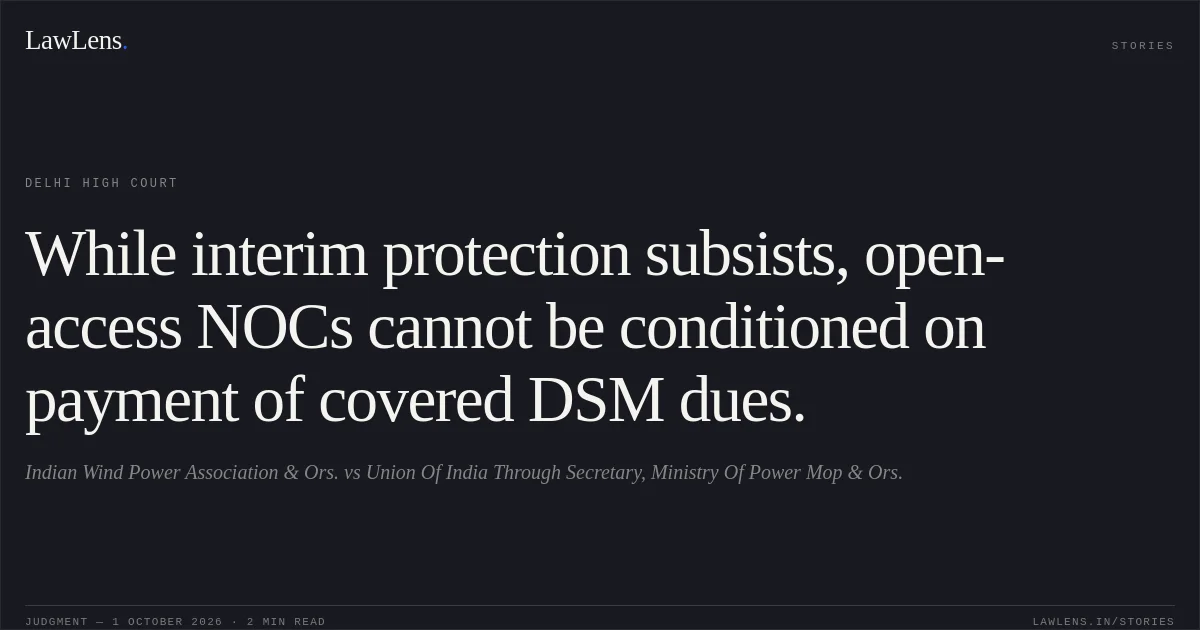
The Court held that APSLDC could not withhold, revoke, or restrict NOCs or Standing Clearances on account of DSM dues covered by the interim orders while those orders remained in force.
It declined to direct issuance of full-capacity NOCs for an entire month, leaving APSLDC free to regulate NOCs on independent grounds and the applicants free to pursue available remedies concerning capacity or duration.
Source reference: p.18, paras. 25–26The application was disposed of with directions for strict compliance with the interim orders.
Source reference: p.18, paras. 25–26Acts & Sections Cited
3 provisions across 2 statutes referred to in this judgment. Each provision opens on LawLens.
Code of Civil Procedure, 19081
Electricity Act, 20032
Original Court PDF
Indian Wind Power Association & Ors.vsUnion Of India Through Secretary, Ministry Of Power Mop & Ors.
Click to open original judgment
Original judgment, available to read, download and summarize on LawLens.in