Facts
The Respondent No. 1 married the Appellant’s son, Amit Das, in 2022. Following the marriage, she resided at the Appellant's house where she alleged torture over monetary demands
Source reference: p. 2While pregnant, she was driven out of the matrimonial home and moved into a rented room. In April 2023, Respondent No. 2 was born, and in May 2023, the Appellant’s son (the husband) passed away
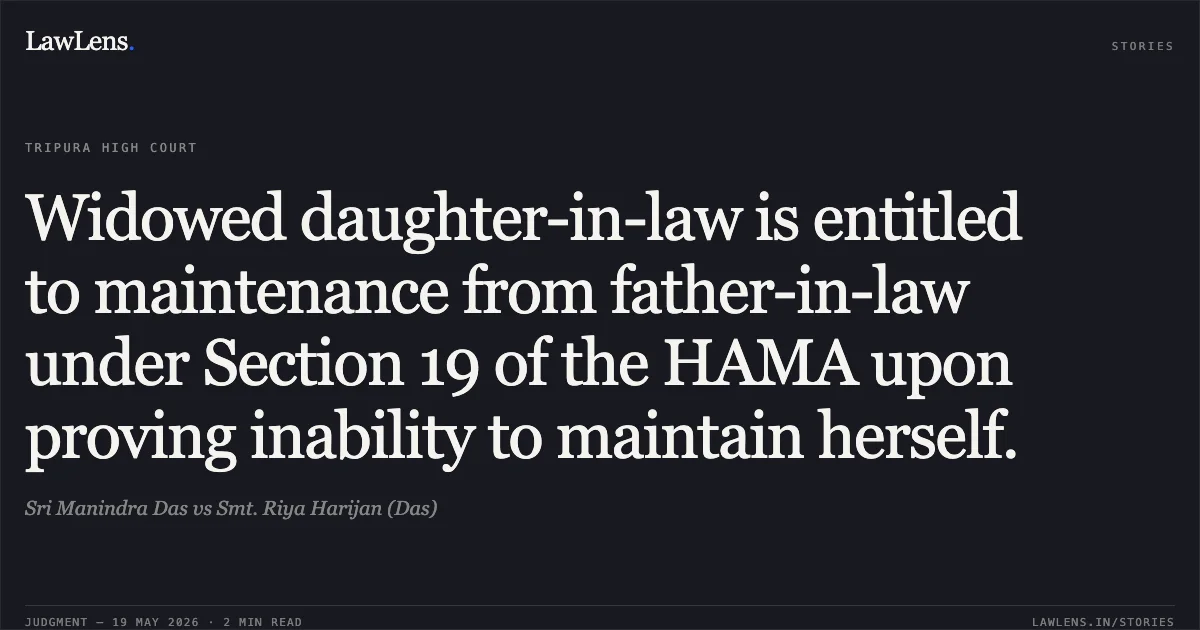
Source reference: p. 2Facing starvation and lacking independent income, the Respondents filed a petition under Section 19 of the Hindu Adoptions and Maintenance Act, 1956, seeking maintenance from the Appellant (father-in-law).
Source reference: p. 1-2The Family Court, Kailasahar, via order dated 21.02.2025, directed the Appellant to pay ₹700 per month to Respondent No. 1 and ₹500 per month to Respondent No. 2
Source reference: p. 1-2The Appellant challenged this order, claiming he is an ailing e-rickshaw puller with insufficient means
Source reference: p. 3Issues
1. Whether a widowed daughter-in-law is entitled to maintenance from her father-in-law under Section 19 of the Hindu Adoptions and Maintenance Act, 1956, when she has no source of income or estate
Source reference: p. 4, para. 92. Whether the Appellant, as an e-rickshaw puller, possesses the "means" to provide maintenance as required under the Act
Source reference: p. 5, para. 9Law Applied
Section 19 of the Hindu Adoptions and Maintenance Act, 1956
Source reference: p. 4This provision stipulates that a Hindu widowed daughter-in-law is entitled to maintenance from her father-in-law to the extent that she is unable to maintain herself from her own earnings, the estate of her husband, or her parents
Source reference: p. 4Per Section 19(2), this obligation is enforceable if the father-in-law has the "means" to do so from coparcenary property in his possession, provided the daughter-in-law has not obtained a share in such property, and the obligation ceases upon her remarriage
Source reference: p. 4Reasoning
The Court observed that the Appellant admitted to several material facts: the marriage of his son to Respondent No. 1, the birth of the grandchild (Respondent No. 2), the death of his son, and the fact that Respondent No. 1 has no source of income
Source reference: p. 3, 5The Court found that Respondent No. 1 met the statutory criteria of Section 19(1) as she was unable to maintain herself or obtain maintenance from the estate of her deceased husband
Source reference: p. 5Regarding the Appellant’s financial capacity, the Court noted his admission that he is an e-rickshaw puller, which evidenced that he is earning from a profession and thus possesses the "means" to provide the modest sum ordered
Source reference: p. 5The Court reasoned that maintenance must encompass basic needs including food, medicine, clothing, and shelter to allow the respondents to live with dignity
Source reference: p. 5Holding
The Court answered the issues in the affirmative, holding that the Respondent No. 1 successfully established her right to maintenance under Section 19.
The High Court found no error in the trial court's judgment and affirmed the order dated 21.02.2025. Consequently, the appeal was dismissed, requiring the Appellant to continue the monthly maintenance payments of ₹700 and ₹500 respectively
Source reference: p. 5, para. 11Acts & Sections Cited
1 provisions across 1 statute referred to in this judgment. Each provision opens on LawLens.
Hindu Adoptions and Maintenance Act, 19561
Original Court PDF
Sri Manindra DasvsSmt. Riya Harijan (Das)
Click to open original judgment
Original judgment, available to read, download and summarize on LawLens.in