Facts
Smt. Sangeeta Bajpayee, an Assistant Teacher, died in harness on April 23, 2021
Source reference: para. 2She was survived by her husband (a pensioner) and an unemployed son, Nikhil Bajpayee
Source reference: para. 2Nikhil’s application for compassionate appointment was rejected on April 10, 2023, because his father was receiving a pension
Source reference: para. 3Meanwhile, Nikhil married the Appellant on February 15, 2023, but subsequently died on May 13, 2023
Source reference: paras. 4-5The Appellant then sought compassionate appointment as the "widowed daughter-in-law"
Source reference: para. 6After several rounds of litigation, her appointment was initially granted but later cancelled by the District Inspector of Schools (D.I.O.S.) on the ground that she was not a dependent at the time of the employee's death
Source reference: paras. 8-9A learned Single Judge dismissed her writ petition, holding she was not a "member of family" at the time of death
Source reference: para. 10Issues
1. Whether the date of becoming a widow is a relevant factor to include a ‘widowed daughter-in-law’ within the definition of “family” to claim compassionate appointment under the Regulations.
Source reference: para. 17Law Applied
The Court applied Regulations 103 to 107 issued under Section 16G of Chapter III of the U.P. Intermediate Education Act, 1921, which define "members of the family" to include a "widow daughter-in-law"
Source reference: paras. 8, 18It relied on the principle from Umesh Kumar Nagpal v. State of Haryana (1994) 4 SCC 138, which establishes that compassionate appointment is an exception to Articles 14 and 16, intended solely to mitigate immediate financial crisis
Source reference: paras. 15, 23The Court also cited Director of Education (Secondary) v. Pushpendra Kumar (1998) 5 SCC 192, emphasizing that such appointments must not nullify general recruitment rules
Source reference: para. 23Union of India v. B. Kishore (2011) 13 SCC 131 regarding the necessity of proving indigence
Source reference: para. 34Reasoning
The Court reasoned that under Regulation 104, the names of family members must be reported within seven days of the employee's death; as the Appellant married the son 22 months after the death, she did not exist in the family unit at the relevant time
Source reference: paras. 22, 24, 26The term "widowed daughter-in-law" in Regulation 103 presupposes a status existing at the time of death or a dependency flowing from a son who was himself eligible
Source reference: paras. 20, 21The Court noted that Nikhil’s own claim had been rejected and attained finality; thus, the Appellant could not claim a better right through him
Source reference: paras. 27, 32Furthermore, the fact that the son could afford to marry two years after his mother's death negated the claim of "immediate financial crisis" or "indigence" required for such an equitable exception
Source reference: paras. 30, 34The Court concluded that "member of family" must be interpreted as those dependent at the time of the employee's death
Source reference: para. 30Holding
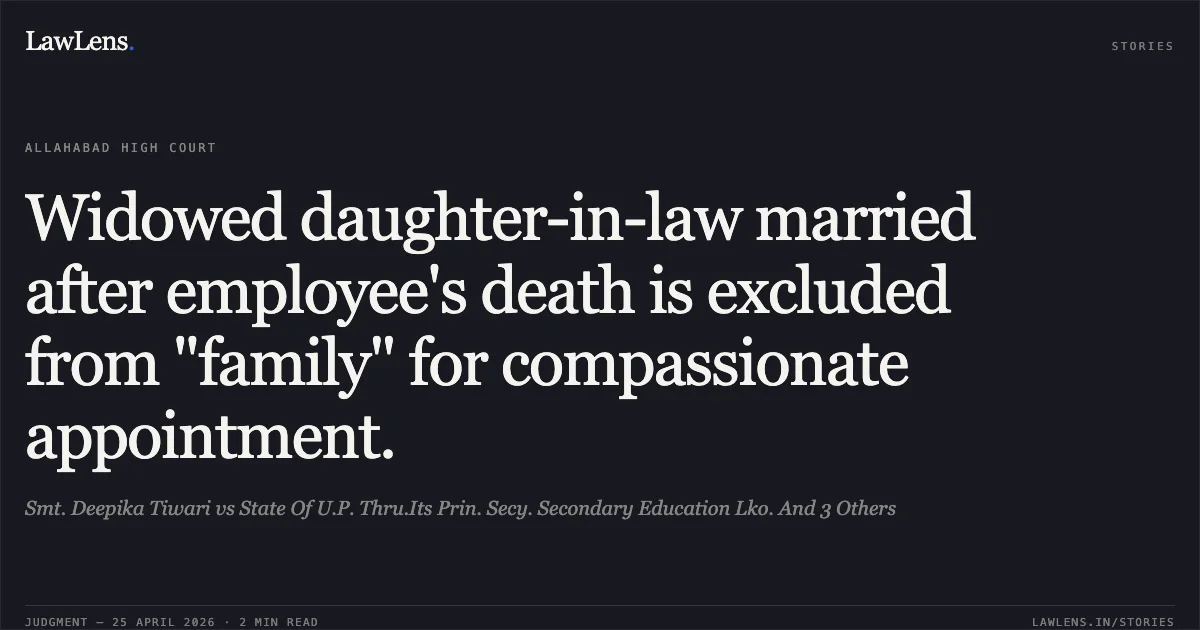
The status of a "widowed daughter-in-law" must be assessed relative to the date of the government servant's death
The Appellant, having entered the family via marriage nearly two years after the death, was not a "member of family" or a "dependent" under Regulation 103
Source reference: paras. 24, 33The Court upheld the Single Judge's order and dismissed the Special Appeal, finding no perversity in the earlier judgment
Source reference: paras. 35, 36Acts & Sections Cited
1 provisions across 1 statute referred to in this judgment. Linked provisions open on LawLens.
Uttar Pradesh Intermediate Education Act, 19211
Original Court PDF
Smt. Deepika TiwarivsState Of U.P. Thru.Its Prin. Secy. Secondary Education Lko. And 3 Others
Click to open original judgment
Original judgment, available to read, download and summarize on LawLens.in