Facts
The Petitioner is the widowed daughter of Late Sh. Lal Chand, a recognized freedom fighter and recipient of the Swatantrata Sainik Samman Pension.
Source reference: para. 4Following the death of her husband in 1993, the Petitioner resided with her parents and remained dependent on them.
Source reference: para. 4-5After her father’s death in 2004, her mother received the pension until her demise in 2018.
Source reference: para. 4The Petitioner sought to transfer the pension to her name as the surviving dependent, but her claim remained undecided by the Respondents.
Source reference: para. 5The Respondents resisted the claim based on Clause 5.2.5 of the 2014 Guidelines, which explicitly states that widowed or divorced daughters are ineligible for the pension.
Source reference: para. 6Issues
1. Whether the widowed daughter of a deceased freedom fighter stands excluded from the "Swatantrata Sainik Samman Pension Scheme, 1980" on account of her marital status alone.
Source reference: para. 12. Whether the restrictive interpretation of "eligible dependents" in Clause 5.2.5 of the Scheme’s guidelines is legally sustainable.
Source reference: para. 7, 9Law Applied
The court applied the Swatantrata Sainik Samman Pension Scheme, 1980, specifically Para 3 defining "Eligible Dependants".
Source reference: para. 3It relied on the precedent of Smt. Kohli Indira Kumari v. Union of India, which held that widowed daughters should not be denied benefits despite restrictive guidelines.
Source reference: para. 7-8The court further adopted the reasoning of the Punjab & Haryana High Court in Khazani Devi v. Union of India, which established that beneficial schemes for freedom fighters must not be fettered by rigorous interpretations that negate their laudable motives.
Source reference: para. 7Finally, it applied Article 14 of the Constitution of India as interpreted in Sonali Hatua Giri v. Union of India, which declared the blanket exclusion of widowed/divorced daughters as patently discriminatory and violative of the guarantee of equality.
Source reference: para. 9Reasoning
The Court reasoned that the Scheme is not a traditional contractual pension but a formal state recognition of sacrifice.
Source reference: para. 3It observed that since "unmarried daughters" are included as eligible dependents, excluding "widowed or divorced daughters" lacks rationality and creates an arbitrary classification.
Source reference: para. 7The Court emphasized that a beneficial scheme intended to ensure a life of dignity for the dependents of unsung heroes should be interpreted liberally rather than restrictively.
Source reference: para. 7By citing Sonali Hatua Giri, the Court noted that excluding widowed daughters who have no independent source of income is "worse than gender bias" and violates Article 14.
Source reference: para. 9Consequently, the Court found the legal position settled (res-integra), determining that marital status (widowhood) should not act as a bar if the daughter is otherwise a dependent.
Source reference: para. 10Holding
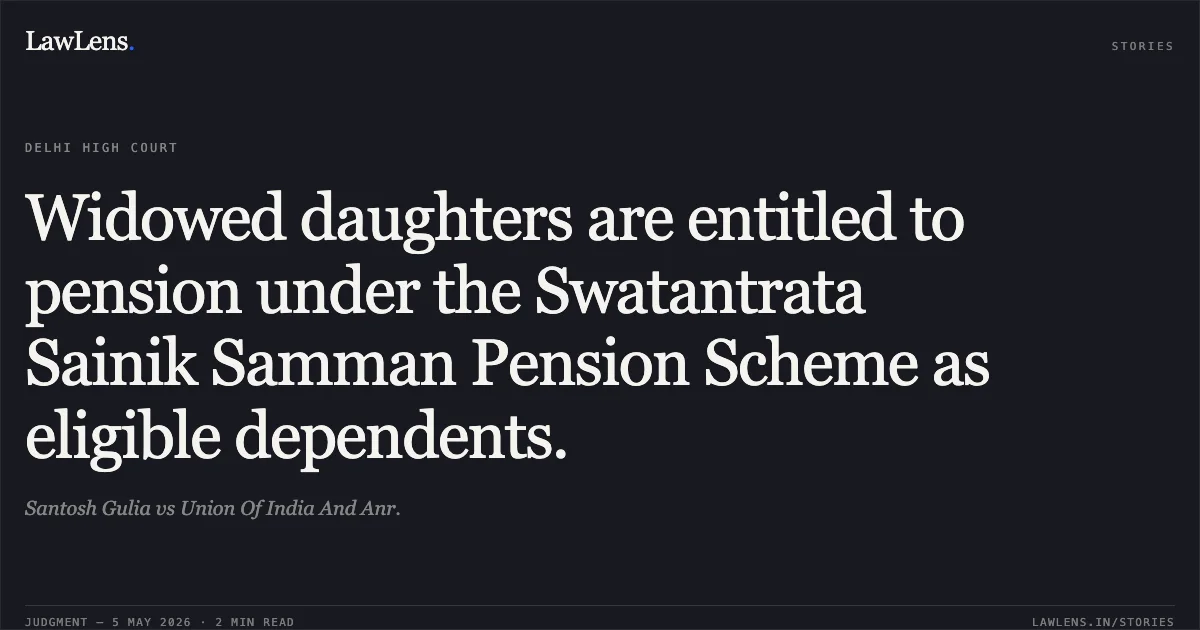
The Court answered the issues in favor of the Petitioner, holding that a widowed daughter cannot be excluded from the Scheme solely due to her marital status.
The Court directed the Respondents to consider the Petitioner’s case for the grant of dependent pension, provided she satisfies other conditions, such as having no independent source of income, within eight weeks.
Source reference: para. 10The writ petition was disposed of accordingly.
Source reference: para. 11Acts & Sections Cited
1 provisions across 1 statute referred to in this judgment. Linked provisions open on LawLens.
Swatantrata Sainik Samman Pension Scheme, 19801
Original Court PDF
Santosh GuliavsUnion Of India And Anr.
Click to open original judgment
Original judgment, available to read, download and summarize on LawLens.in


