01Facts
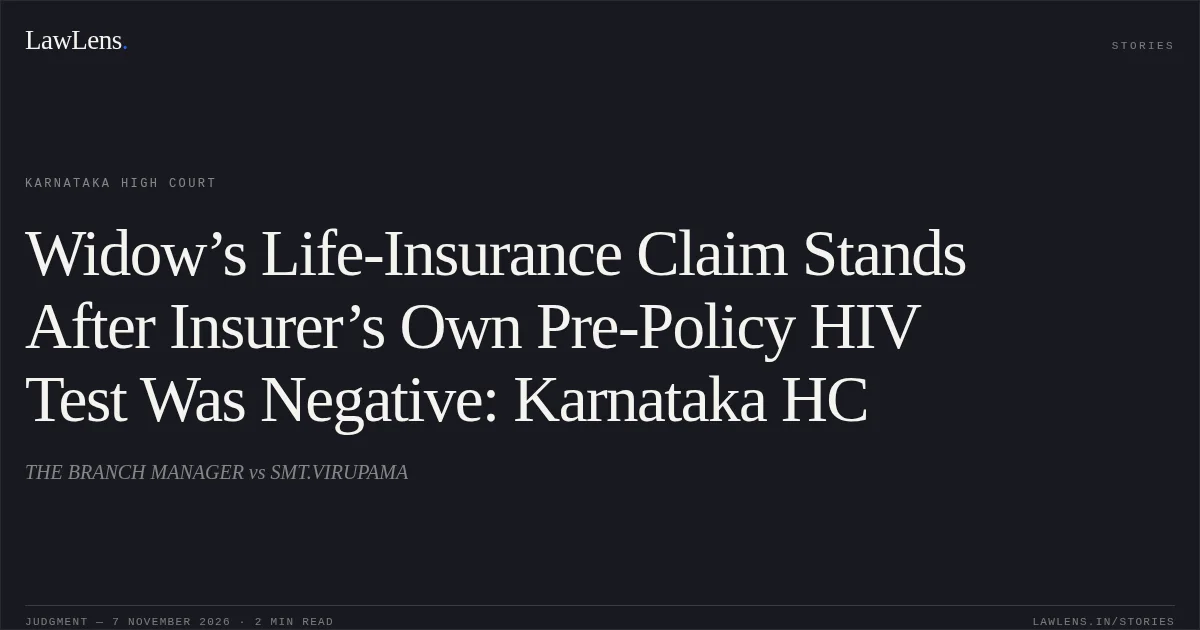
The complainant’s husband applied for life insurance in February 2006 and underwent medical examinations arranged by the insurer.
¶ 3–7 · pp. 3–5A Tri-Dot HIV test on 23 March 2006 was negative, and the insurer issued a policy with an assured sum of ₹26 lakh.
¶ 3–7 · pp. 3–5The insured died on 15 August 2006; the insurer repudiated the claim on the ground of non-disclosure of a pre-existing disease.
¶ 3–7 · pp. 3–5The Karnataka State Consumer Disputes Redressal Commission dismissed the complaint, but the National Consumer Disputes Redressal Commission allowed the complainant’s appeal.
¶ 3–7 · pp. 3–5The insurer then challenged the National Commission’s order under Articles 226 and 227 of the Constitution.
¶ 3–7 · pp. 3–502Issues
i.1. Whether the Consumer Forum had jurisdiction to determine whether the alleged non-disclosure justified repudiation of the insurance claim, or whether the complainant should have been relegated to a civil suit.
¶ 11 · pp. 6–8ii.2. Whether the National Commission erred in reversing the State Commission’s decision, including by relying on medical expert evidence said to conflict with the insurer’s doctor.
¶ 10, 12–16 · pp. 6, 8–1403Law Applied
Section 2(1)(g) of the Consumer Protection Act, 1986 defines “deficiency” in service.
¶ 11 · pp. 7–8A consumer forum may examine whether an insurer’s repudiation was justified under the policy and whether alleged suppression of material facts occurred; an insurer’s assertion of non-disclosure does not, by itself, oust the forum’s jurisdiction.
¶ 11 · pp. 7–8The Court also considered LIC of India v. Sunita Hemnani, II (2009) CPJ 172 (NC), and Reliance Life Insurance Co. Ltd. v. Rekha Ben Naresh Bhai Rathod, (2019) 6 SCC 175, distinguishing the former on its facts and noting that the National Commission had distinguished the latter.
¶ 14–16 · pp. 12–14Provisions in the judgment · 1
Consumer Protection Act, 1986 Section 2
04Reasoning
The High Court held that the Consumer Forum could adjudicate the dispute because the central question was whether the insurer’s repudiation constituted deficiency in service, not whether the matter necessarily required a civil suit.
¶ 11 · pp. 7–8On the merits, the National Commission relied on expert reports stating that the available records did not establish how long the insured had been HIV-positive and that a negative Tri-Dot result in March followed by a positive result in August could be consistent with infection acquired in the intervening period or, rarely, with the earlier test occurring during the window period.
¶ 12–13 · pp. 8–12The High Court considered that evidence consistent with the insurer-arranged negative test and found no basis for the insurer’s claim that the National Commission relied on evidence contrary to its own medical evidence.
¶ 12–13 · pp. 8–12It further held that the State Commission had failed to give proper consideration to the March 2006 medical report and that the insured’s case was distinguishable from Sunita Hemnani; the insurer had produced no evidence of prior treatment indicating suppression.
¶ 14–16 · pp. 12–1405Holding
The High Court rejected the insurer’s jurisdictional and merits-based challenges, found no perversity in the National Commission’s order, and dismissed the writ petition.
¶ 13, 16–17 · pp. 11–15The National Commission’s order allowing the complainant’s appeal therefore remained undisturbed.
¶ 13, 16–17 · pp. 11–15Original Court PDF
THE BRANCH MANAGERvsSMT.VIRUPAMA
Click to open original judgment
Original judgment, available to read, download and summarize on LawLens.in