01Facts
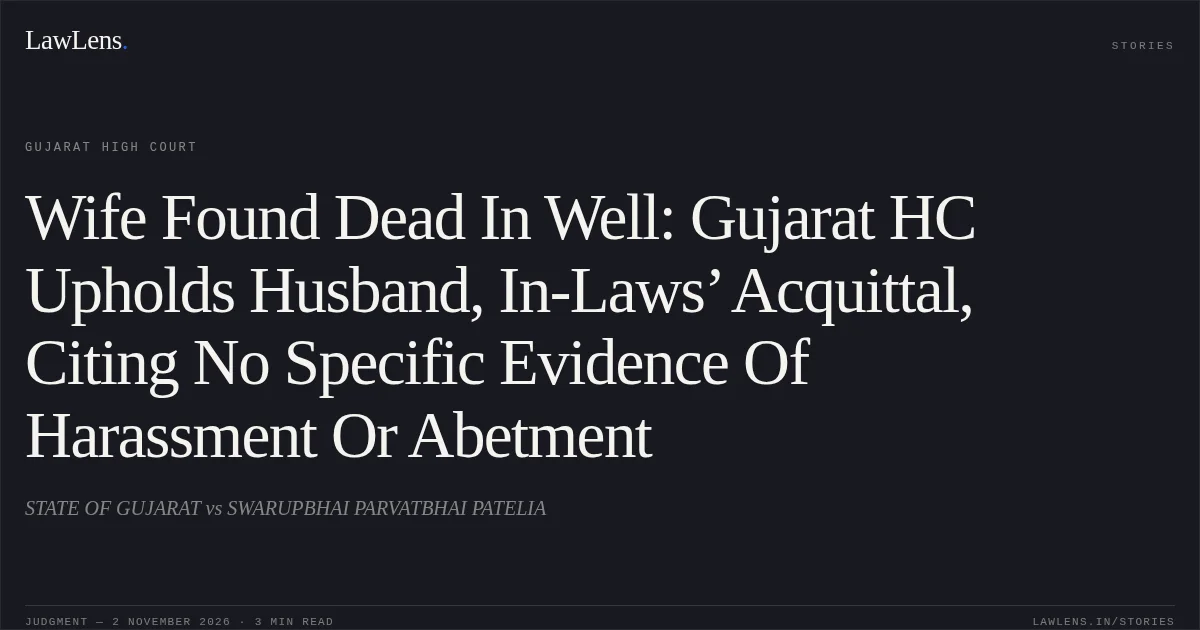
Baliben, wife of accused No. 1 and daughter of the complainant, died by drowning after her body was recovered from a well on 25 November 2010.
pp. 1–4The prosecution alleged that her husband and in-laws had persistently harassed her because she had lost an infant son and later suffered a miscarriage.
pp. 1–4Her father lodged a complaint the following day, alleging offences under Sections 498A, 306 and 114 of the Indian Penal Code (IPC).
pp. 1–4The Sessions Court acquitted the accused. The State appealed under Section 378 of the Code of Criminal Procedure, 1973 (CrPC).
pp. 1–4On appeal, the High Court reappreciated the evidence, including testimony that the complainant had not initially alleged harassment, that no witness described a specific act of instigation, and that the post-mortem attributed death to drowning.
pp. 12–2502Issues
i.Whether the evidence established cruelty or harassment by the accused sufficient to sustain their acquittal under Section 498A IPC
pp. 21–26ii.Whether the prosecution proved that the accused abetted Baliben’s suicide, as required for liability under Section 306 read with Section 107 IPC
pp. 22–26iii.Whether the Trial Court’s acquittal was perverse or otherwise warranted appellate interference
pp. 6–8, 26–2803Law Applied
Under Section 306 IPC, the prosecution must prove abetment within Section 107 IPC—instigation, conspiracy accompanied by an act or illegal omission, or intentional aid—and the requisite mens rea; mere matrimonial discord or allegations of harassment, without evidence of a sufficiently proximate act of incitement or intentional assistance, do not establish abetment.
pp. 9–11, 25–26The Court relied on Mahendra Awase v. State of Madhya Pradesh, Criminal Appeal No. 221 of 2025, and the principles in Ramesh Kumar v. State of Chhattisgarh, M. Mohan v. State and Amalendu Pal v. State of West Bengal.
pp. 9–11Section 498A IPC requires reliable proof of cruelty or harassment within that provision; Section 114 IPC could not sustain liability where the substantive offences were not established.
p. 26Under Chandrappa v. State of Karnataka, an appellate court may review the evidence in an appeal against acquittal, but should not disturb a reasonable view favouring the accused; an acquittal reinforces the presumption of innocence, and where two reasonable views are possible, the acquittal should stand.
pp. 6–8Provisions in the judgment · 8 · Linked ones open on LawLens
Code of Criminal Procedure, 1973 Section 378Section 209Section 207Section 313
Indian Penal Code, 1860 Section 306Section 114Section 323Section 107
04Reasoning
The Court found the alleged harassment insufficiently corroborated: the complainant had made no such allegation in his initial statement or during Baliben’s lifetime, while other witnesses did not support the claim of ill-treatment.
pp. 21–22No witness identified a specific act of instigation, intentional aid or other conduct by the accused connected to the suicide; the evidence therefore did not establish the necessary elements of Section 306 IPC.
pp. 22–26The medical evidence established drowning but did not support the complainant’s later assertion of significant injuries, and the Court also noted gaps concerning the initial accidental-death inquiry.
pp. 23–25Given these evidentiary deficiencies, the Trial Court’s view was reasonable and not perverse; the acquittal therefore did not warrant appellate interference.
pp. 26–2705Holding
The High Court held that the prosecution had not proved cruelty under Section 498A IPC or abetment of suicide under Section 306 read with Section 107 IPC; Section 114 IPC consequently did not apply.
pp. 26–28Finding no basis to overturn the Trial Court’s acquittal, the Court dismissed the State’s appeal and confirmed the judgment and order dated 11 August 2011.
pp. 26–28Original Court PDF
STATE OF GUJARATvsSWARUPBHAI PARVATBHAI PATELIA
Click to open original judgment
Original judgment, available to read, download and summarize on LawLens.in