01Facts
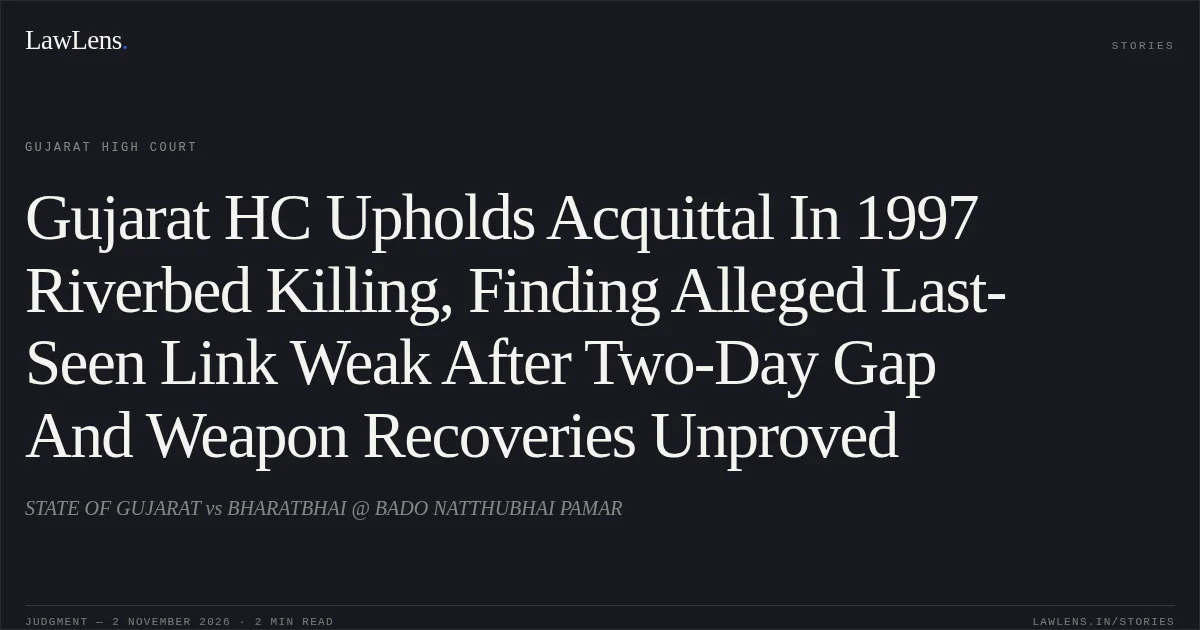
The State appealed under Section 378 CrPC against the acquittal of the accused of offences under Sections 302 read with 120B, 34 and 114 IPC
¶ 1, 3–7The prosecution alleged that the accused killed Anjaji Mamtaji Marwadi following a gambling-related financial dispute and concealed his body near a river drain
¶ 2Its case rested principally on circumstantial evidence, including alleged last-seen evidence, recoveries and forensic evidence
¶ 28–33The High Court noted that the appeal had abated as to certain accused who had died and proceeded to hear it in the absence of counsel for the remaining respondents
¶ 8, 1102Issues
i.Whether the prosecution proved a complete chain of circumstances establishing the respondents’ guilt beyond reasonable doubt
¶ 29–43ii.Whether the trial court’s acquittal warranted interference in the State’s appeal
¶ 44–4803Law Applied
Section 378 CrPC permits an appellate court to review and reappreciate evidence in an appeal against acquittal, but the accused retain the double presumption of innocence; where two reasonable views are possible, the acquittal should not be disturbed (*Chandrappa v. State of Karnataka*)
¶ 44–46For a conviction based on circumstantial evidence, each circumstance must be established, the circumstances must form a complete chain consistent only with guilt, and the chain must exclude reasonable hypotheses of innocence (*Hanumant Govind Nargundkar v. State of Madhya Pradesh* and *Sharad Birdhichand Sarda v. State of Maharashtra*, as discussed in the judgment)
¶ 40–43The last-seen circumstance is ordinarily probative where the interval between the accused and deceased being seen together and the discovery of death is so short that intervention by another person can be excluded; the assessment depends on the evidence as a whole
¶ 34–39Provisions in the judgment · 6 · Linked ones open on LawLens
Code of Criminal Procedure, 1973 Section 378Section 209Section 313
Indian Penal Code, 1860 Section 302Section 34Section 114
04Reasoning
The alleged last-seen evidence did not establish a sufficiently proximate or reliable connection to the death: P.W.1’s account was hearsay, while P.W.2’s evidence was undermined by the Investigating Officer’s testimony that she had stated the quarrel was settled and her brother went home
¶ 29–32The deceased was allegedly last seen with the accused on 16 July 1997, but his body was found on 18 July, and the prosecution did not exclude the possibility of another person intervening during that interval
¶ 30, 33, 39Panch witnesses did not support the alleged recoveries, and the blood evidence linked the blood at the scene and on the deceased’s clothes to the deceased, not to the accused
¶ 31–32These deficiencies left the circumstantial chain incomplete; given the reinforced presumption of innocence following acquittal, the trial court’s conclusion was not shown to be perverse or otherwise warranting appellate interference
¶ 43–4805Holding
The Court held that the prosecution had not proved the respondents’ guilt beyond reasonable doubt and that the trial court had committed no error in acquitting them
¶ 47–48The State’s appeal was dismissed, the acquittal dated 5 March 1998 was confirmed, and any bail bonds were discharged; the record was directed to be returned to the trial court
¶ 49Original Court PDF
STATE OF GUJARATvsBHARATBHAI @ BADO NATTHUBHAI PAMAR
Click to open original judgment
Original judgment, available to read, download and summarize on LawLens.in