01Facts
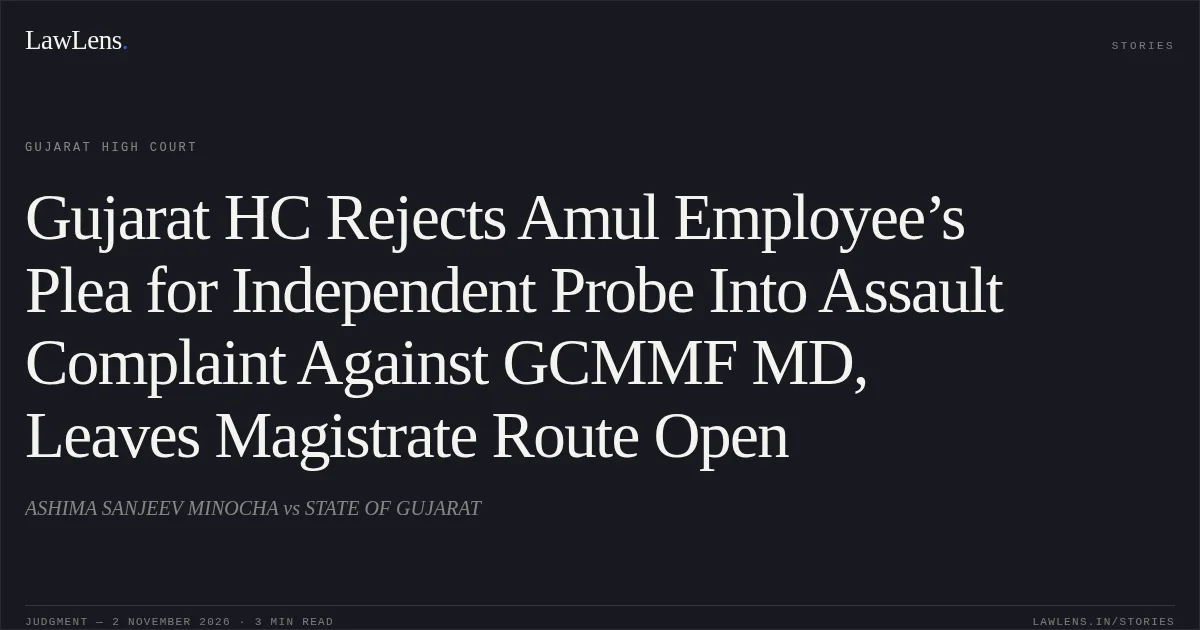
The petitioner alleged that, on 28 May 2025, GCMMF’s Managing Director and other employees assaulted her at work, forcibly took her mobile phone, and that the police thereafter failed to register an FIR and mistreated her.
¶ 1–2.4She complained to the police and other authorities and sought preservation of CCTV footage.
¶ 1–2.4The police investigation concluded that no cognizable offence was made out; the petitioner challenged the investigating officer’s report dated 2 April 2026 and the communication dated 27 April 2026, seeking their quashing and transfer of the investigation to an independent agency outside Anand District.
¶ 1–2.4The petitioner also relied on medical evidence and alleged bias and procedural irregularities in the investigation; the State maintained that the police had independently considered the CCTV footage, medical certificate and witness statements.
¶ 4–5.202Issues
i.Whether the petitioner had established exceptional circumstances warranting exercise of the High Court’s jurisdiction under Article 226, notwithstanding the alternative remedies available for seeking registration of an FIR or proper investigation.
¶ 6–7, 10ii.Whether the circumstances warranted quashing the impugned communication and report, or directing a de novo investigation by an independent agency outside Anand District.
¶ 1, 7, 1003Law Applied
Articles 21 and 226 of the Constitution protect the right to a fair investigation, while Article 226 jurisdiction is discretionary and ordinarily should not be invoked where an efficacious alternative remedy exists.
Under Sakiri Vasu v. State of U.P., (2008) 2 SCC 409, an aggrieved complainant may seek appropriate directions for registration or proper investigation from the Magistrate under Section 156(3) of the Code of Criminal Procedure, 1973; the Magistrate may monitor the investigation but cannot investigate it personally.
¶ 6.1Sudhir Bhaskarrao Tambe v. Hemant Yashwant Dhage, (2016) 6 SCC 277, and M. Subramaniam v. S. Janaki, (2020) 16 SCC 728, reiterate that complainants should ordinarily pursue that statutory remedy rather than approach the High Court in the first instance.
¶ 6.2–6.3Sujal Vishwas Attavar v. State of Maharashtra, 2026 SCC OnLine SC 798, restates the discretionary nature of writ jurisdiction and the ordinary rule against bypassing an available statutory remedy, subject to recognised exceptions such as enforcement of fundamental rights, breach of natural justice, lack of jurisdiction, or challenge to legislative vires.
¶ 6.4A direction for investigation by an independent agency is exceptional and should not be ordered routinely.
¶ 6.1Provisions in the judgment · 9 · Linked ones open on LawLens
Bharatiya Nagarik Suraksha Sanhita, 2023 Section 528
Code of Criminal Procedure, 1973 Section 36Section 125Section 154Section 156Section 173Section 190Section 200Section 482
04Reasoning
The Court considered the petitioner’s allegations alongside the medical report, CCTV material, witness statements, the ICC report and material concerning the police’s handling of the matter.
¶ 8–9.4It noted that the medical report recorded no history of assault or observable injury, and that the CCTV footage showed the Managing Director holding the petitioner’s wrist while her phone was taken, but did not depict the alleged inappropriate touching; the recorded witness statements did not support her account.
¶ 8.1, 9.3On the material before it, the Court found no basis to invoke an exception to the alternative-remedy rule or to order an independent or de novo investigation.
¶ 10It left the merits of any application before the Magistrate open.
¶ 1005Holding
The Court dismissed the petition and declined to quash the communication dated 27 April 2026 or the report dated 2 April 2026, and declined to transfer the investigation.
¶ 10It reserved liberty to the petitioner to pursue the alternative remedy available in accordance with law and clarified that its observations would not prejudice that remedy.
¶ 10–11Original Court PDF
ASHIMA SANJEEV MINOCHAvsSTATE OF GUJARAT
Click to open original judgment
Original judgment, available to read, download and summarize on LawLens.in