01Facts
The petitioner, the husband of the deceased Sukanya, sought quashing of the charge sheet in C.C. No. 14949/2020 (arising out of Crime No. 55/2020, Parappana Agrahara PS) for offences under s. 498A IPC and ss. 3 and 4 of the Dowry Prohibition Act.
p. 2The charge sheet alleges that the marriage was solemnised at Chennai on "20.01.2026", that the petitioner left his job in 2016 and withdrew money using the deceased's ATM card, and that he subjected her to physical and mental cruelty demanding dowry and gold.
pp. 3–4The deceased complained to the Chennai police on 01.12.2017, to the Tamil Nadu authorities on 02.11.2018, and to Parappana Agrahara PS on 04.03.2019, and she filed a petition before the Family Court.
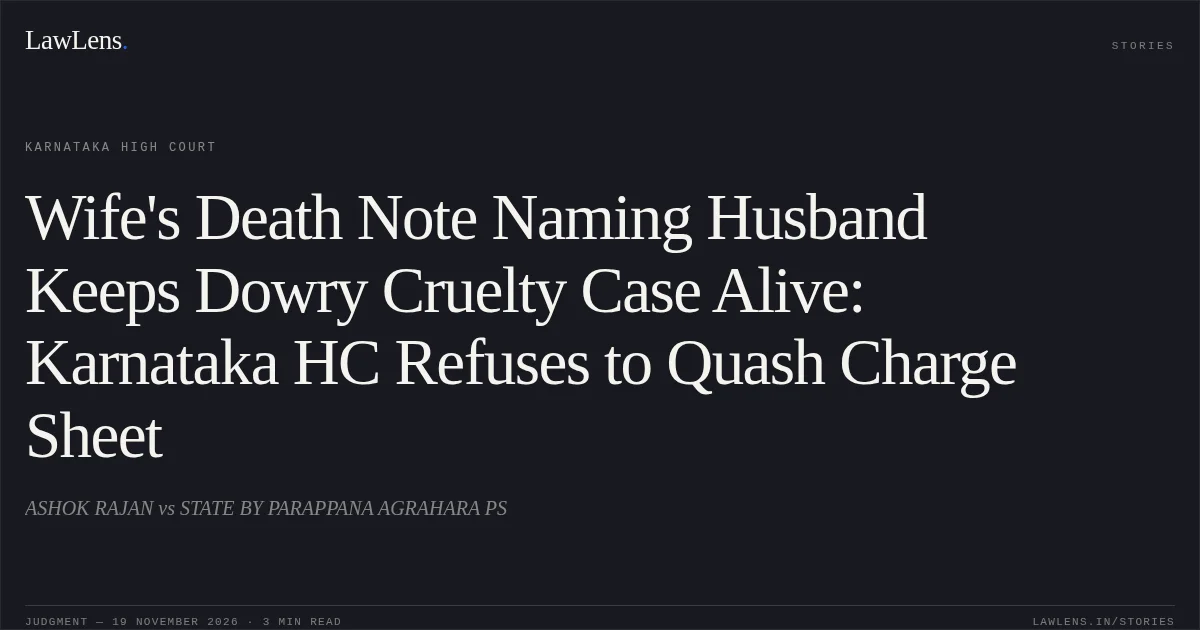
pp. 4–5The deceased died on 08.11.2019. The investigation found she had written several complaints but none against the petitioner, and a death note, sent to FSL and found to be in her handwriting, was seized.
pp. 4–5The petitioner contends that the death was due to anaemia, that the parties had lived separately for about 10 months, that a mutual divorce petition was pending, and that the death note surfaced only on 06.01.2020 and the complaint was registered belatedly.
pp. 5–6The State contends that the death note contains specific accusations against the husband and that the complaints show repeated cruelty.
p. 6The complainant's counsel was absent and did not pursue the matter.
p. 6Counsel for the petitioner had repeatedly failed to assist the Court, and the petition was listed for admission over several adjournments.
pp. 2–302Issues
i.1. Whether the charge sheet under s. 498A IPC and ss. 3 and 4 of the Dowry Prohibition Act, based on the deceased's complaints and death note, discloses allegations that require trial, such that quashing under s. 482 CrPC is not warranted.
p. 7 · ¶ 6ii.2. Whether the petition should be dismissed for non-prosecution where the petitioner's counsel repeatedly failed to pursue it diligently.
p. 3 · ¶ 1 · p. 7 · ¶ 703Law Applied
Section 482 CrPC, the inherent power to quash proceedings or prevent abuse of process.
p. 1 · p. 7 · ¶ 6Section 498A IPC (cruelty by husband or relatives) and ss. 3 and 4 of the Dowry Prohibition Act (penalties for giving or demanding dowry) as the charged offences.
p. 2Where specific accusations are made in the complaint, the witnesses speak to them, and the material (including a death note and handwritten complaints) is prima facie in the accused's favour, the matter must proceed to trial rather than be quashed.
p. 7 · ¶ 6Provisions in the judgment · 3 · Linked ones open on LawLens
Code of Criminal Procedure, 1973 Section 482
04Reasoning
The Court first noted that counsel for the petitioner had repeatedly failed to assist the Court and that the petition had been adjourned on several occasions, but it proceeded to decide the merits.
pp. 2–3 · ¶ 1–2On the merits, the Court held that the charge sheet contains specific accusations against the petitioner, supported by the complaint and witness statements.
p. 7 · ¶ 6The Court gave decisive weight to the death note, which the FSL and an expert (C.W.17) linked to the deceased, and which specifically attributes her decision to end her life to her husband's refusal to change his conduct. It also relied on the handwritten complaints about cruelty over demands for jewellery and property.
p. 7 · ¶ 6The petitioner's defence (anaemia, separate residence, a pending divorce petition, and delayed registration) was treated as matters of defence to be examined at trial, not as grounds for quashing at the threshold.
pp. 6–7 · ¶ 3, 6The Court did not separately discuss the State's submission on the complainant's absence, nor did it address the petitioner's argument about the timing of the death note's receipt in detail.
p. 6 · ¶ 405Holding
The allegations in the charge sheet, read with the death note and the handwritten complaints, raise specific accusations that must be tested at trial, and the case was not fit for exercise of inherent power under s. 482 CrPC.
p. 7 · ¶ 6The criminal petition is dismissed, and the Trial Court (IX Addl. CMM, Bengaluru, in C.C. No. 14949/2020) is directed to dispose of the matter expeditiously.
p. 7 · ¶ 7Original Court PDF
ASHOK RAJANvsSTATE BY PARAPPANA AGRAHARA PS
Click to open original judgment
Original judgment, available to read, download and summarize on LawLens.in



