Facts
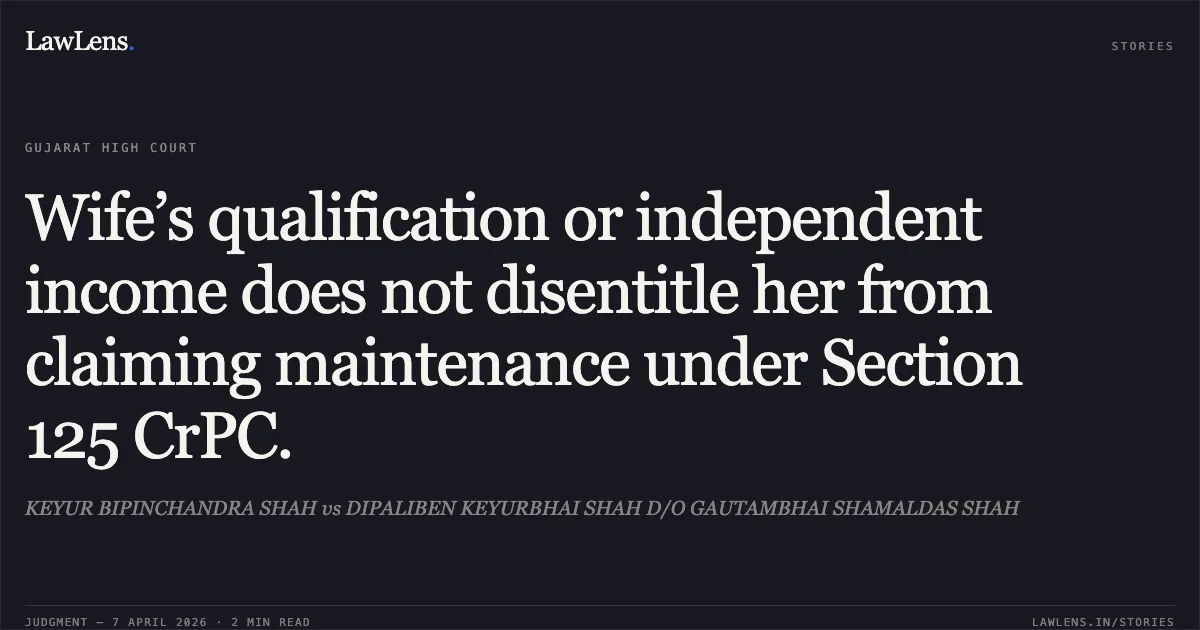
The applicant (husband) sought to quash the Family Court’s order dated April 16, 2018, which directed him to pay monthly maintenance of ₹15,000 to the respondent (wife) under Section 125 of the Cr.P.C.
Source reference: p. 2The respondent alleged that following their marriage in 2012, she was subjected to harassment and driven out of the matrimonial home.
Source reference: p. 2The applicant, a software engineer with an M.Tech from Australia, contended that the wife was well-qualified (MBA), employed at a hospital earning ₹15,980 per month, and had suppressed material facts regarding her income to claim maintenance.
Source reference: p. 2-3The Family Court found that the husband had suppressed his actual income, estimated his earnings at ₹80,000 to ₹90,000 per month, and awarded maintenance despite the wife's employment, noting her total requirement was ₹30,000 per month.
Source reference: p. 4-5Issues
1. Whether a wife is disqualified from claiming maintenance under Section 125 Cr.P.C. solely because she is well-qualified and possesses some earning capacity.
Source reference: p. 52. Whether the Family Court’s estimation of the husband’s income and the resulting maintenance award warranted interference under revisional jurisdiction.
Source reference: p. 4, 6Law Applied
Section 125 of the Cr.P.C., which governs the maintenance of wives, children, and parents.
Source reference: p. 2Section 106 of the Indian Evidence Act to address the husband’s suppression of income, placing the burden on him to disclose facts within his special knowledge.
Source reference: p. 4Sunita Kachwaha v. Anil Kachwaha (2014), which held that a wife's qualifications or some earnings are not sufficient grounds to deny maintenance if she cannot maintain herself at the appropriate standard.
Source reference: p. 5Bhuwan Mohan Singh v. Meena (2015) regarding the husband's ethical and legal duty to maintain his wife.
Source reference: p. 6Amit Kapoor v. Ramesh Chander (2012) regarding the restricted scope of revisional jurisdiction.
Source reference: p. 6Reasoning
The Court observed that the marriage was undisputed and that the applicant had failed to provide income tax returns or financial documents, leading the lower court to reasonably infer his income based on his profession.
Source reference: p. 4In applying the Sunita Kachwaha precedent, the Court reasoned that "inability to maintain herself" does not require the wife to be in a state of destitution; rather, it relates to the standard of living enjoyed during the marriage.
Source reference: p. 5-6The Court found that since the husband’s income was substantial (₹80,000-₹90,000) and the wife’s income (₹15,000) was insufficient to meet her assessed need of ₹30,000, the Family Court’s order to bridge the gap via a ₹15,000 maintenance award was equitable.
Source reference: p. 5The Court concluded that the husband cannot shirk his social and lawful duty to provide financial support.
Source reference: p. 6Holding
The Court dismissed the revision application, answering both issues in favor of the respondent-wife.
It held that the Family Court’s order was just and proper, assigning sufficient reasons based on the evidence.
Source reference: p. 5-6The Court upheld the award of ₹15,000 per month in maintenance and ₹7,500 towards litigation expenses, ruling that there was no patent error or miscarriage of justice requiring revisional interference.
Source reference: p. 3, 6, 7All pending stay applications were disposed of accordingly.
Source reference: p. 7Acts & Sections Cited
1 provisions across 1 statute referred to in this judgment. Each provision opens on LawLens.
Code of Criminal Procedure, 19731
Original Court PDF
KEYUR BIPINCHANDRA SHAHvsDIPALIBEN KEYURBHAI SHAH D/O GAUTAMBHAI SHAMALDAS SHAH
Click to open original judgment
Original judgment, available to read, download and summarize on LawLens.in