01Facts
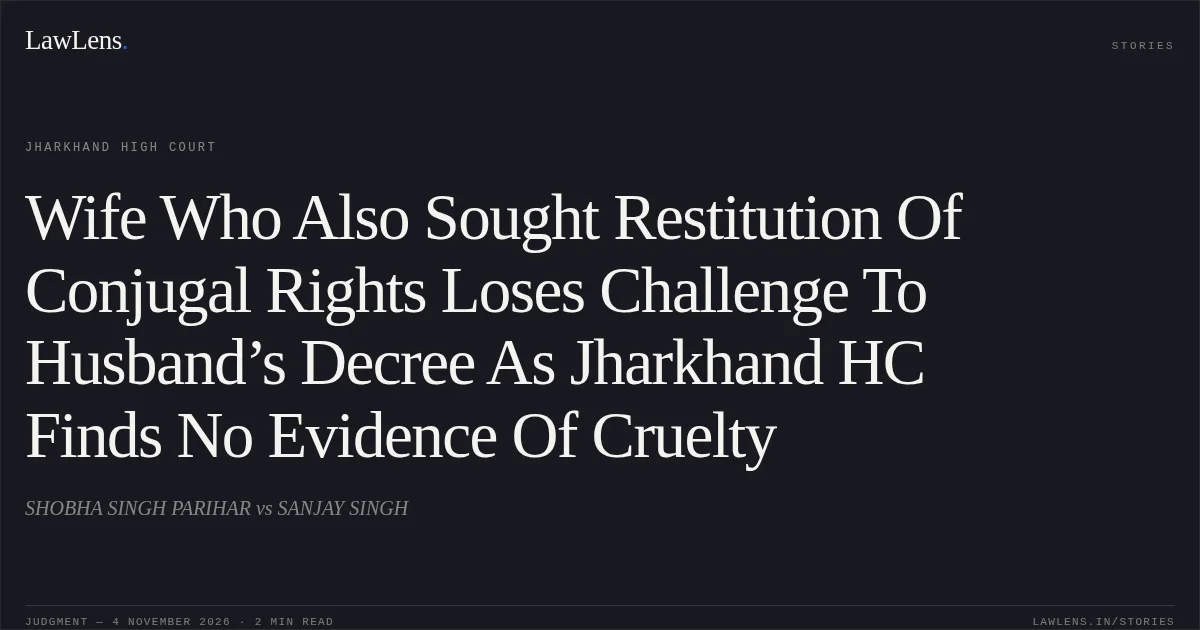
The respondent-husband filed a petition under Section 9 of the Hindu Marriage Act, 1955, seeking restitution of conjugal rights, alleging that the appellant-wife had withdrawn from his society without reasonable excuse.
¶ 3–6The wife appeared before the Family Court but did not file a written statement despite several opportunities.
¶ 3–6The Family Court heard the matter ex parte, recorded the husband’s evidence by affidavit, and decreed restitution of conjugal rights.
¶ 3–6The wife appealed, alleging, among other things, cruelty, that the husband had obtained the decree to support later divorce proceedings, and that the evidence-taking procedure was unlawful.
¶ 8–9The appeal also concerned the wife’s contention that evidence in an appealable case had to be recorded in accordance with Order XVIII Rule 5 of the Code of Civil Procedure, 1908 (“CPC”).
¶ 802Issues
i.1. Whether examination-in-chief by affidavit, with evidence recorded through a Pleader Commissioner, breached the procedure under Order XVIII Rules 4 and 5 CPC in an appealable case
¶ 12(i)ii.2. Whether the husband was entitled to a decree for restitution of conjugal rights on the basis that the wife had withdrawn from his society without reasonable excuse
¶ 12(ii)03Law Applied
Section 9 of the Hindu Marriage Act permits a decree for restitution of conjugal rights where one spouse has withdrawn from the society of the other without reasonable excuse; desertion need not be proved.
¶ 19Under Order XVIII Rules 4 and 5 CPC, examination-in-chief may be given by affidavit, including in appealable cases; Rule 5 governs the recording of evidence where applicable, including the recording of evidence subject to cross-examination.
¶ 14–16The Court relied on Ameer Trading Corporation Ltd. v. Shapoorji Data Processing Ltd., (2004) 1 SCC 702, and Rasiklal Manikchand Dhariwal v. M/s M.S.S. Food Products, (2012) 2 SCC 196, for the compatibility of affidavit evidence with the requirements of Order XVIII.
¶ 14–17The Court also noted that, where no written statement is filed, the trial court may proceed under Order VIII Rule 10 CPC, though it required the husband to prove his case by evidence.
¶ 19Provisions in the judgment · 1 · Linked ones open on LawLens
Hindu Marriage Act, 1955 Section 9
04Reasoning
The Court rejected the procedural challenge, holding that examination-in-chief by affidavit was permissible and that the absence of cross-examination in the ex parte proceedings meant the appellant had not shown a breach of Order XVIII Rule 5.
¶ 16–18On the substantive issue, the wife’s allegations of cruelty and being ousted from the matrimonial home were unsupported by pleadings or evidence; she had not filed a written statement or cross-examined the husband’s witnesses.
¶ 19The husband’s evidence therefore stood unchallenged, and the Court found no basis to disturb the finding that the wife had withdrawn from his society without reasonable excuse.
¶ 19The Court left questions concerning the parties’ conduct, the alleged purpose of the decree, and the pending divorce proceedings for determination by the trial court hearing the divorce case.
¶ 21–2305Holding
The Court answered both issues against the appellant, held that the Family Court had committed no error in law or fact in granting restitution of conjugal rights, and dismissed the appeal.
¶ 20, 24–25Pending interlocutory applications were disposed of.
¶ 24–25Original Court PDF
SHOBHA SINGH PARIHARvsSANJAY SINGH
Click to open original judgment
Original judgment, available to read, download and summarize on LawLens.in