Facts
Crime No. 228/2022 was registered against respondents 2–5 for offences under Sections 498-A, 323, 506 and 34 of the IPC and Sections 3 and 4 of the Dowry Prohibition Act.
Source reference: para. 2Respondents 3–5 were granted anticipatory bail on 2 September 2022, with a condition referring to their undertaking to consider steps concerning ownership of a Bengaluru flat; respondent 2 was granted anticipatory bail on 18 October 2022.
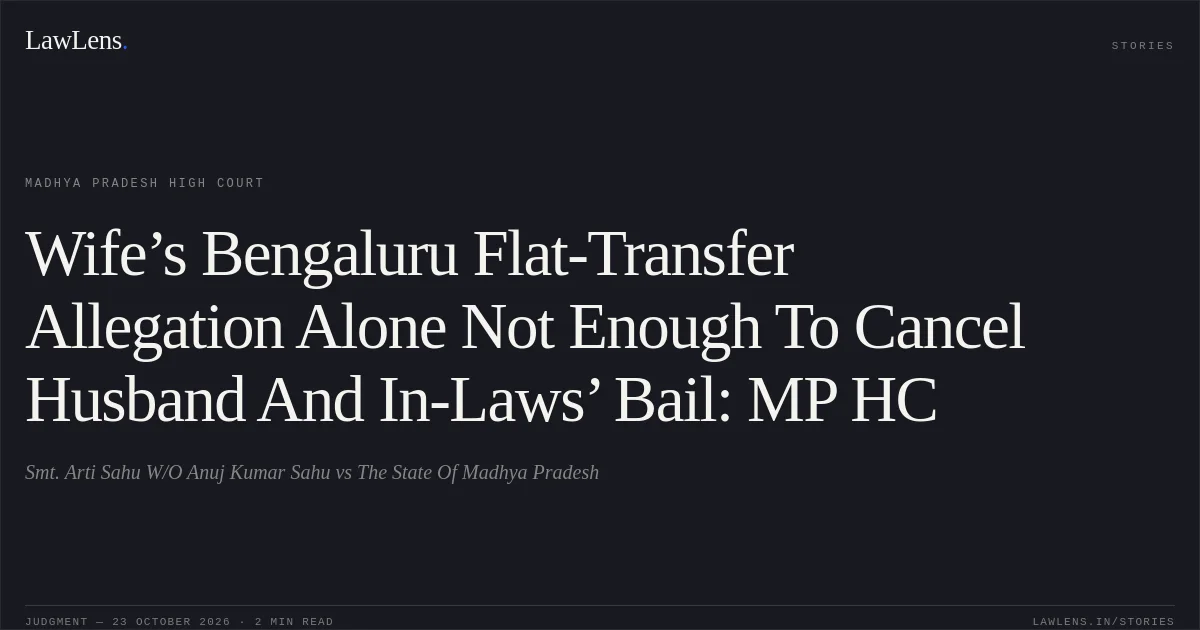
Source reference: para. 2–3The complainant sought cancellation of bail, alleging that the respondents had not transferred the flat and were threatening her to compromise.
Source reference: para. 4The respondents opposed the application, stating that she had received the amount payable to her and that no ground for cancellation existed.
Source reference: para. 5Issues
Whether the alleged failure to transfer the Bengaluru flat, contrary to the undertaking referred to in the bail order, warranted cancellation of the respondents’ bail.
Source reference: para. 3–4, 10Whether the complainant established cogent circumstances or misuse of liberty sufficient to cancel the bail granted to respondents 2–5.
Source reference: para. 7–10Law Applied
Section 483(3) of the Bharatiya Nagarik Suraksha Sanhita, 2023, was invoked for cancellation of bail.
Source reference: no citationApplying the principles in Dolat Ram v. State of Haryana, (1995) 1 SCC 349, the Court stated that cancellation of bail requires very cogent and overwhelming circumstances; relevant grounds may include interference with the administration of justice, evasion of justice, or abuse of the concession of bail, and bail should not be cancelled mechanically.
Source reference: para. 7–8Relying also on Bhuri Bai v. State of Madhya Pradesh, 2022 LiveLaw (SC) 956, the Court reiterated that cancellation requires a strong case, ordinarily based on a supervening event, and that the power must be exercised with care and circumspection.
Source reference: para. 9Reasoning
The Court found that the complainant had not established circumstances meeting the demanding threshold for cancellation.
Source reference: para. 10The alleged failure to transfer the flat, considered on its own, did not constitute a legally sustainable ground for cancelling bail; nor was sufficient material produced to show that respondents 2–5 had misused their liberty or adversely affected the fairness of the trial.
Source reference: para. 10The Court therefore declined to treat the dispute over the flat or the challenge to the original grant of bail as sufficient grounds for cancellation.
Source reference: para. 7–10Holding
The Court held that no justifiable ground had been shown to cancel or set aside the bail orders.
The application seeking cancellation of bail granted to respondents 2–5 was dismissed.
Source reference: para. 10–11Acts & Sections Cited
7 provisions across 4 statutes referred to in this judgment. Each provision opens on LawLens.
Bharatiya Nagarik Suraksha Sanhita, 20231
Indian Penal Code, 18603
Code of Criminal Procedure, 19731
Original Court PDF
Smt. Arti Sahu W/O Anuj Kumar SahuvsThe State Of Madhya Pradesh
Click to open original judgment
Original judgment, available to read, download and summarize on LawLens.in