01Facts
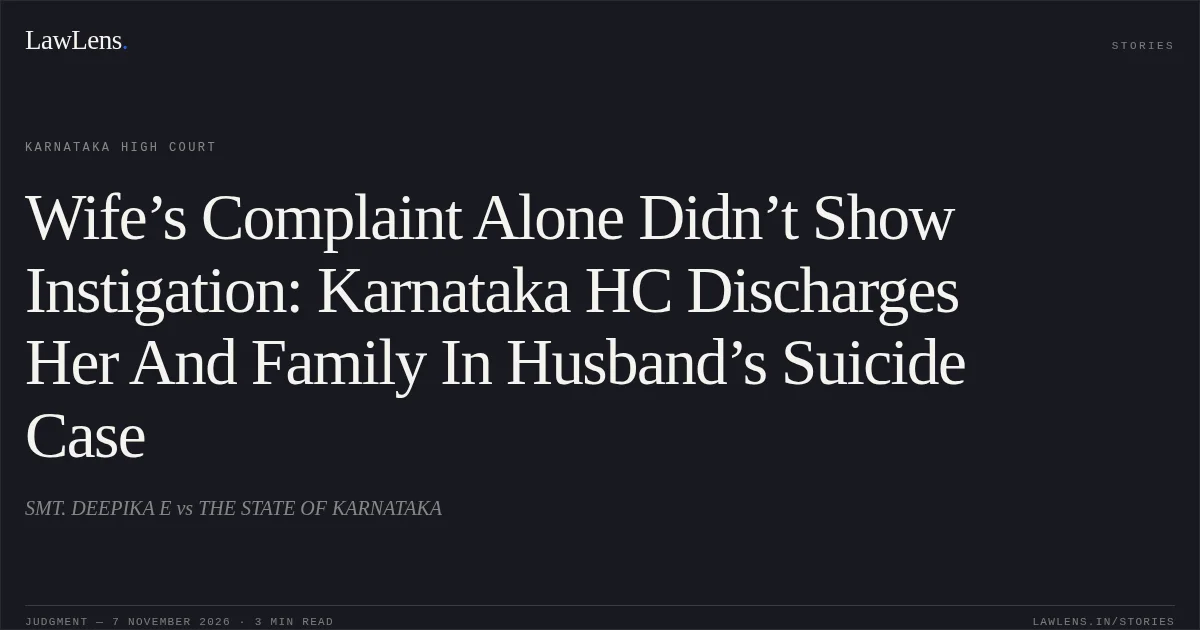
The deceased Prasad was married to petitioner No. 1, Deepika.
¶ 1–6After marital differences arose, Deepika lodged a complaint against Prasad and respondent No. 2, his mother, on 4 March 2022.
¶ 1–6The complaint underlying the present prosecution alleged that police threatened Prasad at the station on 18 April 2022, after which he became distressed and died by suicide the following day.
¶ 1–6The police registered a case against the petitioners under Sections 306 and 34 of the IPC and filed a charge sheet.
¶ 1–6The Sessions Court dismissed their application for discharge under Section 227 Cr.P.C.; the petitioners challenged that decision under the High Court’s inherent jurisdiction.
¶ 1–6The High Court recorded that the complaint attributed the immediate threat to police officers, while witness statements also referred to an alleged threat by petitioner No. 3’s mother in February 2022.
¶ 20–2202Issues
i.Whether the charge-sheet materials, taken at face value, disclosed a prima facie case that the petitioners abetted Prasad’s suicide under Sections 306 and 107 IPC.
¶ 15–16, 25, 27–28ii.Whether the Sessions Court’s refusal to discharge the petitioners warranted interference under the High Court’s inherent jurisdiction.
¶ 1, 27–2903Law Applied
Section 306 IPC applies where a person abets another’s suicide; under Section 107 IPC, abetment requires instigation, participation in a qualifying conspiracy, or intentional aid.
¶ 15–16The Court relied on Geo Varghese v. State of Rajasthan, (2021) 19 SCC 144, for the principle that harassment alone is insufficient without conduct amounting to incitement that is connected to the suicide.
¶ 22Mariano Anto Bruno v. Inspector of Police, 2022 LiveLaw (SC) 834, for the requirement of clear mens rea and an active or direct act leading to suicide.
¶ 23Nipur Aneja v. State of Uttar Pradesh, 2024 SCC OnLine SC 870, for assessing whether the materials indicate, even prima facie, that the accused intended the consequence of suicide.
¶ 24Relying also on Mohammad Wajid v. State of U.P., 2023 SCC OnLine SC 951, the Court noted that a quashing court may examine the overall circumstances and investigation materials, not merely the complaint’s allegations.
¶ 26Provisions in the judgment · 7 · Linked ones open on LawLens
Code of Criminal Procedure, 1973 Section 482Section 227
Bharatiya Nagarik Suraksha Sanhita, 2023 Section 528
Indian Penal Code, 1860 Section 306Section 34Section 377Section 107
04Reasoning
The Court found no material indicating that the petitioners instigated or intentionally aided Prasad’s suicide, or had the requisite mens rea.
¶ 25The complaint itself attributed the immediate threat on 18 April to the police, not the petitioners; Deepika’s complaint had been lodged more than a month before the suicide and, by itself, did not constitute abetment.
¶ 18–20, 25The alleged threat attributed to petitioner No. 3’s mother was said to have occurred in February, and the relevant witness statement was recorded months later; the Court considered the alleged conduct too remote from the suicide to establish the necessary connection.
¶ 22On an overall assessment of the charge-sheet materials, the Court concluded that the essential ingredients of Sections 306 and 34 IPC were not made out.
¶ 27–2905Holding
The High Court held that the materials did not disclose a prima facie offence under Sections 306 read with 34 IPC against the petitioners and that continuing the prosecution would amount to an abuse of process.
¶ 28–29It allowed the petition, set aside the Sessions Court’s order, allowed the petitioners’ Section 227 Cr.P.C. discharge application, and discharged them from the offences charged.
¶ 29Original Court PDF
SMT. DEEPIKA EvsTHE STATE OF KARNATAKA
Click to open original judgment
Original judgment, available to read, download and summarize on LawLens.in