01Facts
The wife petitioned for divorce under Section 13(1)(ia) of the Hindu Marriage Act, 1955, alleging physical and mental cruelty, including harassment and dowry demands.
pp. 2–6The husband denied the allegations and said he was willing to resume cohabitation, including in a separate home.
pp. 2–6The Family Court dismissed the petition after hearing the wife’s and husband’s evidence.
pp. 2–6The wife appealed under Section 19(1) of the Family Courts Act, 1984; the husband did not appear despite service of notice.
pp. 2–602Issues
i.1. Whether the wife proved that the Family Court’s judgment was made without proper appreciation of the evidence and was perverse or arbitrary
p. 6ii.2. What order should be made in the appeal
p. 603Law Applied
Section 13(1)(ia) of the Hindu Marriage Act, 1955 permits dissolution of marriage on the ground of cruelty.
p. 2, 6Cruelty has no fixed, uniform standard and must be assessed on the facts of each case; it must be grave, and ordinary irritations and quarrels associated with the normal wear and tear of married life do not, by themselves, amount to cruelty. The Court relied on Samar Ghosh v. Jaya Ghosh, (2007) 4 SCC 511.
p. 9The appeal was brought under Section 19(1) of the Family Courts Act, 1984.
p. 2Provisions in the judgment · 2 · Linked ones open on LawLens
Family Courts Act, 1984 Section 19
Hindu Marriage Act, 1955 Section 13
04Reasoning
The High Court considered the wife’s testimony and the exhibits, which established the marriage but did not independently substantiate the alleged cruelty.
pp. 7–9In cross-examination, she acknowledged that the husband had told the police he was willing to take her back and that he and his family had come to her parents’ home to seek her return; she nevertheless stated she was unwilling to live with him.
pp. 7–9She also alleged that the husband had killed his first wife but produced no supporting records.
pp. 7–9The Court noted that she had not examined independent witnesses or neighbours to support her allegations and concluded, on the evidence as a whole, that the alleged physical and mental ill-treatment had not been proved.
pp. 7–9Applying the Samar Ghosh principles, it upheld the Family Court’s assessment.
pp. 7–905Holding
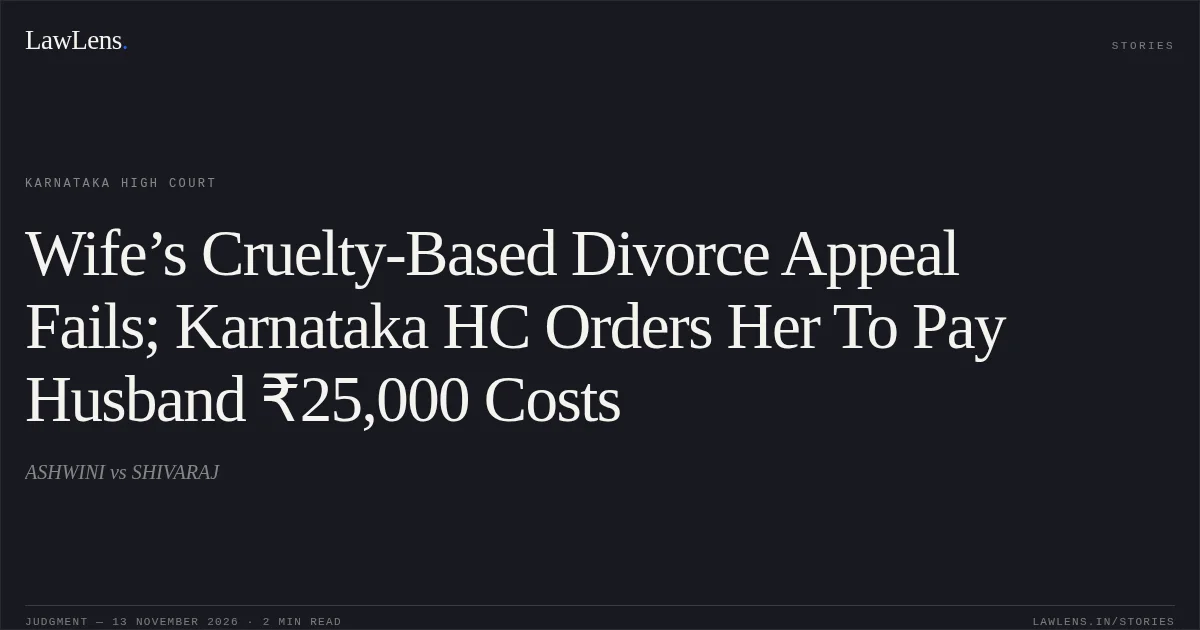
The High Court answered the first issue in the negative and dismissed the appeal, thereby leaving the Family Court’s dismissal of the divorce petition undisturbed.
p. 10It ordered the wife to pay the husband costs of Rs. 25,000 within two months; failing payment, the husband may recover the amount as land revenue through due process of law.
p. 10Original Court PDF
ASHWINIvsSHIVARAJ
Click to open original judgment
Original judgment, available to read, download and summarize on LawLens.in