Facts
The respondent–plaintiff instituted a suit for recovery of ₹23,41,693 based on invoices for goods allegedly supplied to the appellant–defendant.
Source reference: p.2The Trial Court dismissed the suit under Section 69(2) of the Indian Partnership Act, 1932, holding that the plaintiff had failed to prove that it was a registered partnership firm.
Source reference: p.2The First Appellate Court accepted Exhibit-8, a memorandum issued by the Registrar of Firms, West Bengal, showing Registration No. L73931 and registration on 14 May 2010, and also admitted a certified copy of Form-VIII under Order XLI Rule 27 CPC.
Source reference: pp.2–3It consequently decreed the suit for ₹24,36,105 with interest at 6% per annum.
Source reference: pp.2–3In appeal, the defendant challenged the decree principally on the grounds that the suit was barred by limitation and that the plaintiff had not validly proved its registration.
Source reference: p.2The plaintiff relied on a demand, an alleged acknowledgment of debt, part payment, and the pendency of an earlier winding-up proceeding to contend that limitation had been extended or excluded.
Source reference: pp.4–5Issues
1. Whether the plaintiff proved that it was a registered partnership firm, thereby avoiding the bar under Section 69(2) of the Indian Partnership Act, 1932?
Source reference: pp.2–32. Whether the suit for recovery based on the invoices was filed within the prescribed period of limitation?
Source reference: pp.3–4, 9–113. Whether the defendant’s reply, payment of certain admitted invoices, or the earlier winding-up proceeding constituted an acknowledgment or otherwise extended or excluded the period of limitation for the recovery suit?
Source reference: pp.4–5, 7–11Law Applied
Section 69(2) of the Indian Partnership Act, 1932 bars an unregistered firm from instituting a suit to enforce contractual rights, but registration may be proved through reliable documentary evidence issued by the Registrar of Firms.
Source reference: pp.2–3Order XLI Rule 27 CPC permits production of additional evidence where necessary to enable the appellate court to pronounce judgment or further the ends of justice, particularly where the additional document corroborates existing evidence.
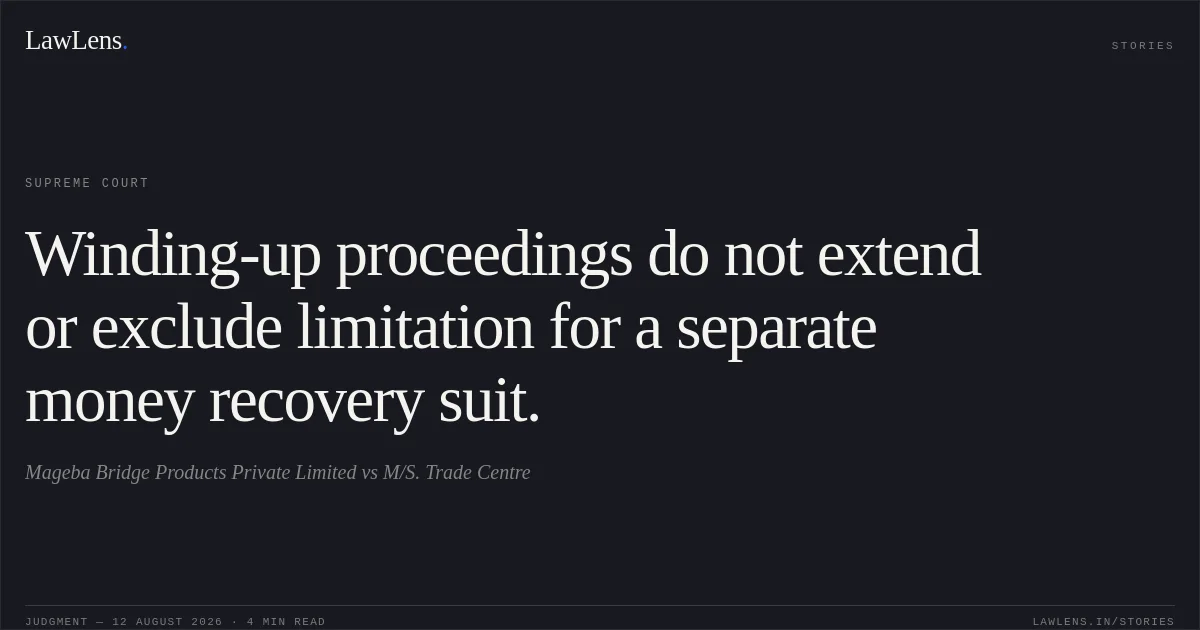
Source reference: p.3Under the Limitation Act, exclusion of time under Section 14 is available only where the earlier proceeding was prosecuted in good faith and with due diligence for the same relief; proceedings for winding up and a suit for recovery of money are distinct remedies and cannot ordinarily extend or suspend limitation for one another.
Source reference: pp.6–9The Court relied on Yeswant Deorao Deshmukh v. Walchand Ramchand Kothari, 1950 SCC 766, and Jignesh Shah v. Union of India, (2019) 10 SCC 750, for the distinction between insolvency/winding-up proceedings and a money-recovery suit.
Source reference: pp.7–9It also applied the principle that an acknowledgment must relate to the debt forming the subject matter of the suit; payment of separately admitted invoices, accompanied by disputes regarding the remaining claims, does not amount to acknowledgment of those disputed debts.
Source reference: pp.9–12The Court also referred to Kalpraj Dharamshi v. Kotak Investment Advisors Ltd., (2021) 10 SCC 401, regarding the purposive application of Sections 5 and 14 of the Limitation Act.
Source reference: pp.5–7Reasoning
The Supreme Court held that Exhibit-8 itself sufficiently established the plaintiff-firm’s registration: it recorded Registration No. L73931 and indicated registration by 14 May 2010.
Source reference: pp.2–3The certified Form-VIII produced under Order XLI Rule 27 CPC independently corroborated the same particulars; therefore, the Trial Court was wrong to dismiss the suit under Section 69(2).
Source reference: pp.2–3However, the suit was founded on individual invoices and not on a running account.
Source reference: pp.3–4, 11–12The defendant’s reply did not acknowledge the invoices forming the subject matter of the suit; it admitted only three invoices, two of which were paid, while disputing the remaining claims.
Source reference: pp.9–12The payment therefore could not revive or extend limitation for the disputed invoices.
Source reference: pp.9–12Further, the earlier winding-up proceeding did not seek the same relief as the civil recovery suit and could not extend or exclude the limitation period under Section 14.
Source reference: pp.9–11In any event, the winding-up petition was filed on 10 February 2009, after the limitation period for the invoices dated 30 January 2006 had expired, while the remaining invoices were also time-barred when the suit was filed on 5 June 2010.
Source reference: pp.9–11Holding
The Court answered the registration issue in favour of the plaintiff, holding that its status as a registered partnership firm had been duly proved and that Section 69(2) did not bar the suit.
Nevertheless, it held that the recovery claim was barred by limitation because there was no valid acknowledgment of the disputed invoice debts, the payments related only to separately admitted invoices, and the winding-up proceeding did not extend or exclude limitation.
Source reference: pp.9–12The First Appellate Court’s decree for ₹24,36,105 with interest was therefore reversed to the extent that it granted recovery, and the suit was dismissed as time-barred.
Source reference: p.12The appeal was allowed, with pending applications disposed of.
Source reference: p.12Acts & Sections Cited
3 provisions across 2 statutes referred to in this judgment. Each provision opens on LawLens.
Indian Partnership Act, 19321
Limitation Act, 19632
Original Court PDF
Mageba Bridge Products Private LimitedvsM/S. Trade Centre
Click to open original judgment
Original judgment, available to read, download and summarize on LawLens.in