Facts
The petitioner, a Hawaldar posted with Bihar Special Armed Police-9, Jamalpur, was deputed as a guard at C-Company, Sikandarpur Police Station.
Source reference: para. 3On 2 October 2018, a video circulated on social media allegedly showing the petitioner and Driver Hawaldar Ajeet Kumar Chaudhary collecting illegal money from truck drivers on Jamui Road.
Source reference: para. 3Following a preliminary enquiry, the petitioner was suspended and Departmental Proceeding No. 15 of 2018 was initiated against him.
Source reference: paras. 4–6The Enquiry Officer recorded the statements of departmental witnesses and submitted a report dated 17 August 2019 finding the charges proved.
Source reference: para. 7After issuance of a second show-cause notice, the disciplinary authority dismissed the petitioner from service by order dated 18 September 2019. His departmental appeal was rejected on 6 January 2020.
Source reference: paras. 8–9A co-delinquent involved in the same incident had obtained relief in an identical writ petition, CWJC No. 12297 of 2021, in which the disciplinary and appellate orders had been set aside.
Source reference: paras. 14–20Issues
1. Whether non-supply of the video clip, which constituted the foundational material for the charge, violated the principles of natural justice and Rule 17(3) and (4) of the Bihar Government Servants (Classification, Control & Appeal) Rules, 2005?
Source reference: paras. 17–20, 25–262. Whether the disciplinary authority could lawfully rely upon statements recorded during the preliminary enquiry without examining the concerned witnesses in the departmental enquiry and affording the petitioner an opportunity of cross-examination?
Source reference: paras. 10–12, 213. Whether the findings of guilt and the consequential orders of dismissal and rejection of appeal were sustainable in the absence of substantive evidence proving the allegation of extortion?
Source reference: paras. 19–21, 25–27Law Applied
The Court applied Rule 17(3) and (4) of the Bihar Government Servants (Classification, Control & Appeal) Rules, 2005, together with the principles of natural justice, requiring disclosure of material relied upon against a delinquent employee and a meaningful opportunity to cross-examine witnesses and produce defence evidence.
Source reference: paras. 20, 24–26Relying on State of Punjab v. Bhagat Ram, (1975) 1 SCC 155, the Court held that denial of witness statements relied upon in the enquiry prevents effective cross-examination.
Source reference: para. 20Under Chandrama Tewari v. Union of India, 1987 Supp SCC 518, material documents relied upon to record guilt must ordinarily be supplied to the delinquent, and witnesses must be available for cross-examination.
Source reference: para. 24The Court also relied on Arjun Panditrao Khotkar v. Kailash Kushanrao Gorantyal, (2020) 7 SCC 1, concerning the statutory conditions governing the admissibility of electronic records, including certification under Section 65-B of the Evidence Act.
Source reference: para. 20Although departmental proceedings are governed by the standard of preponderance of probabilities, the Enquiry Officer must still base the finding on legally acceptable evidence and provide reasons linking the evidence to the charge.
Source reference: para. 20Reliance was also placed on Deepali Gundu Surwase v. Kranti Junior Adhyapak Mahavidyalaya, (2013) 10 SCC 324, regarding consequential relief following wrongful termination.
Source reference: para. 23Reasoning
The Court found that the charge of extorting money was founded substantially, if not exclusively, on the viral video. However, the video was not included in the charge memorandum or supplied to the petitioner, and its maker was not examined.
Source reference: paras. 18–20, 25The truck driver allegedly subjected to extortion was also not produced as a witness.
Source reference: paras. 18–20, 25The departmental witnesses merely identified the petitioner in the video or referred to statements recorded during the preliminary enquiry; none testified to having personally seen the petitioner accept money or extort a truck driver.
Source reference: para. 20Consequently, the essential evidentiary link between the charge and the finding of guilt was absent.
Source reference: para. 21The Court further held that reliance on previous statements without producing the witnesses for examination and cross-examination violated natural justice and had no legal sanction in the departmental enquiry.
Source reference: para. 21Since the co-delinquent’s identical dismissal had already been quashed on the same evidentiary and procedural grounds, the same reasoning applied to the petitioner’s case.
Source reference: paras. 18–22Holding
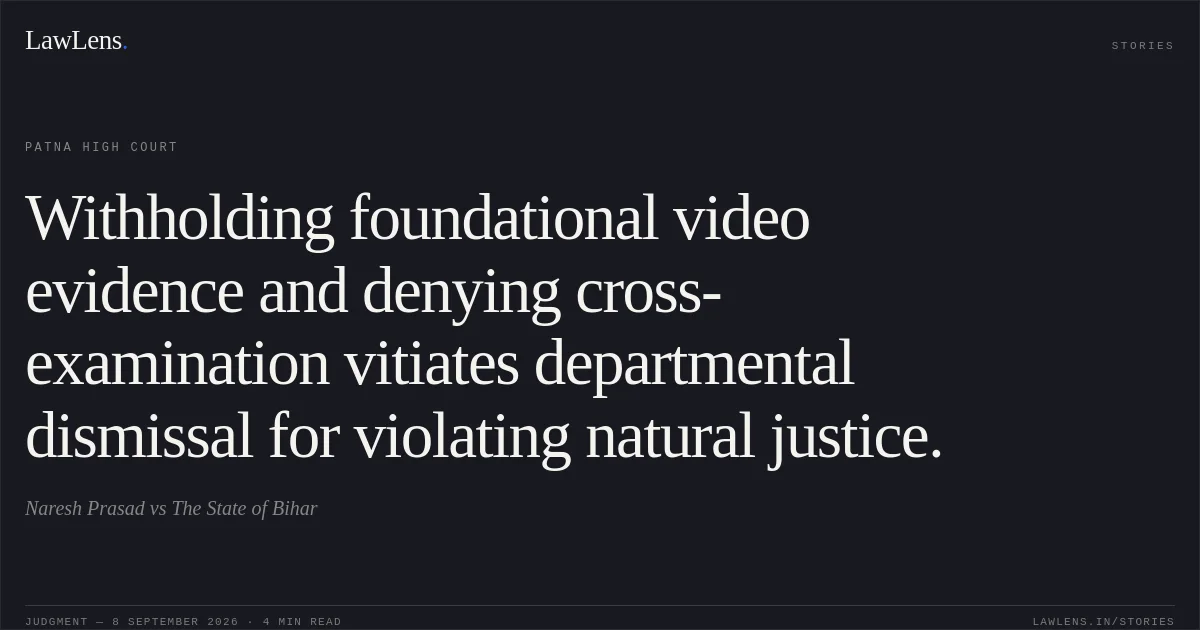
The Court held that non-supply of the foundational video clip, coupled with the failure to examine the video-maker, the alleged victim, and the relevant witnesses in the petitioner’s presence, constituted a violation of natural justice and Rule 17(3) and (4) of the 2005 Rules.
The enquiry report was found perverse and unsupported by adequate evidence, rendering the disciplinary authority’s dismissal order and the appellate order legally unsustainable.
Source reference: para. 27Accordingly, dismissal order No. 962/2019 dated 18 September 2019 and appellate order No. 3/2019 dated 6 January 2020 were set aside.
Source reference: para. 23The petitioner was held entitled to consequential benefits, to be granted preferably within eight weeks of receipt or production of the judgment, subject to the law laid down in Deepali Gundu Surwase.
Source reference: para. 23The writ petition was disposed of without any order as to costs.
Source reference: paras. 23–25Acts & Sections Cited
2 provisions across 1 statute referred to in this judgment. Linked provisions open on LawLens.
Indian Evidence Act, 18722
Original Court PDF
Naresh PrasadvsThe State of Bihar
Click to open original judgment
Original judgment, available to read, download and summarize on LawLens.in