Facts
The petitioner, a Class-III employee, was subjected to the penalty of withholding two annual increments with cumulative effect by order dated 30 June 2018 issued by the Collector, Gwalior.
Source reference: para. 2The penalty followed only a show-cause notice dated 20 March 2018 and a fact-finding enquiry; no charge-sheet was issued, nor were an Inquiry Officer or Presenting Officer appointed.
Source reference: para. 2The petitioner’s departmental appeal before the Commissioner, Gwalior Division, was rejected on 17 October 2023.
Source reference: paras. 2, 4During the proceedings, the petitioner retired on 31 January 2025.
Source reference: para. 11Issues
Whether withholding two annual increments with cumulative effect constitutes a major penalty requiring compliance with the regular departmental enquiry procedure under Rule 14 of the Madhya Pradesh Civil Services (Classification, Control and Appeal) Rules, 1966?
Source reference: paras. 7, 10Whether the Collector, having delegated authority only to impose minor penalties upon Class-III employees, had jurisdiction to impose the major penalty of withholding increments with cumulative effect?
Source reference: paras. 3, 6, 9–10Whether the punishment order and the appellate order were liable to be quashed for want of jurisdiction and violation of the prescribed disciplinary procedure?
Source reference: para. 11Law Applied
The Court applied Rule 10 of the Madhya Pradesh Civil Services (Classification, Control and Appeal) Rules, 1966, which classifies penalties and distinguishes minor penalties from major penalties.
Source reference: para. 6Relying on Kulwant Singh Gill v. State of Punjab, 1991 Supp (1) SCC 504, the Court held that withholding increments with cumulative effect is, in substance, a major penalty because its adverse financial effect continues throughout the employee’s service and may affect post-retirement benefits.
Source reference: para. 7Such a penalty cannot be imposed under the summary procedure applicable to minor penalties and requires a regular enquiry under Rule 14.
Source reference: paras. 8–10The Court also relied on M.M. Mudgal v. State of M.P., ILR 2012 (MP) 2651, and K.R. Shankara Kaimal v. State of M.P., 1995 MPLJ (SN) 54, which applied the same principle.
Source reference: paras. 8–9Under the State notification dated 23 May 1996, published on 10 January 2007, the Collector was delegated power under Rules 9 and 10 only to suspend and impose minor penalties upon Class-III and Class-IV employees posted in the district; the Collector therefore lacked authority to impose a major penalty.
Source reference: paras. 3, 6, 9The Court further applied the principle that statutory power must be exercised only by the authority legally empowered to exercise it, as recognized in Joint Action Committee of Air Line Pilots’ Association of India v. DGCA, (2011) 5 SCC 435.
Source reference: para. 8Reasoning
The Court found that the penalty of withholding two increments with cumulative effect was not a mere withholding of increments simpliciter.
Source reference: para. 7Applying Kulwant Singh Gill, it treated the cumulative effect of the penalty as reduction to a lower stage in the pay scale, thereby making it a major penalty.
Source reference: para. 7Since the respondents had proceeded only through a show-cause notice and fact-finding enquiry, without issuing a charge-sheet or appointing an Inquiry Officer and Presenting Officer, the mandatory procedure for imposing a major penalty under Rule 14 had not been followed.
Source reference: paras. 2, 10Independently, the Collector’s delegated authority extended only to minor penalties for Class-III employees. By imposing a major penalty, the Collector exceeded the jurisdiction conferred by the notification dated 23 May 1996.
Source reference: paras. 6, 9–10The appellate authority failed to correct these jurisdictional and procedural defects.
Source reference: para. 11The Court followed its earlier decisions in Ashok Jain, Govind Singh Yadav, and Ramesh Deen Baiga, which held that the Collector could not impose a major penalty upon a Class-III employee under the relevant delegation.
Source reference: para. 6Holding
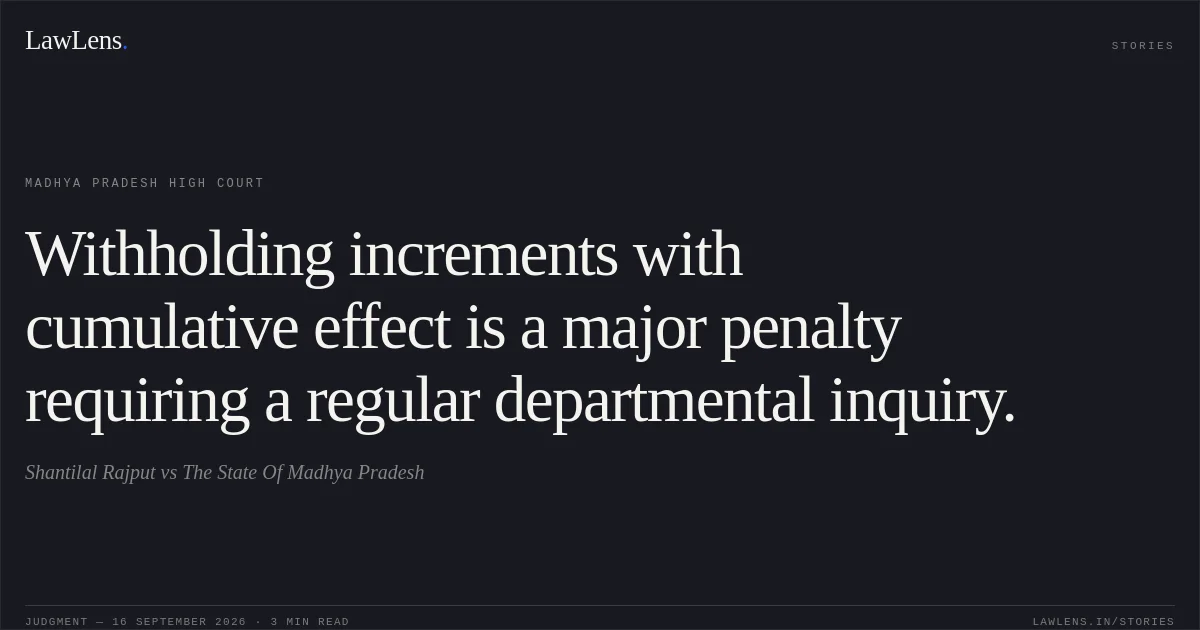
The Court held that withholding two annual increments with cumulative effect is a major penalty and cannot be imposed without a regular departmental enquiry under Rule 14.
It further held that the Collector lacked jurisdiction to impose such a major penalty upon the petitioner, a Class-III employee, under the applicable delegation of powers.
Source reference: paras. 10–11Accordingly, the punishment order dated 30 June 2018 and the appellate order dated 17 October 2023 were quashed.
Source reference: para. 11The respondents were directed to grant the petitioner all consequential benefits within two months of receiving the certified copy of the order.
Source reference: para. 11Since the petitioner had retired on 31 January 2025, the Court granted no liberty to the respondents to initiate fresh disciplinary proceedings.
Source reference: paras. 11–12The writ petition was therefore allowed and disposed of.
Source reference: paras. 11–12Original Court PDF
Shantilal RajputvsThe State Of Madhya Pradesh
Click to open original judgment
Original judgment, available to read, download and summarize on LawLens.in