Facts
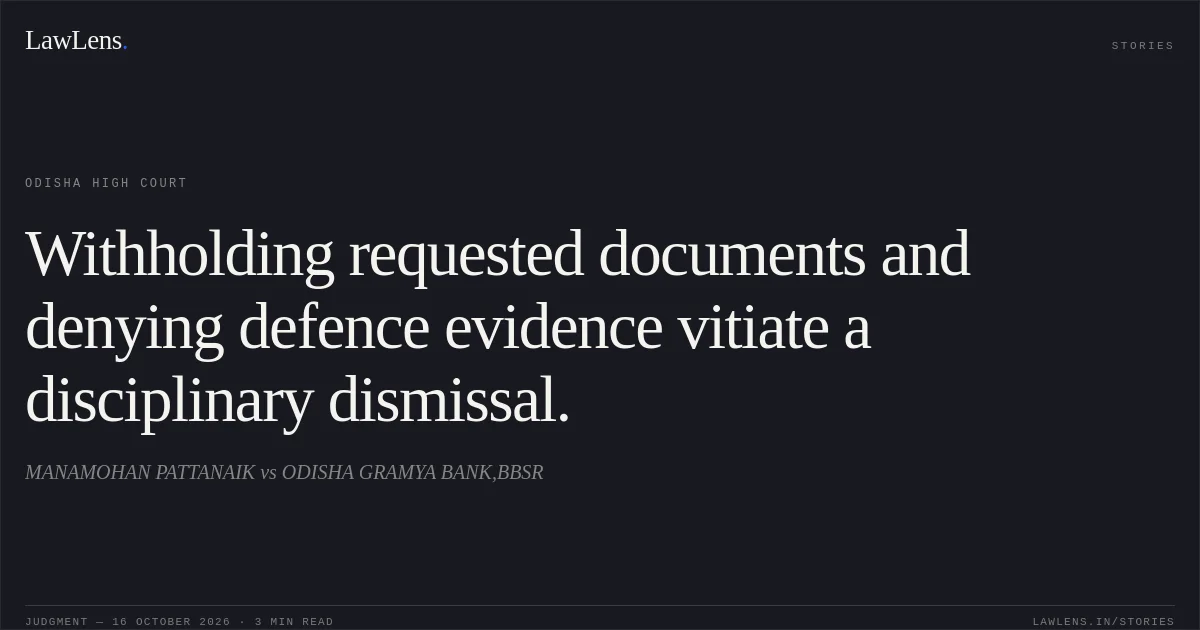
The Bank initiated disciplinary proceedings against the petitioner, a Senior Manager, by charge-sheet dated 15 October 2013. He requested documents on 25 October and 6 November 2013 to enable him to answer the charges, but was directed to submit his reply without further delay; the Bank later appointed an Inquiry Officer.
Source reference: p. 2–3, 15The Inquiry Officer examined the Management’s witnesses and closed the inquiry on 21 August 2015 without allowing the petitioner to present his documents or witnesses. The petitioner’s later request to give evidence was not accepted.
Source reference: p. 4–5, 16The disciplinary authority dismissed him on 10 June 2016, and the appellate authority rejected his appeal on 12 December 2016. The petitioner challenged both orders under Articles 226 and 227 of the Constitution.
Source reference: p. 2, 14–17Issues
1. Whether the disciplinary proceedings were vitiated by the Bank’s failure to provide requested documents and by the closure of the inquiry without a proper opportunity for the petitioner to present his defence.
Source reference: p. 15–182. Whether the appellate authority’s rejection of the appeal was legally sustainable when it referred to a reply to the charge-sheet that the petitioner had not filed.
Source reference: p. 17Law Applied
Regulation 39(b) of the Odisha Gramya Bank (Officers’ and Employees’ Service) Regulation, 2010 requires written charges, an inquiry, and a reasonable opportunity for the employee to answer the charges and defend himself before a major penalty is imposed.
Source reference: p. 11–12The principles of natural justice require a meaningful opportunity to meet the case, including access to relevant documents and a fair chance to present a defence.
Source reference: no citationThe Court also relied on Rani Lakshmi Bai Kshetriya Gramin Bank v. Jagdish Sharan Varshney, (2009) 4 SCC 240, for the requirement that an appellate order disclose, at least briefly, that the authority applied its mind; and on Sujata Panigrahi v. Chairman, Local Board of Administration, 2017 (Supp.-I) OLR 467, concerning the need for reasons in quasi-judicial decisions.
Source reference: p. 8–10It further referred to Anil Gilurker v. Bilaspur Raipur Kshetriya Gramin Bank, (2011) 14 SCC 379, on the requirement that disciplinary charges be sufficiently specific and that proceedings adhere to statutory requirements and natural justice.
Source reference: p. 10Reasoning
The petitioner had requested documents to answer serious charges, but the Bank directed him to respond without supplying them. The Inquiry Officer then closed the inquiry after examining the Management’s witnesses, without permitting the petitioner to present his documents or witnesses, despite his subsequent request to give evidence. The Court held that these circumstances seriously prejudiced the petitioner and rendered the proceedings procedurally unfair.
Source reference: p. 15–18The appellate order was also defective: it stated that the petitioner’s reply to the charge-sheet had been considered, although no such reply had been filed, indicating that the appeal had not been properly appreciated.
Source reference: p. 17These defects, viewed against Regulation 39(b) and the applicable principles of natural justice and reasoned decision-making, undermined both the dismissal and the appellate decision.
Source reference: p. 17–18Holding
The Court quashed the dismissal order dated 10 June 2016 and the appellate order dated 12 December 2016, and remitted the disciplinary proceeding to the disciplinary authority from the stage of supplying the requested documents.
It directed the Bank to provide the documents within eight weeks, allow the petitioner six weeks thereafter to file his reply, and dispose of the proceeding under the 2010 Regulation, with a hearing, preferably within six months after receiving the reply. The writ petition was disposed of accordingly.
Source reference: p. 19Original Court PDF
MANAMOHAN PATTANAIKvsODISHA GRAMYA BANK,BBSR
Click to open original judgment
Original judgment, available to read, download and summarize on LawLens.in