Facts
The plaintiff claimed to have purchased a 25 ft. × 40 ft. plot from Thakur Prasad by registered sale deed dated 3 November 1976. He alleged that Dashrath and others later encroached on a 7 ft. × 40 ft. strip of that land. The defendant denied encroachment and claimed to own a separate 25 ft. × 40 ft. plot purchased from the same seller, on which he had built a house.
Source reference: p. 1The trial court decreed the plaintiff’s suit for possession and mesne profits, but the first appellate court reversed that decree, finding the alleged encroachment unproved. The plaintiff appealed under Section 100 of the Code of Civil Procedure.
Source reference: pp. 1–2Issues
1. Whether the courts below erred by deciding the encroachment dispute without demarcating, measuring and identifying the parties’ plots through a competent Commissioner.
Source reference: p. 22. Whether the courts below erred by failing to determine what land the plaintiff purchased and whether it was land remaining with the seller after the seller had sold the other portion to late Dashrath.
Source reference: p. 2Law Applied
Section 100 of the Code of Civil Procedure governed the second appeal, and Order XXVI Rule 9 empowered the court to appoint a Commissioner for local investigation where necessary to elucidate a matter in dispute.
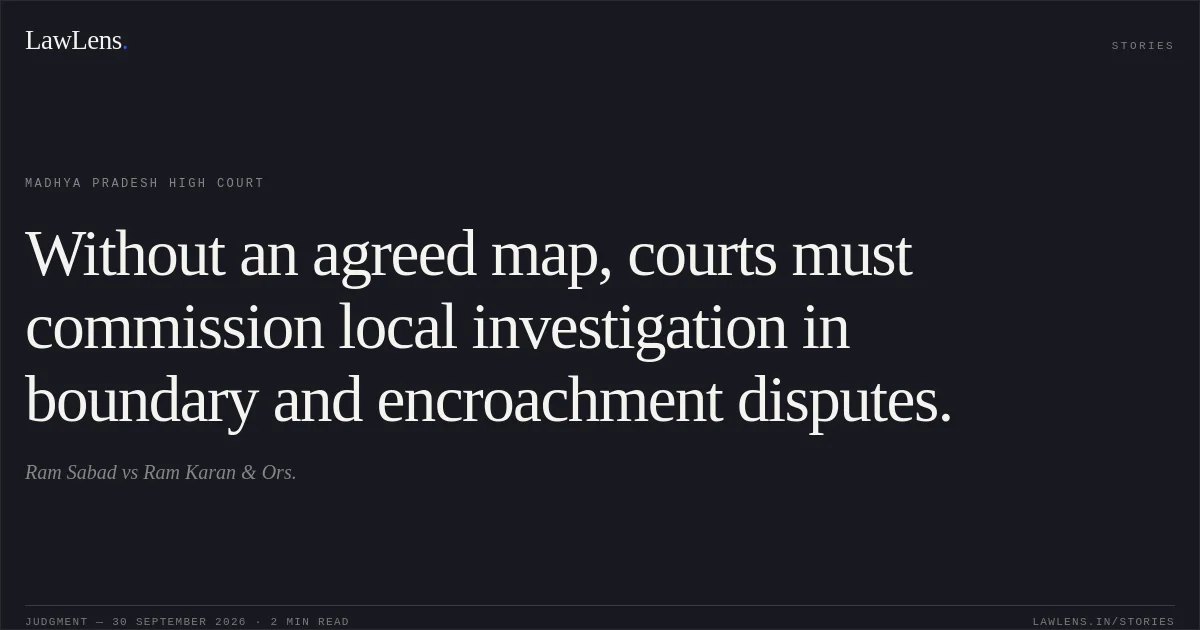
Source reference: pp. 2–9The court relied on Bagdiram v. Ramsingh, Prembai v. Ghanshyam, Loknath Gautam v. State of M.P., Suman Pandagre v. Madhu Pandagre, Jaswant v. Dindayal, Vayathinattar v. Sakkubai Ammal and Baliram v. Melaram, among other authorities. These authorities support the rule that, where land identity, boundary demarcation or encroachment is disputed and there is no agreed map, local investigation by a competent Commissioner may be necessary to establish the relevant boundaries and possession; the court may issue the commission on its own motion, and neither party’s application is essential.
Source reference: pp. 2–9Reasoning
The dispute concerned whether the land occupied by the defendant formed part of the plaintiff’s plot or the separate plot claimed by the defendant. Because the parties disputed the identity and boundaries of their respective plots, and the alleged encroachment could not reliably be determined without demarcation, the lower courts should not have resolved the issue on the existing record without a local investigation.
Source reference: pp. 2–9Applying Order XXVI Rule 9 and the cited authorities, the High Court concluded that a Commissioner’s report was necessary. It also directed the trial court to determine what land the plaintiff had actually purchased, including whether the plaintiff’s purchase was confined to land left with the seller after the sale to Dashrath.
Source reference: pp. 2–9Holding
The High Court answered the substantial questions in favour of further inquiry, set aside the judgments and decrees of both lower courts, and remanded the matter to the trial court to appoint a local Commissioner under Order XXVI Rule 9, obtain a report and decide the case afresh in accordance with law.
The trial court must also determine the extent of the plaintiff’s purchase. The parties may lead evidence only to the extent of the Commissioner’s report; there was no order as to costs.
Source reference: p. 10Acts & Sections Cited
2 provisions across 2 statutes referred to in this judgment. Each provision opens on LawLens.
Code of Civil Procedure, 19081
MP Land Revenue Code 19591
Original Court PDF
Ram SabadvsRam Karan & Ors.
Click to open original judgment
Original judgment, available to read, download and summarize on LawLens.in