01Facts
Dasaiah was injured when a car struck him while he was walking near Channapatna bus-stand on 21 October 2010.
¶ 2He filed a personal-injury claim under Section 166 of the Motor Vehicles Act, 1988, but died during its pendency; his wife and children were substituted and alleged that his death resulted from the accident.
¶ 2–3The Tribunal awarded ₹3,19,000 with interest at 8% per annum and held the insurer jointly liable with the vehicle owner.
¶ 5The insurer appealed, contending that there was insufficient evidence connecting Dasaiah’s death to the accident.
¶ 6–702Issues
i.1. Whether the Tribunal was justified in holding the insurer liable for a death claim without sufficient proof that Dasaiah’s death resulted from the accidental injuries.
¶ 1103Law Applied
The claim was brought under Section 166 of the Motor Vehicles Act, 1988, and the appeal under Section 173(1) of that Act.
¶ 2, 11The Court applied the principle that a claim attributing death to accidental injuries must be supported by evidence establishing the causal connection; where that connection is not proved, compensation for death cannot be imposed on that basis.
A claimant may nevertheless recover compensation for injury-related medical and incidental expenses supported by the claim.
Provisions in the judgment · 2 · Linked ones open on LawLens
Motor Vehicles Act, 1988 Section 173Section 166
04Reasoning
The Court found no specific assertion in the widow’s evidence that Dasaiah’s death was caused by the accident, no medical evidence establishing continued treatment for the injuries, and no doctor’s testimony on causation.
¶ 12The death certificate recorded that he died at home, without a post-mortem examination; although the wound certificate showed a right subtrochanteric fracture, the treatment records did not indicate injuries likely to cause death, and the medical evidence did not establish that death more than a year later resulted from the accident.
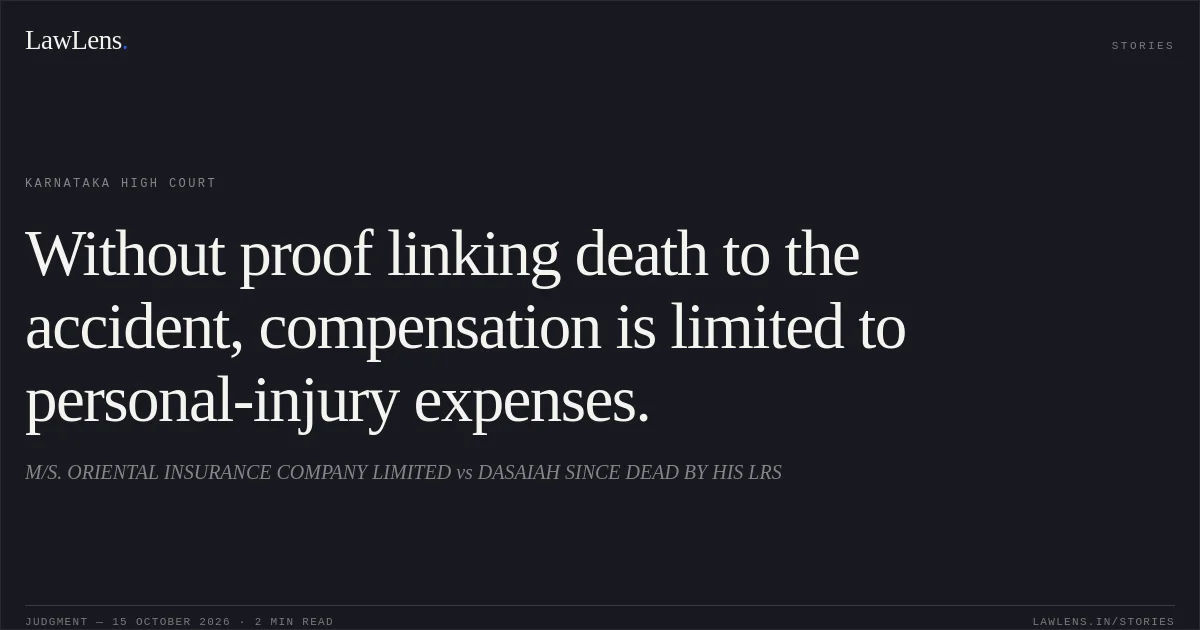
¶ 13The Court therefore rejected liability for the death claim.
¶ 13Because the proceeding had begun as a personal-injury claim, it nevertheless considered compensation for medical and incidental expenses, despite the absence of treatment records or bills.
¶ 1305Holding
The appeal was allowed in part and the Tribunal’s award was modified.
¶ 14(i)–(ii)The insurer was held liable to pay ₹25,000, with interest at 9% per annum from the date of the claim petition until deposit, instead of ₹3,19,000 with interest.
¶ 14(i)–(ii)The statutory deposit was to be transmitted to the Tribunal, with any excess refunded to the insurer; on an application for release, the compensation was to be paid to the claimant in a lump sum by electronic means.
¶ 14(iii)–(iv)Original Court PDF
M/S. ORIENTAL INSURANCE COMPANY LIMITEDvsDASAIAH SINCE DEAD BY HIS LRS
Click to open original judgment
Original judgment, available to read, download and summarize on LawLens.in