Facts
Respondent No. 2 alleged that Accused No. 1 sold a property to her under a registered sale deed dated 10 July 2013, then executed a gift deed for the same property in favour of Accused No. 2 on 24 November 2021.
Source reference: pp. 2–5, paras. 2–6The petitioners were Accused Nos. 3 to 5: Petitioners 1 and 2 allegedly witnessed the gift deed, and Petitioner 3 drafted it.
Source reference: pp. 2–5, paras. 2–6Respondent No. 2 filed a private complaint alleging offences under Sections 166, 167, 405, 420, 463, 464, 465, 468, 470 and 471 read with Section 34 of the IPC. After the Magistrate took cognisance and issued summons, the petitioners sought to quash the proceedings against them under Section 482 CrPC / Section 528 BNSS.
Source reference: pp. 2–5, paras. 2–6Issues
Whether the complaint, taken at face value, disclosed the essential ingredients of the alleged offences against the petitioners, given their alleged roles as witnesses to and drafter of the gift deed
Source reference: p. 6, para. 11Whether the allegations supported invoking Sections 166 and 167 IPC, or Section 34 IPC, against the petitioners
Source reference: pp. 8–10, paras. 16–22Law Applied
The Court considered the alleged offences under Sections 166, 167, 405, 420, 463, 464, 465, 468, 470 and 471 IPC, read with Section 34 IPC, and its inherent jurisdiction to quash proceedings under Section 482 CrPC / Section 528 BNSS.
Source reference: pp. 2–3, paras. 1–2It applied the principle that quashing is warranted where, even accepting the complaint’s allegations as true, the essential ingredients of an offence are not disclosed against the particular accused.
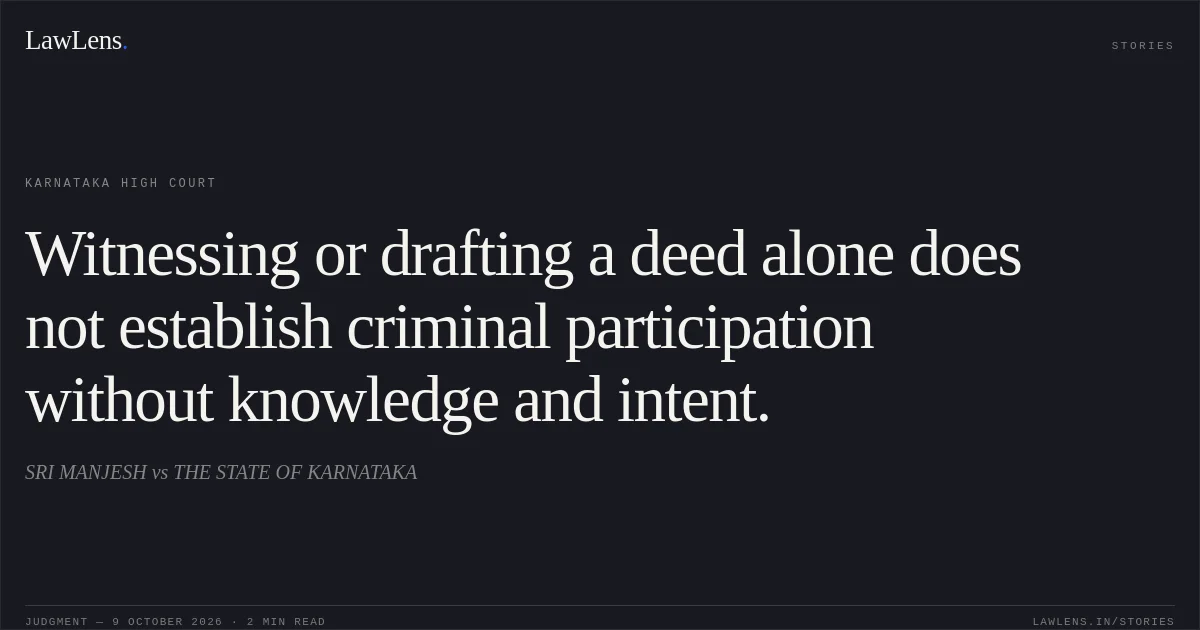
Source reference: p. 9, para. 19A witness’s signature or a deed writer’s preparation of a document, without material indicating knowledge of falsity and the requisite criminal intention, does not by itself establish participation in forgery or cheating; common intention likewise requires material from which shared intent may reasonably be inferred.
Source reference: pp. 7–9, paras. 14–17Sections 166 and 167 IPC could not be sustained against these petitioners absent an allegation that they were public servants acting in the discharge of official duties.
Source reference: p. 10, para. 22Reasoning
The complaint attributed to the petitioners only the acts of witnessing the gift deed or drafting it on a party’s instructions. It did not allege that they participated in the earlier sale, knew of Respondent No. 2’s ownership or possession, had prior dealings with her, benefited from the later transaction, or engaged in any communication or arrangement suggesting conspiracy or shared intent.
Source reference: pp. 7–9, paras. 13–18The Court therefore held that their roles, without further material showing knowledge of the earlier sale or intentional participation in creating a false document, did not disclose the necessary ingredients of the alleged property offences or Section 34 IPC.
Source reference: pp. 9–10, paras. 20–21The complaint also did not allege that the petitioners were public servants, defeating the basis for Sections 166 and 167 IPC.
Source reference: p. 10, para. 22Holding
The Court allowed the petition and quashed the criminal proceedings arising from PCR No. 23/2024/FIR No. 244/2024 insofar as they concerned the petitioners.
It expressly left the proceedings against Accused Nos. 1 and 2 unaffected and expressed no opinion on the validity of either deed.
Source reference: p. 11, paras. 25–26Acts & Sections Cited
14 provisions across 3 statutes referred to in this judgment. Each provision opens on LawLens.
Code of Criminal Procedure, 19732
Bharatiya Nagarik Suraksha Sanhita, 20231
Original Court PDF
SRI MANJESHvsTHE STATE OF KARNATAKA
Click to open original judgment
Original judgment, available to read, download and summarize on LawLens.in