Facts
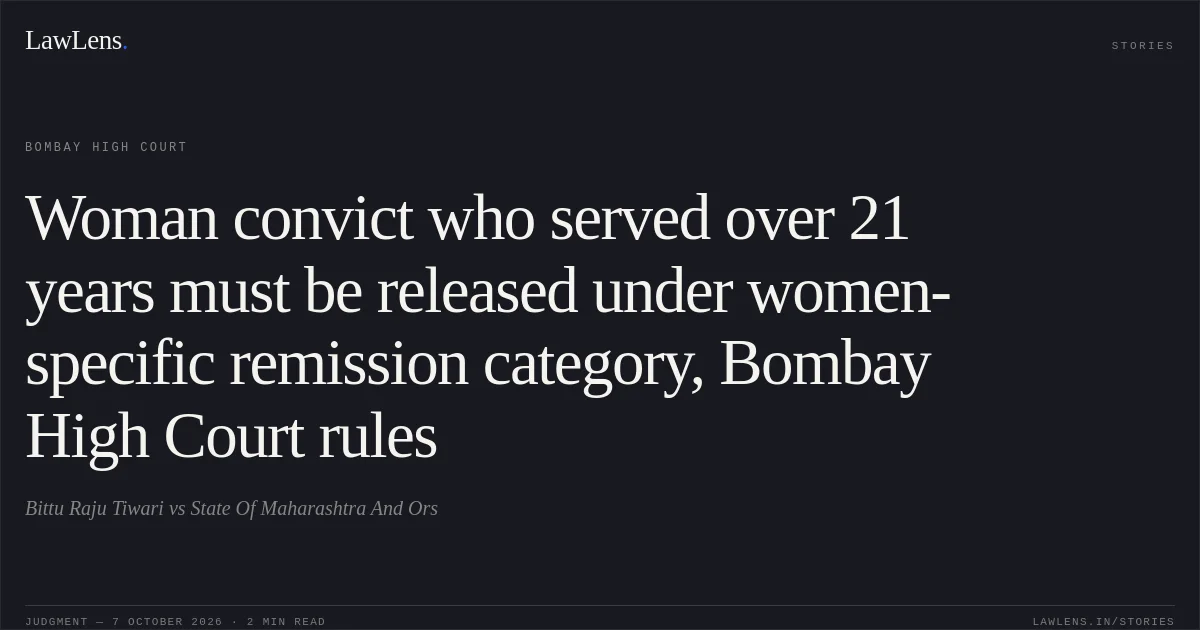
The Petitioner, a woman convicted under Section 302 read with Section 34 of the Indian Penal Code, challenged the State’s order placing her in Category 4(e) of Annexure-I to the Government Resolution dated 15 March 2010.
Source reference: pp. 1–4, paras. 3–9The State relied on the brutality of the murder and a Government Circular dated 8 December 2011, which provided that accused and co-accused convicted in the same trial should be placed in the same category.
Source reference: pp. 1–4, paras. 3–9The Petitioner argued that, as a woman offender, she could be placed only in Category 1(b), the special category for crimes by women.
Source reference: pp. 1–4, paras. 3–9The State informed the Court that she had served 21 years, 10 months and 9 days by 30 September 2026.
Source reference: p. 5, para. 12Issues
Whether a woman offender may be placed in the general offence-based Category 4(e), or must be considered under the special category for women offenders in Annexure-I to the 2010 Government Resolution.
Source reference: pp. 2–5, paras. 4–6, 10–11Whether the 8 December 2011 Circular requiring co-accused convicted in the same trial to be placed in the same category justified retaining the Petitioner in Category 4(e).
Source reference: p. 4, para. 9Law Applied
Annexure-I to the Government Resolution dated 15 March 2010 creates Category 1 specifically for “Crime by Women,” while the remaining categories classify offenders by the nature of their offences.
Source reference: pp. 4–5, para. 10In Usha Munna Upadhyay v. State of Maharashtra, Criminal Writ Petition No. 3701 of 2012, order dated 15 March 2013, a Division Bench held that the women-specific category is special and excludes the application of the general offence-based categories to women offenders; otherwise, the special category would be rendered redundant.
Source reference: pp. 4–5, para. 10The State also relied on the Government Circular dated 8 December 2011 concerning categorisation of co-accused convicted in the same trial.
Source reference: p. 4, para. 9Reasoning
The Court adopted the reasoning in Usha Munna Upadhyay, finding it directly applicable: because the 2010 Resolution provides a distinct category for women offenders, the general categories—including Category 4(e)—do not apply to the Petitioner.
Source reference: pp. 4–5, paras. 10–11The Court therefore rejected the State’s reliance on the offence’s alleged brutality and on the co-accused’s categorisation as grounds to place the Petitioner in Category 4(e).
Source reference: pp. 3–5, paras. 7–11The State’s submission that the Petitioner had already served the maximum period prescribed under Category 1(b) further supported the relief sought.
Source reference: p. 5, para. 12Holding
The Court held that the Petitioner was to be placed in Category 1(b), not Category 4(e), and made the Rule absolute in terms of the prayers to quash the State’s order dated 6 February 2026 and release her under Category 1(b) of the 2010 Government Resolution.
It directed that she be released forthwith, if not required in any other case, and disposed of the petition.
Source reference: p. 6, paras. 13(ii)–(iii)Acts & Sections Cited
2 provisions across 1 statute referred to in this judgment. Each provision opens on LawLens.
Indian Penal Code, 18602
Original Court PDF
Bittu Raju TiwarivsState Of Maharashtra And Ors
Click to open original judgment
Original judgment, available to read, download and summarize on LawLens.in