01Facts
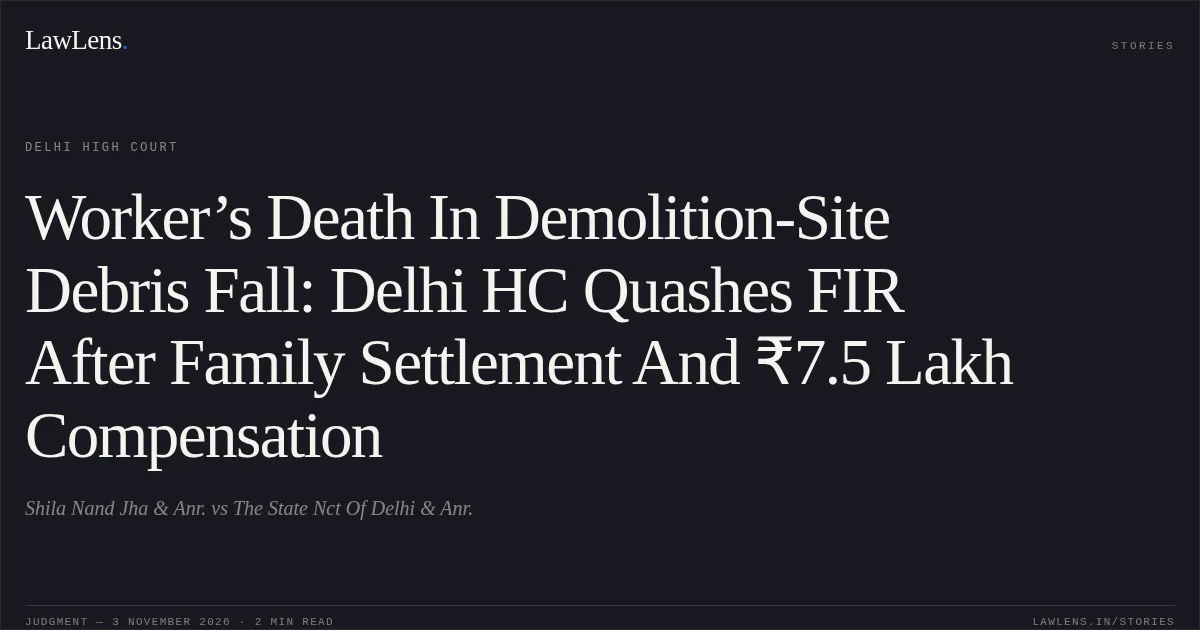
The petitioners sought quashing under Section 528 of the Bharatiya Nagarik Suraksha Sanhita, 2023, of FIR No. 699/2025, registered at P.S. Kalindi Kunj under Sections 290/106 of the Bharatiya Nyaya Sanhita, 2023, and the proceedings arising from it.
p. 1The FIR arose from the death of respondent no. 2’s husband, who was working on demolition and renovation of property owned by petitioner no. 1 and undertaken through petitioner no. 2. Debris fell on him during the work, and he later died at hospital.
p. 2The parties entered into a mediated settlement for Rs. 5,00,000; during the proceedings, the petitioners paid an additional Rs. 2,50,000, which respondent no. 2 acknowledged receiving.
pp. 2–3Respondent no. 2, appearing for herself and as natural guardian of the deceased’s three minor children, consented to quashing.
pp. 3, 6–702Issues
i.Whether the High Court should exercise its inherent jurisdiction under Section 528 BNSS to quash the FIR and consequential proceedings on the basis of the parties’ settlement.
pp. 1, 4–6ii.Whether the settlement and compensation adequately addressed the interests of the deceased’s minor children, such that quashing could be granted subject to protective directions.
pp. 2–3, 7–803Law Applied
Section 528 BNSS, corresponding to Section 482 of the Code of Criminal Procedure, 1973, confers inherent power to quash proceedings to secure the ends of justice or prevent abuse of process, distinct from statutory compounding under Section 320 CrPC.
pp. 1, 4–5Under Gian Singh v. State of Punjab, (2012) 10 SCC 303, the High Court may quash non-compoundable offences following settlement where the nature and gravity of the offence, the likelihood of conviction, and the interests of justice support that course; heinous and serious offences ordinarily should not be quashed merely because of a compromise.
pp. 4–5Narinder Singh v. State of Punjab, (2014) 6 SCC 466, directs the court to consider whether conviction is remote and continuation would cause oppression or injustice.
p. 5Ramgopal v. State of Madhya Pradesh, (2022) 14 SCC 531, identifies the offence’s effect on society, injury, voluntariness of compromise, and the accused’s conduct as relevant considerations.
p. 6Provisions in the judgment · 5 · Linked ones open on LawLens
Bharatiya Nagarik Suraksha Sanhita, 2023 Section 528
Code of Criminal Procedure, 1973 Section 482Section 320
Bharatiya Nyaya Sanhita, 2023 Section 290Section 106
04Reasoning
The Court considered the incident accidental and found no mala fide intention in the allegations concerning failure to provide safety during demolition.
p. 4It also took account of the voluntary mediated settlement with the deceased’s legal heirs, respondent no. 2’s no-objection, and the total compensation of Rs. 7,50,000, which addressed the Court’s earlier concern about the adequacy of the settlement amount.
pp. 2–4, 6–7In light of these circumstances and comparable decisions quashing FIRs under Sections 290/106 BNS following settlements, the Court concluded that continuing the prosecution would be futile.
pp. 6–705Holding
The Court allowed the petition and quashed FIR No. 699/2025 under Sections 290/106 BNS and all consequential proceedings.
p. 7To protect the minor children, it directed that Rs. 1,25,000 for each child be kept in a fixed deposit with a nationalised bank until maturity; interest may be paid to respondent no. 2 solely for the children’s benefit, and premature withdrawal requires leave of the competent court.
pp. 7–8The petition and any pending applications were disposed of accordingly.
p. 8Original Court PDF
Shila Nand Jha & Anr.vsThe State Nct Of Delhi & Anr.
Click to open original judgment
Original judgment, available to read, download and summarize on LawLens.in