Facts
The respondent, a driver, was terminated by the petitioner on March 20, 2005.
Source reference: para. 4.1The Labour Court, Jamnagar, vide award dated April 11, 2016, set aside the termination and directed reinstatement with continuity of service but without back wages.
Source reference: para. 4.1The petitioner challenged this award through a Special Civil Application and a Letters Patent Appeal, both of which were dismissed by December 17, 2018.
Source reference: para. 4.1Despite the award, the respondent was only reinstated on March 6, 2019.
Source reference: para. 4.1The respondent then filed an application under Section 33(C)(2) of the Industrial Disputes Act, 1947, seeking wages for the "post-award" period from June 1, 2016, to February 28, 2019.
Source reference: para. 4.1The Labour Court allowed the recovery of ₹2,68,564/-.
Source reference: para. 1The petitioner challenged this order, arguing the claim amounted to "back wages" which had been previously Denied.
Source reference: para. 5Issues
1. Whether a workman is entitled to full wages for the period between the date of a reinstatement award and the actual date of reinstatement, even if back wages were denied in the original award.
Source reference: para. 82. Whether the principle of "No Work, No Pay" or the requirement to prove unemployment applies to the post-award period when the employer delays reinstatement.
Source reference: para. 8/9Law Applied
Section 33(C)(2) of the Industrial Disputes Act, 1947, regarding the recovery of money due from an employer.
Source reference: para. 4.1Denial of "back wages" (pre-award) does not preclude the entitlement to "wages" for the post-award period.
Source reference: para. 8The principle of "No Work, No Pay" does not apply to the post-award period if the workman was ready and willing to work but was prevented by the employer.
Source reference: para. 8The burden of pleading and proving unemployment, which applies to back wages, does not extend to claims for wages post-dating the award.
Source reference: para. 9Reasoning
The court distinguished between "back wages" (period between termination and award) and "post-award wages" (period between award and actual reinstatement). It noted that while the initial award denied back wages, the respondent’s current claim was strictly for the post-award period.
Source reference: para. 8The court found that the petitioner failed to reinstate the respondent within the mandated 30 days of the 2016 award, choosing instead to litigate without obtaining a stay from the High Court.
Source reference: para. 8/9Evidence showed the respondent attempted to resume duties but was blocked due to pending litigation.
Source reference: para. 8Consequently, the court reasoned that since the termination was held illegal and confirmed by higher benches, the workman is deemed to have been in service post-award and is entitled to minimum wages regardless of whether he proved unemployment during those 33 months.
Source reference: para. 9Holding
The High Court dismissed the petition and upheld the Labour Court's order directing the petitioner to pay ₹2,68,564/-.
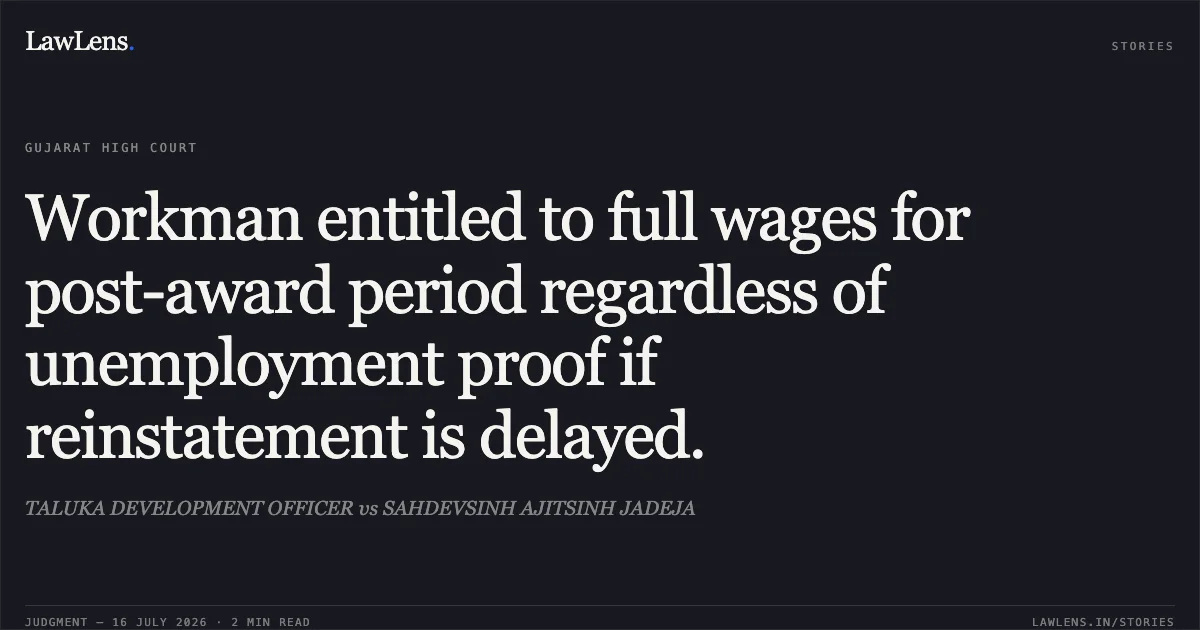
The court held that a workman is entitled to full wages from the date of the award till actual reinstatement if the employer delays the process, as the workman is considered ready and willing to work.
Source reference: para. 8The petitioner was directed to comply within 30 days, failing which a simple interest of 5% per annum would apply from the date of default.
Source reference: para. 10Acts & Sections Cited
1 provisions across 1 statute referred to in this judgment. Linked provisions open on LawLens.
Industrial Disputes Act, 19471
Original Court PDF
TALUKA DEVELOPMENT OFFICERvsSAHDEVSINH AJITSINH JADEJA
Click to open original judgment
Original judgment, available to read, download and summarize on LawLens.in