Facts
The management of the respondent company introduced a Voluntary Retirement Scheme (VRS) in 1999, which expired on 31.03.2000.
Source reference: para. 2On 23.04.2001, the appellant-workman applied for VRS but later requested to continue in service, which the management allowed.
Source reference: para. 3Eight months later, on 10.12.2001, the workman submitted a second VRS application; it was accepted, and he was relieved on 15.12.2001.
Source reference: para. 4He received a VRS payment of Rs. 5,00,000/- and other retiral dues.
Source reference: para. 4In 2005, nearly four years later, the workman challenged his disengagement before the Labour Court.
Source reference: para. 5, 11The Labour Court awarded him Rs. 10,00,000/- as additional compensation, citing that the VRS was not in subsistence in 2001.
Source reference: para. 5The learned Single Judge of the High Court subsequently set aside the Labour Court's award.
Source reference: para. 6This Letters Patent Appeal (LPA) is filed by the workman against that reversal.
Source reference: para. 7Issues
1. Whether a workman, after voluntarily applying for retirement and accepting the subsequent financial benefits under a VRS scheme, is estopped from challenging the legality of his disengagement.
Source reference: para. 6, 122. Whether the acceptance of a VRS application after the formal expiry of the scheme renders the termination of service illegal or improper.
Source reference: para. 8, 9Law Applied
The court applied the equitable doctrine of estoppel, which prevents a party from asserting a right or claim that contradicts their previous actions or conduct.
Source reference: para. 12The court also relied on the principle that the voluntary nature of an application and the subsequent acceptance of terminal benefits (consideration) creates a binding conclusion to the employer-employee relationship, precluding a later claim of "illegal discharge" under industrial law.
Source reference: para. 6, 12Reasoning
The Court rejected the appellant's contention that the management committed an illegality by accepting a VRS application after the formal scheme had lapsed in March 2000.
Source reference: para. 8-9The Court observed that the workman had twice sought voluntary retirement of his own volition—the second time specifically eight months after being permitted to continue in service.
Source reference: para. 3-4, 9Crucially, the Court highlighted that the workman not only accepted the special VRS payment of Rs. 5,00,000/- and other retiral dues but waited for nearly four years before approaching the Labour Court.
Source reference: para. 10-11The Court reasoned that once a workman submits a voluntary application, accepts the relief from service, and pockets the financial benefits associated with the scheme, he is legally estopped from later contending that the disengagement was improper.
Source reference: para. 12The court found that the lack of a "subsisting" formal scheme was irrelevant given the workman's conduct and the acceptance of the specific VRS amount.
Source reference: para. 12-13Holding
The High Court dismissed the appeal, answering the issues in favour of the management.
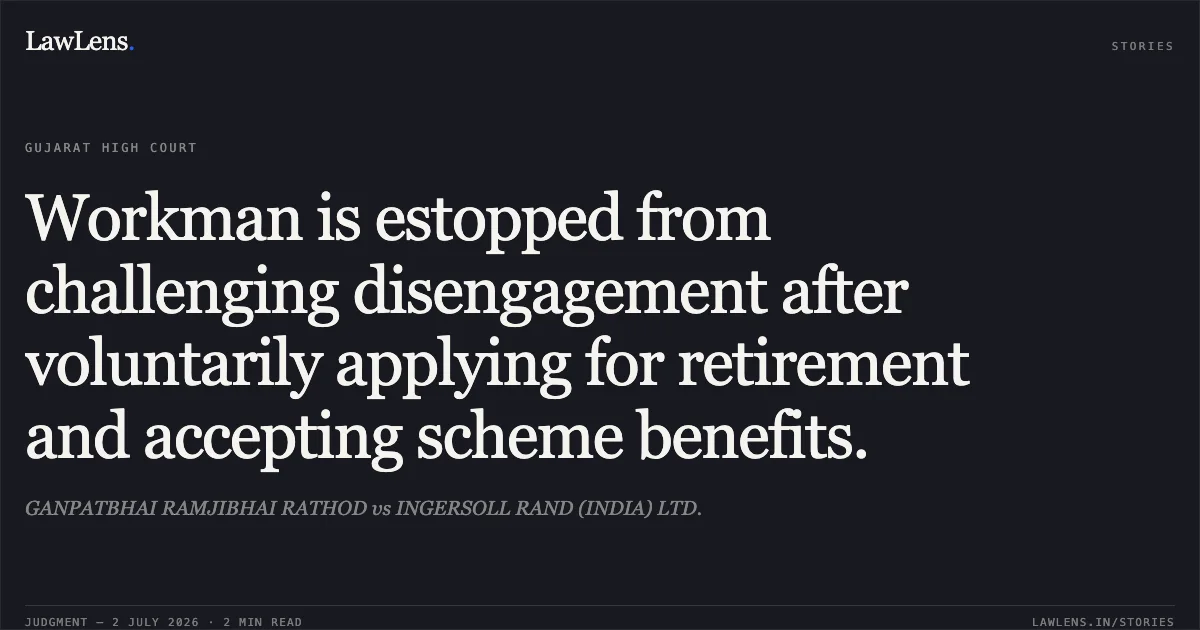
The court held that the workman was estopped from challenging his disengagement after having accepted the VRS benefits.
Source reference: para. 12Consequently, the order of the learned Single Judge setting aside the Labour Court's award of Rs. 10,00,000/- was upheld, and the reference was rejected.
Source reference: para. 13-14Acts & Sections Cited
1 provisions across 1 statute referred to in this judgment. Linked provisions open on LawLens.
Industrial Disputes Act, 19471
Original Court PDF
GANPATBHAI RAMJIBHAI RATHODvsINGERSOLL RAND (INDIA) LTD.
Click to open original judgment
Original judgment, available to read, download and summarize on LawLens.in