Facts
The Respondents (Workmen), Kuldeep and Rameshwar Pandey, were employed by the Petitioner as Assistant Machine Men and alleged their services were illegally terminated in February 2009.
Source reference: para 2The Labour Court, via Award dated 17.05.2016, held the termination illegal and directed reinstatement with 50% back wages.
Source reference: para 3The Petitioner challenged this Award before the High Court, which stayed the operation of the Award on 01.05.2017.
Source reference: para 4Nine years after the writ petition was filed, the Respondents moved applications under Section 17-B of the Industrial Disputes Act, 1947, seeking wages during the pendency of the litigation, supported by affidavits affirming their unemployment.
Source reference: para 1, 4, 12Issues
Whether the Respondents/Workmen are entitled to relief under Section 17-B of the Industrial Disputes Act, 1947, independent of the merits of the main writ petition.
Source reference: para 14Law Applied
Section 17-B of the Industrial Disputes Act, 1947, which mandates the payment of last drawn wages to a workman during the pendency of proceedings in higher courts against an award of reinstatement, provided the workman files an affidavit of non-employment.
Source reference: para 16The court relied on Food Craft Institute v. Rameshwar Sharma and Dena Bank v. Kiritikumar T. Patel to establish that Section 17-B is a beneficial provision where the court cannot deny relief once statutory conditions are met.
Source reference: para 19, 20Surjeet Singh v. Dominant Systems Pvt. Limited was cited to clarify that the burden of proof shifts to the employer to prove "gainful employment" once the workman files an affidavit.
Source reference: para 21-22Reasoning
The court found that the Respondents satisfied the four statutory requirements of Section 17-B: a reinstatement award exists, a challenge is pending in the High Court, and affidavits of non-employment were filed.
Source reference: para 18, 23The Petitioner’s primary defenses—the lack of an employer-employee relationship and the intermittent daily earnings of the workmen—were rejected.
Source reference: para 24-25The court noted that intermittent, irregular earnings (₹250-300/day) do not constitute "gainful employment" or "adequate remuneration" under the law.
Source reference: para 25Regarding the nine-year delay in filing the application, the court held that while delay does not disentitle the workman to the underlying right, it is a relevant factor in determining the commencement date of payments.
Source reference: para 19(B), 30Consequently, the court decided to grant wages not from the date of the award, but from the date of filing the Section 17-B applications.
Source reference: para 30Holding
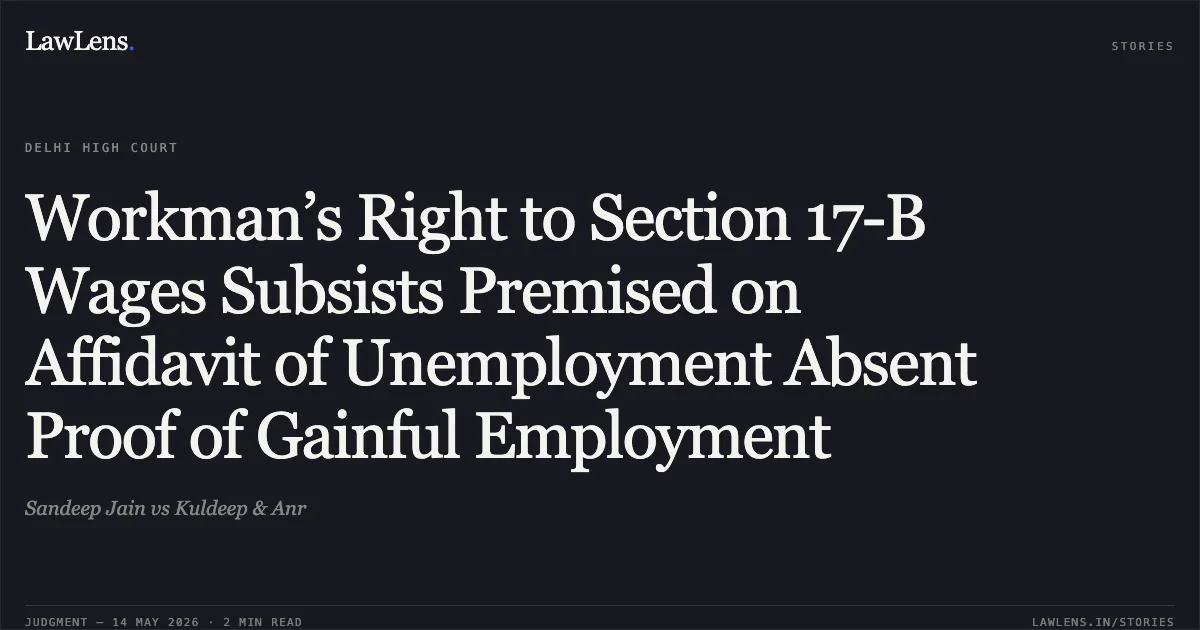
The Court allowed the applications, holding that the Respondents are entitled to wages during the pendency of the writ petition.
The Petitioner was directed to pay wages computed based on the minimum wages for a skilled worker (rather than just last drawn wages) from the date of filing the applications (2025) until the disposal of the petition or superannuation.
Source reference: para 31(i)Arrears must be cleared within three months, and future monthly payments must be made by the 10th of each month, subject to the workmen filing updated undertakings to refund the amount should the Petitioner ultimately succeed in the writ petition.
Source reference: para 31(ii)-(iv)(c)Acts & Sections Cited
2 provisions across 2 statutes referred to in this judgment. Linked provisions open on LawLens.
Industrial Disputes Act, 19471
Minimum Wages Act, 19481
Original Court PDF
Sandeep JainvsKuldeep & Anr
Click to open original judgment
Original judgment, available to read, download and summarize on LawLens.in