Facts
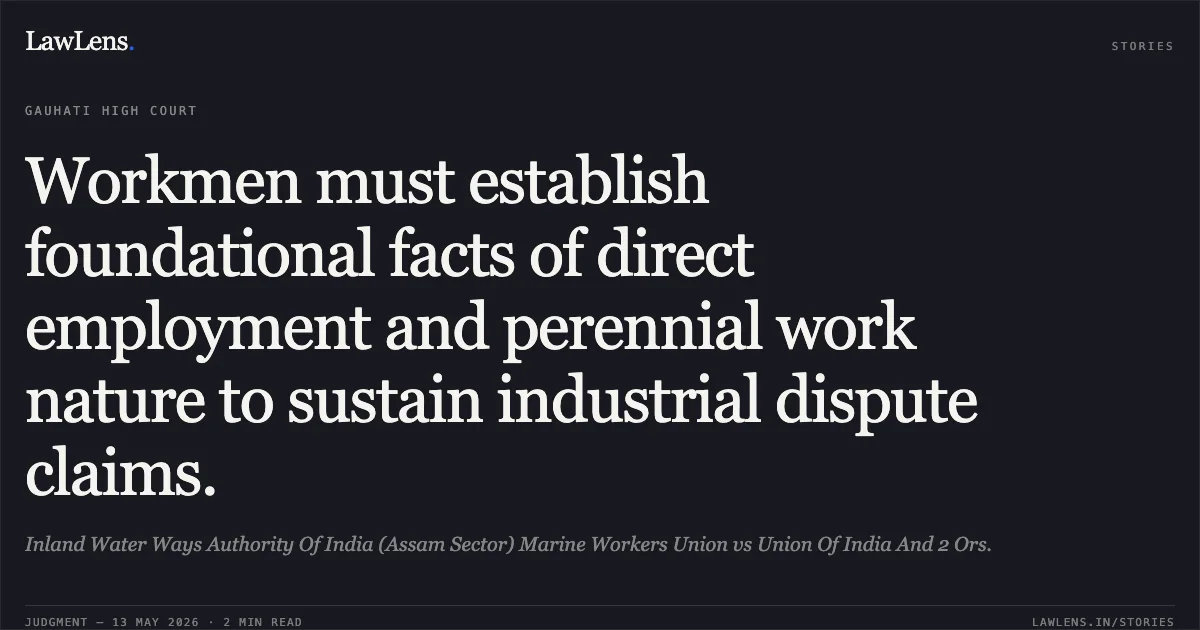
The Petitioner Union, representing marine vessel crews, claimed its members were directly employed by the Inland Waterways Authority of India (IWAI) on a contingency basis for perennial work
Source reference: p. 2They alleged that from 2007 onwards, while remaining under IWAI’s control, their wages were routed through a society and later through private contractors (M/s A C Roy and Co and M/s Chinar Shipping), which they characterized as a "paper arrangement" to deny service benefits
Source reference: p. 3, 8Following failed conciliation, the matter was referred to the Central Government Industrial Tribunal (CGIT), Guwahati, in Ref. Case No. 02/2016
Source reference: p. 3The CGIT passed an Award on 06.02.2018, holding that the workers were not direct employees of IWAI and were not entitled to relief
Source reference: p. 3The Petitioner challenged this Award via the present writ petition.
Source reference: p. 3Issues
1. Whether the CGIT exceeded its jurisdiction by going beyond the terms of reference regarding the nature of the workers' engagement
Source reference: p. 4, 72. Whether the management was justified in engaging marine vessel crews on a casual/contractual basis for 89-day spells for work alleged to be of a perennial nature
Source reference: p. 93. Whether the members of the Petitioner Union were direct employees of IWAI or employees of independent contractors
Source reference: p. 10Law Applied
The Court applied the fundamental principle of the burden of proof in industrial disputes, holding that the party asserting a fact (the existence of an employer-employee relationship) must prove it through admissible evidence
Source reference: p. 11It also considered the Contract Labour (Regulation and Abolition) Act (CLRA), noting that in the absence of a government notification prohibiting contract labour in a specific industry, engagement through contractors is not inherently illegal
Source reference: p. 11The "lifting of the veil" doctrine was referenced as a tool to determine if a contract is a mere "sham" or "paper arrangement," provided foundational facts are first established by the claimants
Source reference: p. 5, 11Reasoning
The Court scrutinized the evidence provided by the Union’s witness, Jiten Deka, which lacked any documentary proof (such as appointment letters or salary slips) to establish direct employment by IWAI
Source reference: p. 10The Court reasoned that the "foundational facts"—that the work was perennial and the employment was direct—must be proven by the workmen before the onus shifts to the management
Source reference: p. 7, 11Since the Union failed to show that dredging and vessel manning were perennial or that the contract system was a sham, the CGIT's refusal to lift the corporate veil was justified
Source reference: p. 11The Court found that the CGIT acted within its jurisdiction because answering the reference naturally required determining the legal status of the workers' employment
Source reference: p. 7Holding
It held that the management did not act in an unjustified manner as the workers failed to prove they were engaged in perennial work or were under the direct employment of IWAI
The High Court dismissed the writ petition, upholding the CGIT’s Award
Source reference: p. 12The Court concluded that the Tribunal’s findings were not perverse and that the intermittent 89-day engagements occurred during transitional tender periods between contractors
Source reference: p. 12No relief was granted
Source reference: p. 12Acts & Sections Cited
2 provisions across 2 statutes referred to in this judgment. Linked provisions open on LawLens.
Contract Labour (Regulation and Abolition) Act, 19701
Industrial Disputes Act, 19471
Original Court PDF
Inland Water Ways Authority Of India (Assam Sector) Marine Workers UnionvsUnion Of India And 2 Ors.
Click to open original judgment
Original judgment, available to read, download and summarize on LawLens.in