Facts
The respondents were temporarily engaged by the Tamil Nadu State Transport Corporation.
Source reference: para. 2The competent authority under the Tamil Nadu Industrial Establishments (Conferment of Permanent Status to Workmen) Act, 1981, passed orders in their favour on 31 May 2005.
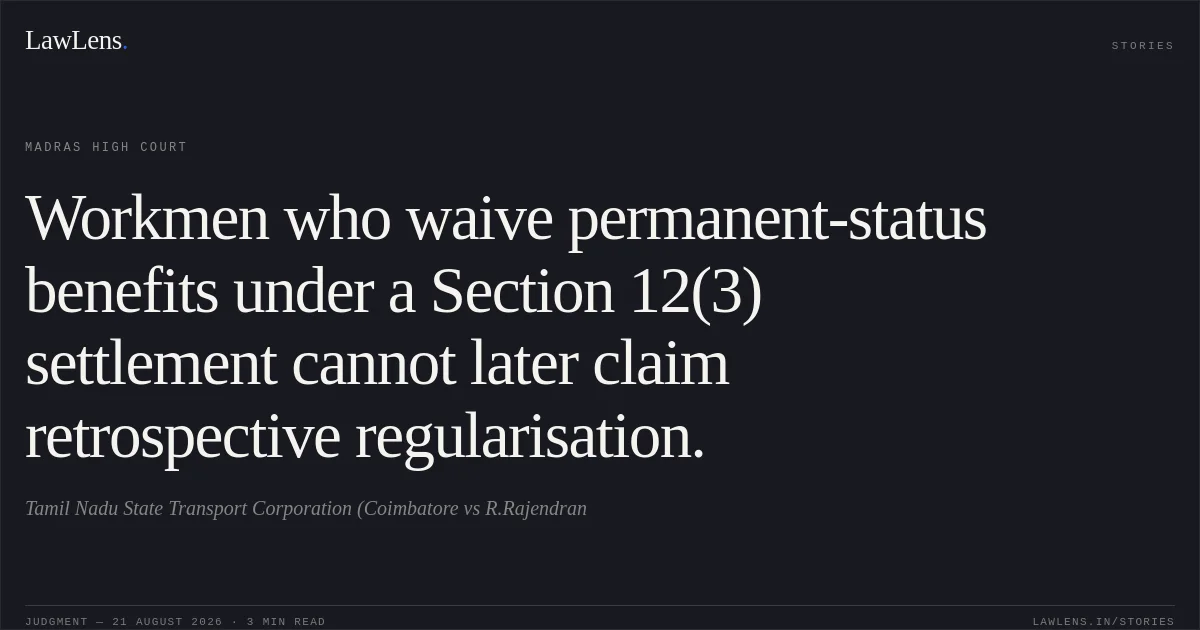
Source reference: para. 2Thereafter, the Management and the Trade Union entered into a settlement under Section 12(3) of the Industrial Disputes Act on 31 August 2005.
Source reference: para. 2Pursuant to that settlement, the respondents executed undertakings that they would not claim benefits under the competent authority’s orders, and their services were regularised prospectively from 1 September 2005.
Source reference: para. 2After approximately nine years, they sought retrospective regularisation from the date of completion of 480 days’ service.
Source reference: para. 3Following earlier writ proceedings directing consideration of their representations, the Corporation rejected their claims on 3 October 2023.
Source reference: paras. 3–4The learned Single Judge subsequently allowed their writ petitions and granted the benefit of the orders under the Permanent Status Act, leading to the present writ appeals.
Source reference: para. 4Issues
1. Whether employees who accepted regularisation under a binding Section 12(3) settlement and expressly undertook not to claim benefits under the Permanent Status Act could subsequently seek retrospective regularisation on the basis of the competent authority’s earlier orders.
Source reference: paras. 10–122. Whether the respondents’ belated claims, raised after approximately nine years without challenging the settlement or the consequential regularisation orders, were barred by delay, laches and acquiescence.
Source reference: paras. 11–133. Whether the learned Single Judge was justified in granting retrospective regularisation despite the respondents’ undertakings and acceptance of prospective regularisation under the settlement.
Source reference: paras. 12, 15–16Law Applied
The Court applied the Tamil Nadu Industrial Establishments (Conferment of Permanent Status to Workmen) Act, 1981, under which qualifying workmen may claim permanent status upon completion of the prescribed continuous service, including 480 days.
Source reference: no citationIt further applied Sections 12(3) and 18(3) of the Industrial Disputes Act, 1947, holding that a settlement reached in the statutory conciliation process is binding on the parties, particularly where employees accept its benefits.
Source reference: no citationThe Court relied on the doctrines of delay, laches and acquiescence, as explained by the Supreme Court in Prabhakar v. Joint Director, Sericulture Department, (2015) 15 SCC 1, namely, that a right not exercised for an unreasonable period may be treated as unenforceable and that a party who knowingly stands by while an inconsistent act occurs cannot later complain.
Source reference: para. 13It also followed the Division Bench decision in Managing Director, Tamil Nadu State Transport Corporation Limited v. O. Veeraiyya, 2025:MHC:2050, that employees who accept regularisation under a Section 12(3) settlement and relinquish claims under the Permanent Status Act cannot later seek retrospective regularisation.
Source reference: paras. 7, 14Reasoning
The respondents had expressly relinquished their claims under the Permanent Status Act as a condition of receiving regularisation under the Section 12(3) settlement, and they accepted such regularisation with effect from 1 September 2005.
Source reference: paras. 2, 10They continued in service under that arrangement without challenging either the settlement or the consequential regularisation orders.
Source reference: paras. 10–12Their attempt, after nine years, to revive the earlier claim for retrospective regularisation was therefore inconsistent with their undertakings and conduct.
Source reference: paras. 10–12Applying the principles of acquiescence and laches, the Court held that the respondents could not accept the benefits of the settlement and subsequently claim an additional or inconsistent benefit under the earlier orders.
Source reference: no citationThe authorities relied upon by the respondents were distinguishable because they involved cases where the employees had challenged the competent authority’s orders and had not executed comparable undertakings; moreover, delay and acquiescence had not been considered in those cases.
Source reference: para. 15Holding
The Court held that the respondents were bound by the Section 12(3) settlement and their undertakings relinquishing claims under the Permanent Status Act.
Their belated claims for retrospective regularisation were barred by their acceptance of the settlement, absence of any challenge to the regularisation orders, and the doctrines of delay, laches and acquiescence.
Source reference: paras. 10–13, 16The writ order dated 1 October 2024 in W.P. Nos. 10560 and 10562 of 2024 was set aside, the writ appeals were allowed, and the connected miscellaneous petitions were closed.
Source reference: para. 16No order as to costs.
Source reference: para. 16Acts & Sections Cited
4 provisions across 3 statutes referred to in this judgment. Linked provisions open on LawLens.
Letters Patent1
Tamil Nadu Industrial Establishments (Conferment of Permanent Status to Workmen) Act, 19811
Industrial Disputes Act, 19472
Original Court PDF
Tamil Nadu State Transport Corporation (CoimbatorevsR.Rajendran
Click to open original judgment
Original judgment, available to read, download and summarize on LawLens.in