Facts
The respondent, a temporarily engaged worker, obtained an order from the competent authority under the Tamil Nadu Industrial Establishments (Conferment of Permanent Status to Workmen) Act, 1981, on 31 May 2005.
Source reference: p.2, para. 2A Section 12(3) settlement was entered into on 31 August 2005; pursuant to it, the respondent undertook not to claim benefits under the competent authority’s order, and his services were regularised from 1 September 2005.
Source reference: p.6, para. 10In 2014, he sought a direction to consider regularisation from completion of 480 days’ service. After the Corporation rejected his claim in 2023, he filed W.P. No. 10564 of 2024, which the Single Judge allowed. The Corporation appealed.
Source reference: pp.3–4, paras. 3–4Issues
Whether the respondent, having accepted regularisation under the Section 12(3) settlement and undertaken not to claim under the permanent-status order, could later seek retrospective regularisation based on that order
Source reference: pp.5–6, paras. 5, 10Whether the respondent’s delay and acquiescence, together with his failure to challenge the settlement and consequential regularisation, barred the relief granted by the Single Judge
Source reference: pp.6–7, paras. 11–12Law Applied
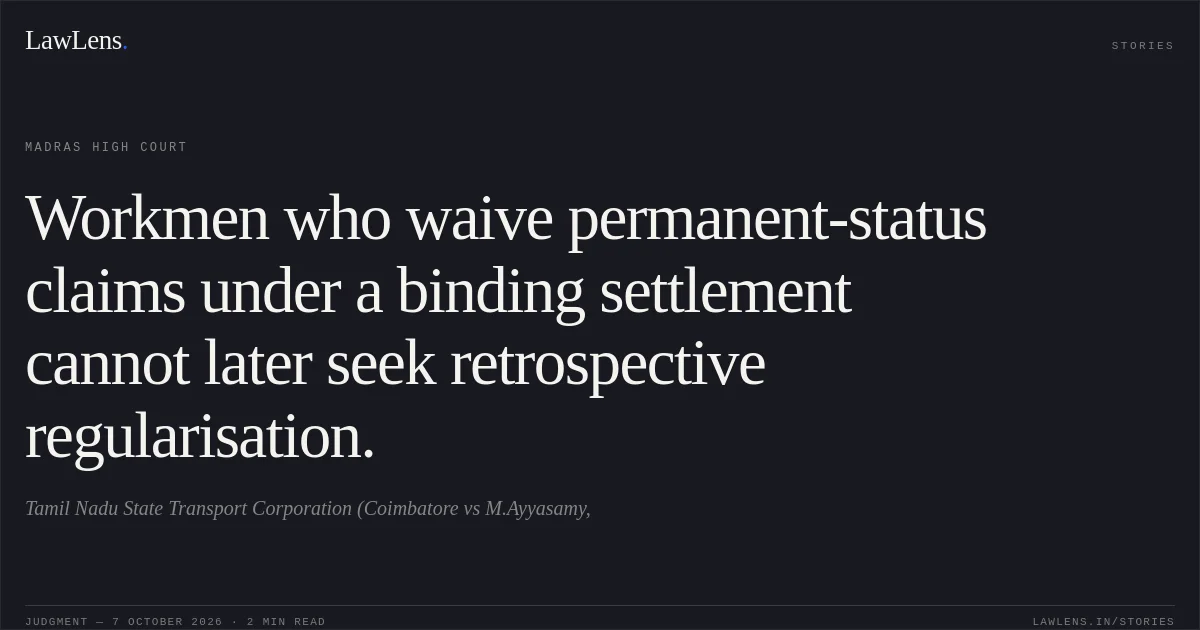
Under the Tamil Nadu Industrial Establishments (Conferment of Permanent Status to Workmen) Act, 1981, the competent authority may determine a workman’s entitlement to permanent status; however, a workman who accepts the benefits of a binding Section 12(3) settlement under the Industrial Disputes Act, 1947, and gives an undertaking relinquishing a claim founded on the permanent-status order cannot later claim retrospective regularisation on that basis.
Source reference: no citationThe Court also applied the principles of laches and acquiescence: as stated in Prabhakar v. Joint Director, Sericulture Department, (2015) 15 SCC 1, an unexplained delay may defeat relief, and a party who stands by while another acts inconsistently with the claimed right may be barred from later complaining.
Source reference: pp.7–8, para. 13It relied on the Division Bench ruling in Managing Director, Tamil Nadu State Transport Corporation Ltd. v. O. Veeraiyya, (2025) MHC 2050, concerning the binding effect of the settlement and the bar on claiming retrospective regularisation after accepting its benefits.
Source reference: pp.4, 7–9, paras. 7, 14Reasoning
The respondent had expressly undertaken not to claim the benefit of the permanent-status order, accepted regularisation under the 2005 settlement, and did not challenge either the settlement or the regularisation order. His later claim, brought after substantial delay, was therefore barred by his undertaking, acceptance of the settlement’s benefits, and acquiescence.
Source reference: pp.6–7, paras. 10–12The Court distinguished the authorities cited for the respondent because those cases involved challenges to permanent-status orders and no comparable undertaking; it also observed that delay and acquiescence had not been considered in those decisions.
Source reference: p.9, para. 15Holding
The Court held that the respondent could not claim retrospective regularisation on the basis of the permanent-status order after accepting the 12(3) settlement and undertaking not to rely on that order.
It set aside the Single Judge’s order dated 1 October 2024, allowed the writ appeal, made no order as to costs, and closed the connected miscellaneous petition.
Source reference: p.9, para. 16Acts & Sections Cited
3 provisions across 2 statutes referred to in this judgment. Linked provisions open on LawLens.
Tamil Nadu Industrial Establishments (Conferment of Permanent Status to Workmen) Act, 19811
Industrial Disputes Act, 19472
Original Court PDF
Tamil Nadu State Transport Corporation (CoimbatorevsM.Ayyasamy,
Click to open original judgment
Original judgment, available to read, download and summarize on LawLens.in