Facts
The Petitioner, a steel manufacturer, utilized a private jetty at Dharamatar for importing iron ore. Because large vessels could not access the jetty, cargo was transferred to small barges for transit through waters controlled by the Respondent No. 1, Mumbai Port Trust (MPT).
Source reference: para 2In 1995, a barge named M.V. Satyam, carrying the Petitioner's iron ore, sank in the Mumbai harbour.
Source reference: para 4The MPT issued a notice under Section 14(1) of the Indian Ports Act, 1908, directing the Petitioner and Respondent Nos. 2 and 3 (the charterer and the registered owner of the barge, respectively) to remove the wreck and deposit ₹70 lakhs as security.
Source reference: para 4When the Petitioner denied liability on the ground that it was not the "owner" of the vessel, the MPT suspended the Petitioner's barge transit permissions.
Source reference: para 5-6The Petitioner filed this Writ Petition, and per interim orders, deposited ₹70 lakhs to resume operations.
Source reference: para 8While the petition was pending, the MPT cleared the wreck through a third-party contractor and later withdrew the deposited amount plus interest (totaling ₹4,09,25,764) after a previous High Court order erroneously dismissed the petition as infructuous—an order subsequently set aside by the Supreme Court.
Source reference: para 9-12, 39Issues
1. Whether the Petitioner, as the cargo owner and principal employer of the charterer, qualifies as the "owner" of the vessel under Section 14 of the Indian Ports Act, 1908, for the purpose of fastening liability for wreck removal.
Source reference: para 38, 402. Whether the MPT’s notice can be sustained by invoking Sections 10 to 12 of the Indian Ports Act, 1908, or Section 402 of the Merchant Shipping Act, 1958, as alternative sources of power.
Source reference: para 62, 733. Whether the principles of Quantum Meruit or "Polluter Pays" are applicable to foist liability on the Petitioner in the absence of a specific statutory mandate or environmental damage evidence.
Source reference: para 78-79Law Applied
Section 14 of the Indian Ports Act, 1908, which mandates that the "owner" of a wrecked vessel is liable to raise, remove, or destroy it.
Source reference: para 42Principle of literal construction to the term "owner," distinguishing between a registered owner and a "disponent owner" under time charter parties.
Source reference: para 48-52The Union of India v. Gosalia Shipping (Pvt.) Ltd. to establish that in a time charter, ownership remains with the original owner.
Source reference: para 54Section 57 of the Indian Ports Act, which requires a stepwise mechanism and Magistrate intervention for disputed expenses.
Source reference: para 58-59Commissioner of Police, Bombay v. Gordhandas Bhanji and Mohinder Singh Gill v. Chief Election Commissioner, holding that an administrative order must be judged by the reasons stated therein and cannot be supplemented by fresh grounds.
Source reference: para 20-21Reasoning
The Court found that Respondent No. 3 was the undisputed registered owner of the barge, and the Petitioner had merely engaged Respondent No. 2 to provide barge services on a time-charter basis.
Source reference: para 3, 46The MPT’s own correspondence and affidavits previously identified Respondent No. 3 as the "owner" and the Petitioner as the "principal employer".
Source reference: para 47The Court rejected the MPT's "disponent owner" argument, clarifying that a time charterer does not exercise the complete commercial control necessary to be deemed an owner.
Source reference: para 53The MPT failed to follow the mandatory stepwise procedure under Section 14 and Section 57, bypassing the statutory right of the parties to have expense disputes determined by a Magistrate.
Source reference: para 60-61The Court dismissed the MPT's attempt to rely on Sections 10-12 of the Ports Act or the Merchant Shipping Act at the final hearing stage, noting these were not mentioned in the original notice and required distinct procedural compliance which was absent.
Source reference: para 68-70, 75The "Polluter Pays" principle was deemed inapplicable as there was no evidence of environmental damage or discharge of pollutants.
Source reference: para 79Holding
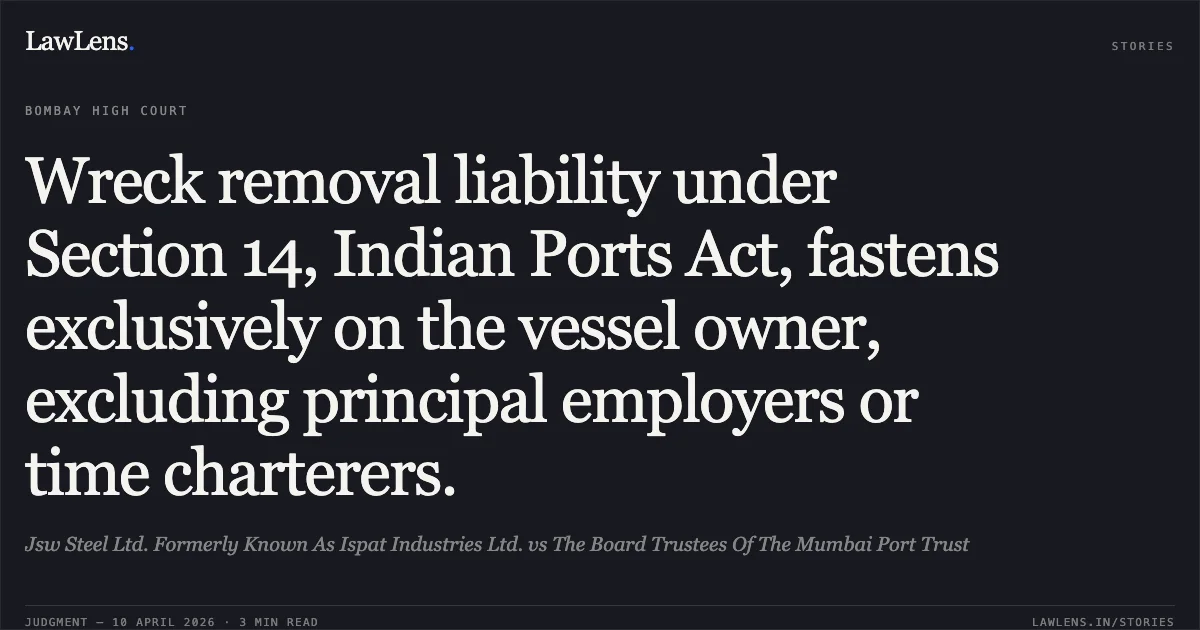
The Court allowed the Writ Petition, holding that the Petitioner was not the "owner" of the vessel and thus not liable under Section 14 of the Indian Ports Act.
The Court set aside the MPT's suspension order dated 14.10.1996 and directed the MPT to refund the withdrawn amount of ₹4,09,25,764 to the Petitioner within six weeks, clarifying that the MPT remains at liberty to proceed against the actual owner (Respondent No. 3) in accordance with the law.
Source reference: para 81, 83, 84Acts & Sections Cited
8 provisions across 2 statutes referred to in this judgment. Linked provisions open on LawLens.
Indian Ports Act, 19086
Merchant Shipping Act, 19582
Original Court PDF
Jsw Steel Ltd. Formerly Known As Ispat Industries Ltd.vsThe Board Trustees Of The Mumbai Port Trust
Click to open original judgment
Original judgment, available to read, download and summarize on LawLens.in