Facts
The Petitioner and Respondent No. 2 entered into a partnership deed in 2013
Source reference: p.2Following disputes regarding alleged forgery and illegal bank operations, the Petitioner lodged an FIR in 2017
Source reference: p.3Respondent No. 2 invoked arbitration via notice on September 4, 2017
Source reference: p.3On May 31, 2023—nearly six years later—Respondent No. 2 filed an application under Section 11 of the Arbitration and Conciliation Act, 1996 ("the Act") for the appointment of an arbitrator
Source reference: p.4The High Court appointed Respondent No. 3 as the sole arbitrator on August 5, 2025
Source reference: p.4The Petitioner filed an application under Section 16 of the Act challenging the Tribunal's jurisdiction, arguing the Section 11 application was time-barred under Article 137 of the Limitation Act
Source reference: p.5The Arbitral Tribunal rejected the application on October 9, 2025, holding it had no jurisdiction to review the High Court's referral on the aspect of limitation
Source reference: p.4-5The Petitioner sought a writ of certiorari under Article 226 of the Constitution to quash this order
Source reference: p.1-2Issues
1. Whether the High Court under Article 226 can interfere in an interlocutory order passed by an arbitrator under Section 16 of the Act?
Source reference: para. 4 / p.102. Whether the High Court, before appointing an arbitrator under Section 11(6), is required to adjudicate on the jurisdictional issue of limitation?
Source reference: para. 4 / p.103. Whether the Arbitral Tribunal erred in law by refusing to adjudicate the Section 16 objection regarding the limitation of the Section 11 application?
Source reference: para. 4 / p.10-11Law Applied
The Court applied Section 5 of the Act regarding minimal judicial interference
Source reference: p.14The doctrine of "competence-competence" under Section 16, which empowers a tribunal to rule on its own jurisdiction
Source reference: p.18-19The Court relied on Bhaven Construction v. Sardar Sarovar Narmada Nigam Ltd., which permits Writ intervention in "exceptional rarity" where a party is left remediless or there is "bad faith"
Source reference: p.15-16The Court further applied the principles from In Re: Interplay Between Arbitration Agreements and SBI General Insurance Co. Ltd. v. Krish Spg., establishing that post-2015 Amendment, the Section 11 Court’s scope is confined strictly to the "existence" of an arbitration agreement, leaving all other preliminary issues, including limitation, to the Arbitral Tribunal.
Source reference: p.33 and p.23-24Reasoning
The Court reasoned that the 2015 insertion of Section 11(6-A) curtailed the High Court's power at the referral stage to a mere "examination" of the agreement's existence, rather than a "ruling" on merits or mixed questions of law and fact like limitation
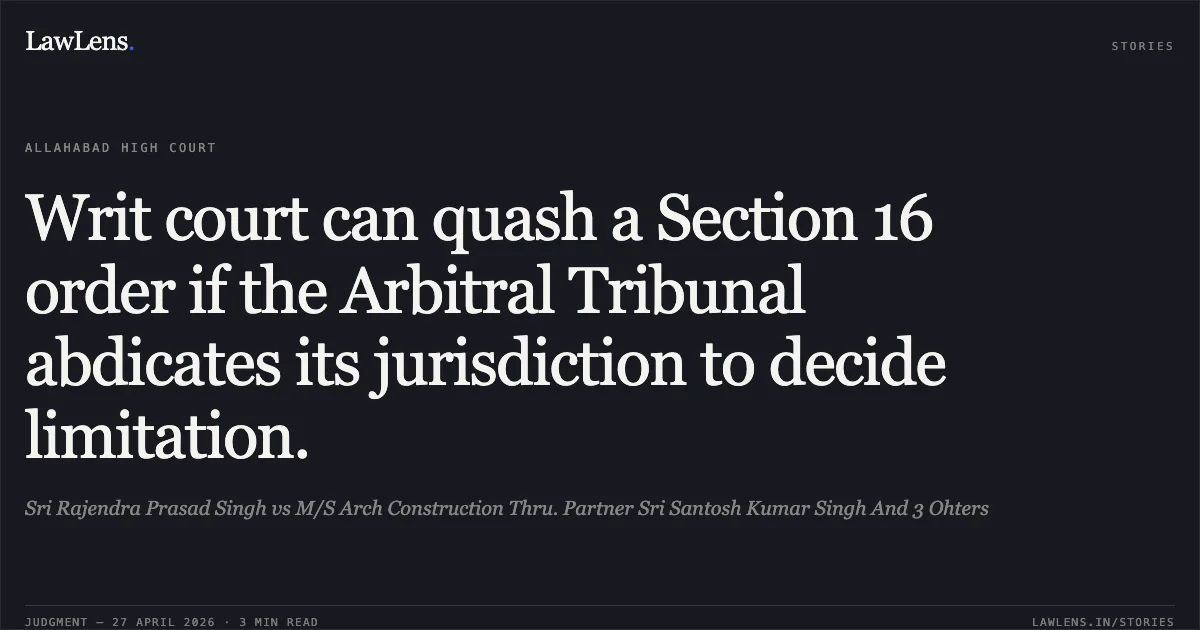
Source reference: para. 23 / p.25Consequently, the Arbitral Tribunal’s reasoning—that it could not re-examine the High Court's referral—was a "patent abdication" of its statutory duty under Section 16
Source reference: para. 24 / p.25The Court found the Tribunal's order "inherently contradictory" because the Tribunal acknowledged that limitation is a jurisdictional issue but refused to decide it, claiming the High Court had already settled it
Source reference: para. 31 / p.35-36Since Section 16(5) forces a party to proceed to a final award before challenging a jurisdictional rejection, the Petitioner was left effectively remediless against a patently illegal refusal to exercise jurisdiction
Source reference: para. 18 / p.19This satisfied the high threshold for Writ interference under Article 226
Source reference: para. 24 / p.26Holding
The Court answered the first and third issues in the affirmative and the second issue in the negative. It held that the Arbitral Tribunal failed to exercise its inherent jurisdiction to rule on the limitation of the appointment application
The Court quashed the order dated October 9, 2025. It directed the Arbitral Tribunal to adjudicate the Petitioner's Section 16 application relating to the limitation of the Section 11(6) filing as a preliminary objection on its merits and to do so expeditiously.
Source reference: para. 35, 36-37 / p.37-38The Writ Petition was allowed
Source reference: para. 39 / p.38Acts & Sections Cited
22 provisions across 6 statutes referred to in this judgment. Each provision opens on LawLens.
Arbitration and Conciliation Act, 1996
Indian Penal Code, 18606
Bharatiya Nyaya Sanhita, 20232
Limitation Act, 19633
Code of Civil Procedure, 19081
Indian Contract Act, 18721
Original Court PDF
Sri Rajendra Prasad SinghvsM/S Arch Construction Thru. Partner Sri Santosh Kumar Singh And 3 Ohters
Click to open original judgment
Original judgment, available to read, download and summarize on LawLens.in


