01Facts
The appellant, Krishna Bhagya Jala Nigam Ltd. (KBJNL), is the beneficiary for whose purpose the private respondents' lands were acquired.
¶ 3 · pp. 2–3KBJNL was not impleaded before the Reference Court, which passed an award.
¶ 3 · pp. 2–3KBJNL challenged the award in W.P. No. 109891/2025.
¶ 3 · pp. 2–3On 16.06.2026, the learned Single Judge quashed the award, remanded the matter to the Reference Court, and imposed conditions (Nos. iv–ix) on the Reference Court's procedure, including directions on the beneficiary's cross-examination and evidence, a comparison with similarly placed lands, time limits, and a requirement that KBJNL deposit 25% of the awarded compensation.
¶ 3 · pp. 2–3 · extracted order · pp. 4–7KBJNL appealed only against conditions 4–9.
p. 2In a connected batch (WA No. 100503/2026 and related appeals), a co-ordinate Bench upheld the quashing and remand but set aside conditions (iv)–(ix), holding that the Reference Court must have a "free hand" to decide the reference in accordance with law.
¶ 4 · pp. 4–9, quoting WA No. 100475/2026 dated 06.08.2026 · ¶ 7–8 · pp. 7–8The present appellant and the AAG sought an identical disposal.
¶ 5–6 · p. 1002Issues
i.1. Whether conditions Nos. 4–9 imposed by the learned Single Judge, which regulate the manner of adjudication before the Reference Court and require a 25% deposit, are sustainable when the writ petition was founded solely on the legal infirmity of the award passed in the beneficiary's absence.
¶ 4 · pp. 4–9 · ¶ 5–6 · p. 10ii.2. Whether notice to the unserved private respondents is required before the appeal is finally disposed of at the preliminary hearing.
¶ 2 · p. 2 · ¶ 4 · p. 403Law Applied
The Court's jurisdiction to hear the appeal rests on Section 4 of the Karnataka High Court Act, 1961.
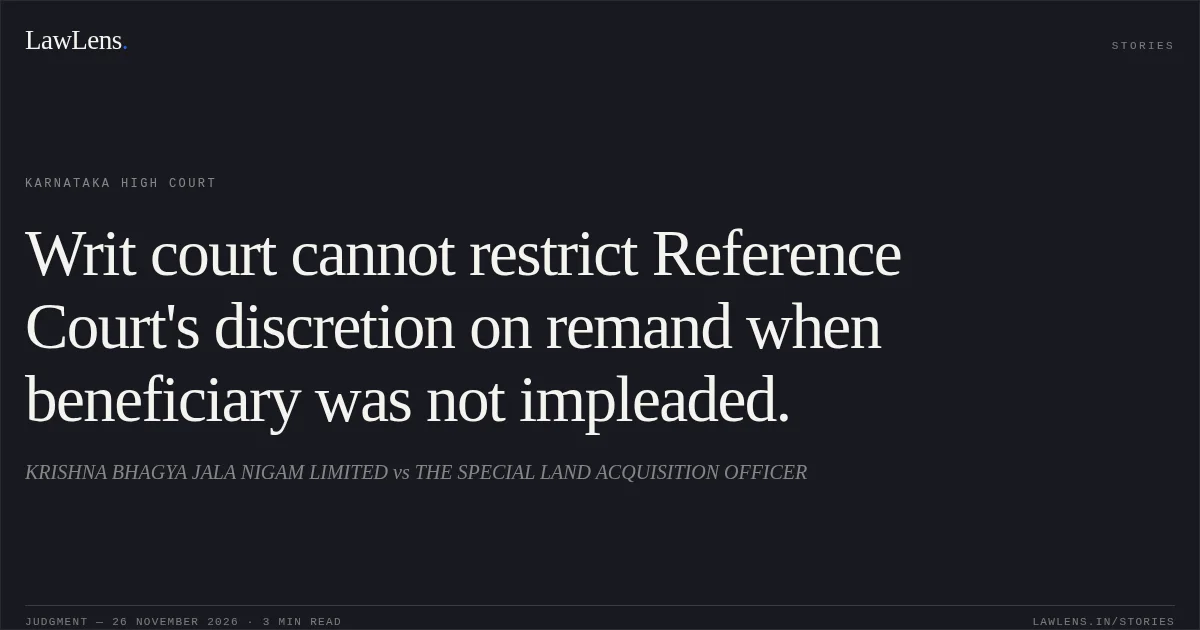
p. 2Where a writ challenge rests solely on the legal invalidity of an award passed in the beneficiary's absence, the Single Judge cannot impose conditions that restrict the Reference Court's discretion over how the reference is decided; the Reference Court must be left a "free hand" to decide in accordance with law.
¶ 4 · pp. 4–9, quoting paras. 7–8 · pp. 7–8Matters may be finally heard without notice to unserved respondents where the order preserves their interests, for example by allowing them to seek remedies on remand.
¶ 2 · p. 2 · ¶ 4 · p. 4The Reference Court is to issue notice to unserved parties and proceed with the matter in accordance with law.
¶ 7 · p. 10Provisions in the judgment · 1 · Linked ones open on LawLens
KARNATAKA HIGH COURT ACT, 1961 Section 4
04Reasoning
The appeal raised the same question already decided in the co-ordinate Bench's ruling in WA No. 100475/2026. That ruling held that because the writ petition challenged only the legal sustainability of the award passed without the beneficiary, the Single Judge was correct to quash the award and remit the matter.
¶ 4 · pp. 4–9, quoting paras. 7–8 · pp. 7–8The conditions on evidence, cross-examination, comparative payment, time limits, and deposit operated to fetter the Reference Court's discretion beyond what the legal ground required, so they were set aside.
¶ 4 · pp. 4–9, quoting paras. 7–8 · pp. 7–8Applying that reasoning, KBJNL's appeal against conditions 4–9 was allowed on identical terms.
¶ 6 · p. 10On the notice question, the Court accepted the parties' submission that notice to the private respondents need not be served before disposal, because the remand order protects their interests.
¶ 2 · p. 2 · ¶ 4 · p. 4Notice was instead to be issued by the Reference Court after the matter is listed.
¶ 7 · p. 1105Holding
Conditions 4–9 of the Single Judge's order dated 16.06.2026 are unsustainable because they restrict the Reference Court's discretion, and the Court followed the co-ordinate Bench's ruling in WA No. 100475/2026.
¶ 6–7 · pp. 10–11The appeal is disposed of on those terms.
¶ 6–7 · pp. 10–11Parties are to appear before the Reference Court on 16.12.2026, and the Reference Court is directed to issue notice to unserved parties and proceed in accordance with law.
¶ 7 · p. 11The pending I.As. are disposed of.
¶ 8 · p. 11The Court did not expressly restate the Single Judge's remand direction; it was left intact by implication, since only conditions 4–9 were challenged.
p. 2 · ¶ 4 · p. 8Original Court PDF
KRISHNA BHAGYA JALA NIGAM LIMITEDvsTHE SPECIAL LAND ACQUISITION OFFICER
Click to open original judgment
Original judgment, available to read, download and summarize on LawLens.in