Facts
The respondent was appointed by the petitioner on 01.10.2014.
Source reference: paras. 1, 4–7; pp. 1–5He allegedly stopped reporting for duty in June 2015, although he worked until 30.06.2015.
Source reference: paras. 1, 4–7; pp. 1–5The petitioner subsequently issued him a fresh appointment letter dated 01.08.2015 for the post of Chapka Worker.
Source reference: paras. 1, 4–7; pp. 1–5Despite this, the respondent raised Reference No. 63 of 2016 on 07.10.2015, alleging oral termination of service.
Source reference: paras. 1, 4–7; pp. 1–5The respondent attained the age of superannuation, namely 58 years, on 17.12.2015.
Source reference: paras. 1, 4–7; pp. 1–5By award dated 06.05.2023, the Labour Court, Surat awarded him lump-sum compensation of ₹1,25,000.
Source reference: paras. 1, 4–7; pp. 1–5The employer challenged that award under Articles 226 and 227 of the Constitution of India.
Source reference: paras. 1, 4–7; pp. 1–5Issues
Whether the Labour Court’s award of ₹1,25,000 as compensation for alleged illegal oral termination suffered from patent illegality, perversity, or an error warranting interference under Articles 226 and 227 of the Constitution?
Source reference: paras. 5–7; pp. 2–5Whether the respondent’s alleged abandonment of employment, the fresh appointment offer dated 01.08.2015, and his subsequent superannuation justified setting aside the compensation awarded by the Labour Court?
Source reference: paras. 4–7; pp. 1–5Law Applied
The Court applied the limited scope of judicial review under Articles 226 and 227 of the Constitution, under which factual findings of a Labour Court are not ordinarily interfered with unless they are shown to be perverse, arbitrary, or patently illegal.
Source reference: paras. 5–7; pp. 2–5The Court also considered the industrial-law principles concerning alleged oral termination, abandonment of service, reinstatement, and monetary compensation in lieu of reinstatement.
Source reference: paras. 5–7; pp. 2–5However, it did not finally adjudicate the merits of those competing claims, expressly deciding the petition on account of the small amount involved, the respondent’s superannuation, and the absence of patent illegality or perversity in the award.
Source reference: paras. 5–7; pp. 2–5Reasoning
The employer contended that the respondent had voluntarily abandoned service, had been offered fresh employment, and had subsequently reached the age of superannuation; therefore, no compensation was payable.
Source reference: paras. 5–7; pp. 2–5The respondent disputed abandonment and maintained that his service had been orally terminated without compliance with the applicable safeguards under industrial law.
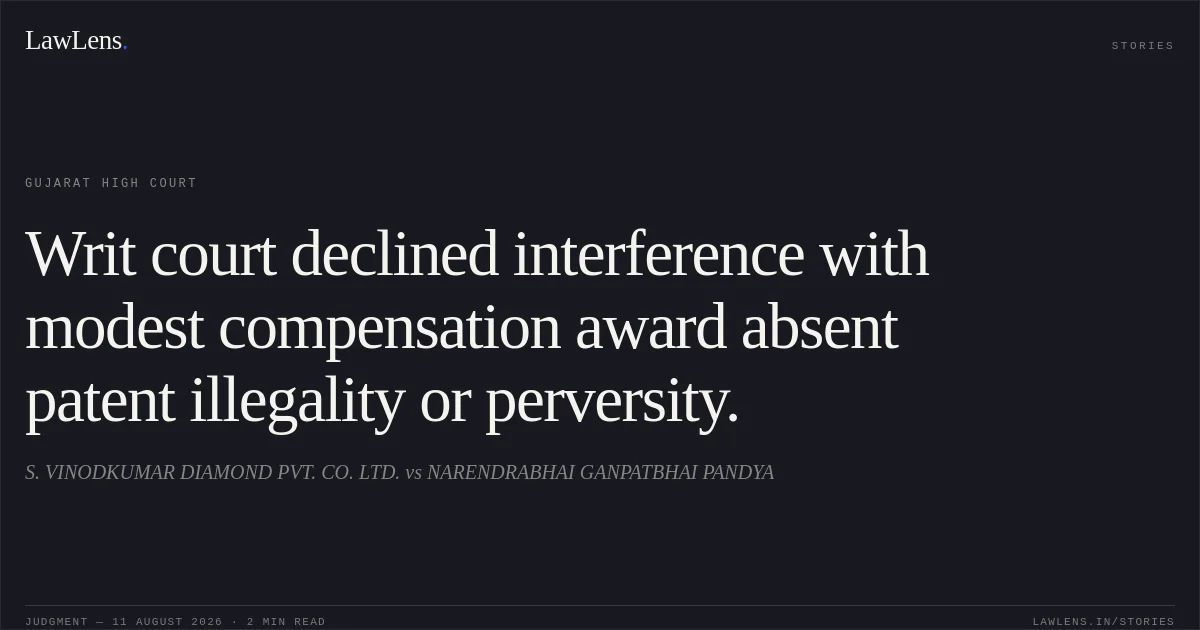
Source reference: paras. 5–7; pp. 2–5The High Court noted that the Labour Court had awarded only ₹1,25,000 as lump-sum compensation and found no patent illegality or perversity warranting exercise of writ jurisdiction.
Source reference: paras. 5–7; pp. 2–5Given the limited monetary value of the dispute and the respondent’s attainment of superannuation, the Court declined to re-examine the merits of the Labour Court’s factual conclusions.
Source reference: paras. 5–7; pp. 2–5Holding
The petition was dismissed, the Rule was discharged, and no order as to costs was made.
The petitioner was directed to deposit the awarded compensation of ₹1,25,000 within six weeks from receipt of a copy of the order.
Source reference: paras. 7–9; p. 5The Court clarified that its decision was based on the smallness of the amount and therefore would not be treated as a precedent.
Source reference: paras. 7–9; p. 5Original Court PDF
S. VINODKUMAR DIAMOND PVT. CO. LTD.vsNARENDRABHAI GANPATBHAI PANDYA
Click to open original judgment
Original judgment, available to read, download and summarize on LawLens.in