01Facts
The petitioner challenged that portion of the order dated 6.4.2017 of the first respondent (State, Urban Development Department), passed in NA AA E 63 GU AA PRAA 2012, which allowed site owners who had constructed houses on illegally formed sites to continue, while shifting public/semi-public spaces or parks elsewhere in the city.
¶ 1The order was passed pursuant to directions issued in W.P. No. 19414/2015.
¶ 3The petitioner relied on a report by the fourth respondent (Deputy Commissioner, RUDA) that found the layout variations violated the Karnataka Town and Country Planning Act, 1961 and the Karnataka Urban Development Authorities Act, 1987, and that CA sites, parks and open spaces had been misutilised and converted into house sites.
¶ 3The fifth respondent (Satyanath Housing Co-operative Society) stated that the layout was approved on 10.06.1983, with modifications allowed on 18.06.1992 and 09.12.1999; members had been allotted sites, sale deeds executed, and many had built and resided in houses since 1983.
¶ 4The first respondent's statement of objections recorded that the vacant diverted sites were liable to eviction, but that, given more than 20 years' lapse, third-party interests and long-standing constructions, it had decided not to cancel the resolution and to reserve an equivalent extent of land in nearby layouts.
¶ 502Issues
i.1. Whether the High Court should quash the portion of the 6.4.2017 order permitting continued occupation of houses constructed on diverted CA sites, parks and open spaces, and direct shifting of such public spaces elsewhere, given the alleged violation of the 1961 and 1987 Acts.
¶ 1 · ¶ 3 · ¶ 6ii.2. Whether, in the peculiar facts of the case (lapse of time, third-party interests, and existing constructions), further orders can be passed in the writ petition.
¶ 603Law Applied
The petitioner invoked Articles 226 and 227 of the Constitution.
¶ 1The petitioner relied on the Karnataka Town and Country Planning Act, 1961 and the Karnataka Urban Development Authorities Act, 1987 as the statutory framework violated by the unauthorised diversion of CA sites and open spaces.
¶ 3The court did not record any finding on the statutory violation, nor did it cite any statute or precedent in its reasoning. Its decision rests on the discretionary principle that, in peculiar facts where diversions occurred long ago (1996-97 and 1998-99) and third-party rights and constructed residences have intervened, the court may decline further directions in writ jurisdiction.
¶ 604Reasoning
The court accepted the State's position that the diversions were made long before the writ petition, resulting in significant time lapse.
¶ 6It then weighed the practical consequences of the State's decision: that third-party interests had been created, houses had been constructed and occupied for decades, and the State had opted to reserve equivalent land elsewhere rather than cancel the resolution.
¶ 5 · ¶ 6Having considered the submissions and objections on the peculiar facts, the court held that further orders could not be passed as prayed.
¶ 6The judgment does not examine whether the 6.4.2017 order was legally sustainable under the 1961 or 1987 Acts, nor does it address the petitioner's contention that the findings of the R-4 report warranted eviction. The reasoning therefore turns on delay and equities rather than on the merits of the statutory violation.
¶ 3The record reflects a discrepancy: the approvals and modifications are dated 1983, 1992 and 1999, while the court refers to diversions in 1996-97 and 1998-99. The judgment does not reconcile these dates.
¶ 4 · ¶ 605Holding
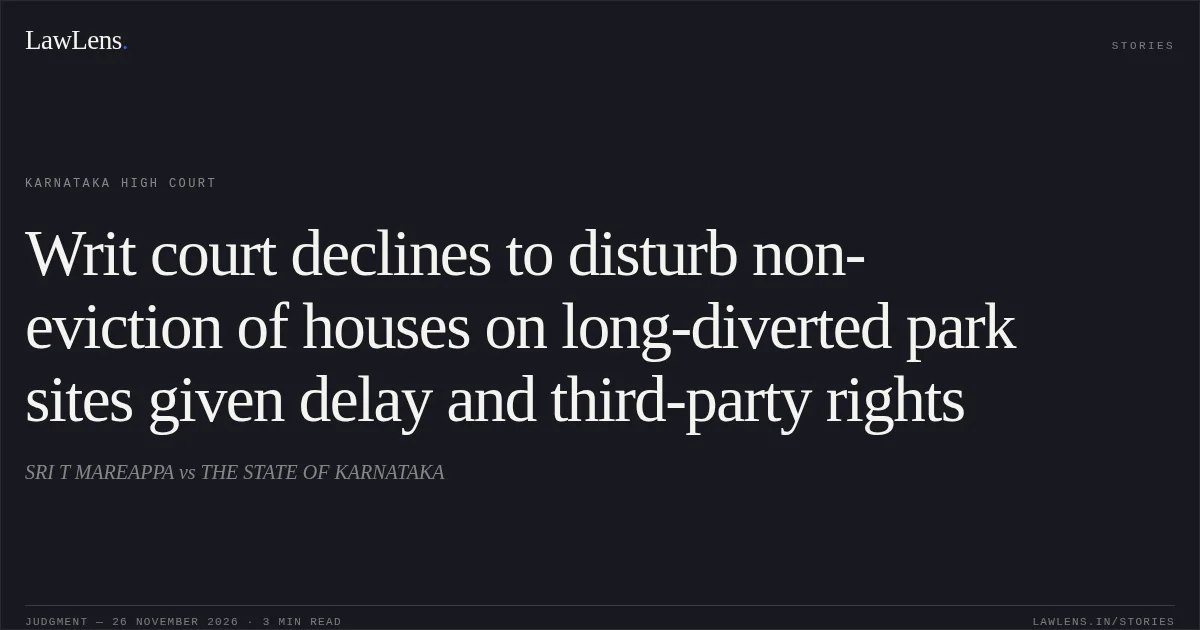
The court answered both issues against the petitioner: in the peculiar facts, given the long lapse of time since the diversions and the third-party interests and constructions involved, no further orders could be passed as prayed.
¶ 6The writ petition was closed, and no quashing or shifting directions were issued against the 6.4.2017 order.
¶ 6The judgment records no finding on the alleged violation of the 1961 and 1987 Acts, so it should not be cited as an affirmative ruling that the diversions were lawful.
¶ 3 · ¶ 6Original Court PDF
SRI T MAREAPPAvsTHE STATE OF KARNATAKA
Click to open original judgment
Original judgment, available to read, download and summarize on LawLens.in