01Facts
The petitioners sought a writ of mandamus under Article 226 directing the District Collector (R1) to consider their representation dated 26.02.2026 within a fixed time and to conduct a joint survey of a 20-feet pathway in Survey No. 50/2 (Re-Survey No. 31/1A9) in Periya Kanganankuppam and Chinna Kanganankuppam villages.
p. 1The learned Government Advocate, on written instructions from the Tahsildar, Cuddalore, submitted that no encroachments were identified in Survey No. 31/1A9.
¶ 1 · p. 2The petitioners' counsel maintained that encroachment exists on the pathway.
¶ 2 · p. 2Respondents 7 and 8 did not appear.
p. 102Issues
i.1. Whether a disputed question of fact, namely the existence of encroachment on the pathway, can be adjudicated in writ proceedings.
¶ 3 · p. 3ii.2. Whether the petitioners' remedy lies in an appeal before the District Collector against the Tahsildar's instructions.
¶ 3 · p. 303Law Applied
The order cites no statute, rule, or precedent.
Writ jurisdiction under Article 226 is not an appropriate forum for adjudicating disputed questions of fact.
¶ 3 · p. 3An alternative statutory remedy, namely an appeal to the District Collector, is the proper forum for challenging the correctness of the Tahsildar's instructions.
¶ 3 · p. 3The petition's invocation of Article 226 for mandamus is the framework within which these principles were applied.
p. 104Reasoning
The Government's position that no encroachment exists, based on the Tahsildar's instructions, directly conflicted with the petitioners' assertion of encroachment.
¶ 1–2 · p. 2The Court treated this as a contested factual dispute that could not be resolved on affidavit-based writ proceedings without a fact-finding inquiry.
¶ 3 · p. 3Rather than directing a joint survey or a time-bound decision on the representation, the Court held that the petitioners could challenge the Tahsildar's instruction through an appeal before the District Collector, the competent authority to test its correctness.
¶ 3 · p. 3The order does not examine the merits of the representation or the survey prayer, and it does not record reasons for not directing consideration of the representation within a time frame.
¶ 4 · p. 305Holding
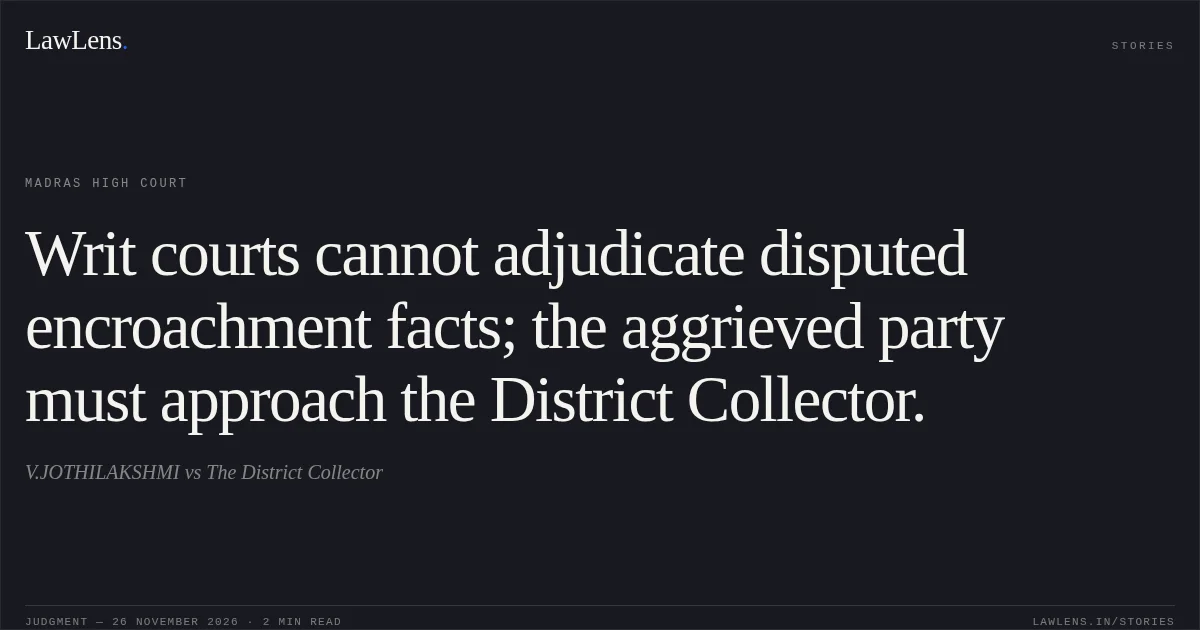
The disputed question of encroachment cannot be adjudicated in writ proceedings, and the correctness of the Tahsildar's instructions must be challenged by appeal before the District Collector.
¶ 3 · p. 3The writ petition was disposed of with liberty to the petitioners to approach the District Collector for resolution of the dispute, without costs, and connected miscellaneous petitions, if any, were closed. No direction for a joint survey or a time-bound disposal of the representation was issued.
¶ 4 · p. 3Original Court PDF
V.JOTHILAKSHMIvsThe District Collector
Click to open original judgment
Original judgment, available to read, download and summarize on LawLens.in