Facts
The appellant claimed that land measuring 0.99 decimal in Khata No. 259, Khesra No. 1405 was ancestral raiyati land, relying on the Khatiyan, Jamabandi and rent receipts. He alleged that the respondents began constructing a Panchayat Bhawan on the land without notice, acquisition or compensation.
Source reference: para. 2–5The writ petition seeking to restrain construction was dismissed, with the Single Judge declining to determine the disputed raiyati claim in writ jurisdiction and leaving the appellant to pursue an alternative remedy. The appellant challenged that order in this intra-court appeal
Source reference: para. 2–5Issues
1. Whether the Single Judge’s refusal to adjudicate the appellant’s claim of raiyati title and grant an injunction in writ jurisdiction disclosed an illegality, perversity or infirmity warranting appellate interference
Source reference: para. 72. Whether the appellant’s claim, founded on revenue records and disputed by the State, could appropriately be determined in writ proceedings or should be pursued before a competent civil court
Source reference: paras. 8, 12Law Applied
Revenue entries, including entries in a record-of-rights or Jamabandi, are primarily fiscal and do not, by themselves, confer or establish title; a claimant must establish title independently of such entries (Union of India v. Vasavi Cooperative Housing Society Ltd., (2014) 2 SCC 269, quoted at para. 9; Suraj Bhan v. Financial Commissioner, (2007) 6 SCC 186, quoted at para. 10).
Source reference: paras. 9–10Serious disputes of fact and title are ordinarily not suited to determination under Article 226 and are appropriately examined by a civil court in a properly constituted suit (Vadiyala Prabhakar Rao v. Government of Andhra Pradesh, Civil Appeal No. 7094 of 2026, order dated 6 May 2026, quoted at para. 11).
Source reference: para. 11The judgment applied these principles to the appellant’s competing title claim and the State’s assertion that the land was Government land
Source reference: paras. 8–12Reasoning
The Court found that the appellant’s claim depended on the evidentiary effect of the Khatiyan, Jamabandi and rent receipts, while the State disputed his title and asserted that the land belonged to the Government. Resolving the claim would require examination of the source of title, competing revenue records, possession and other factual matters.
Source reference: paras. 8–13Because revenue entries alone could not establish title and those disputed matters were unsuitable for determination in writ proceedings, the Single Judge had properly declined to decide the claim or grant the requested relief. The Court found no appellate ground to interfere
Source reference: paras. 8–13Holding
The Court answered the issue against the appellant and dismissed the appeal, finding no illegality, perversity or infirmity in the Single Judge’s order.
It left the appellant at liberty to bring a civil suit before a competent court and clarified that its observations would not prejudice the parties’ rights in that proceeding
Source reference: paras. 13–16Original Court PDF
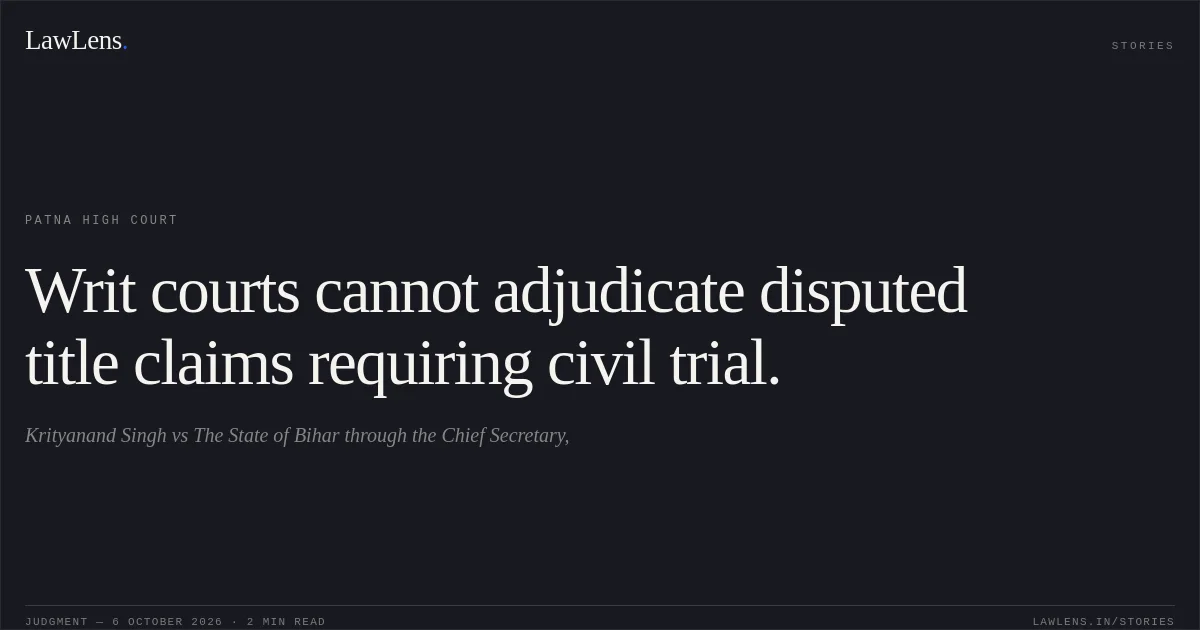
Krityanand SinghvsThe State of Bihar through the Chief Secretary,
Click to open original judgment
Original judgment, available to read, download and summarize on LawLens.in