Facts
The petitioners challenged a 2026 settlement deed by which the third respondent reconveyed to the second respondent property that the second respondent had settled in the third respondent’s favour in 2013.
Source reference: p. 2The petitioners alleged that the deed wrongly proceeded on the basis of a partition among their father and his brothers, when no such partition had occurred.
Source reference: pp. 2–3The State drew attention to differences in the property descriptions in the 2013 and 2026 documents; the Court also compared those descriptions with the village UDR patta and “A” Register.
Source reference: pp. 3–4, 8The petitioners sought a declaration under Article 226 that the 2026 deed was null and void.
Source reference: p. 2Issues
1. Whether the High Court could declare the impugned settlement deed null and void under Article 226 where the challenge involved disputed questions concerning the property and the parties’ respective rights.
Source reference: pp. 2, 5–72. Whether those disputes required adjudication by a civil court after appreciation of oral and documentary evidence.
Source reference: p. 8Law Applied
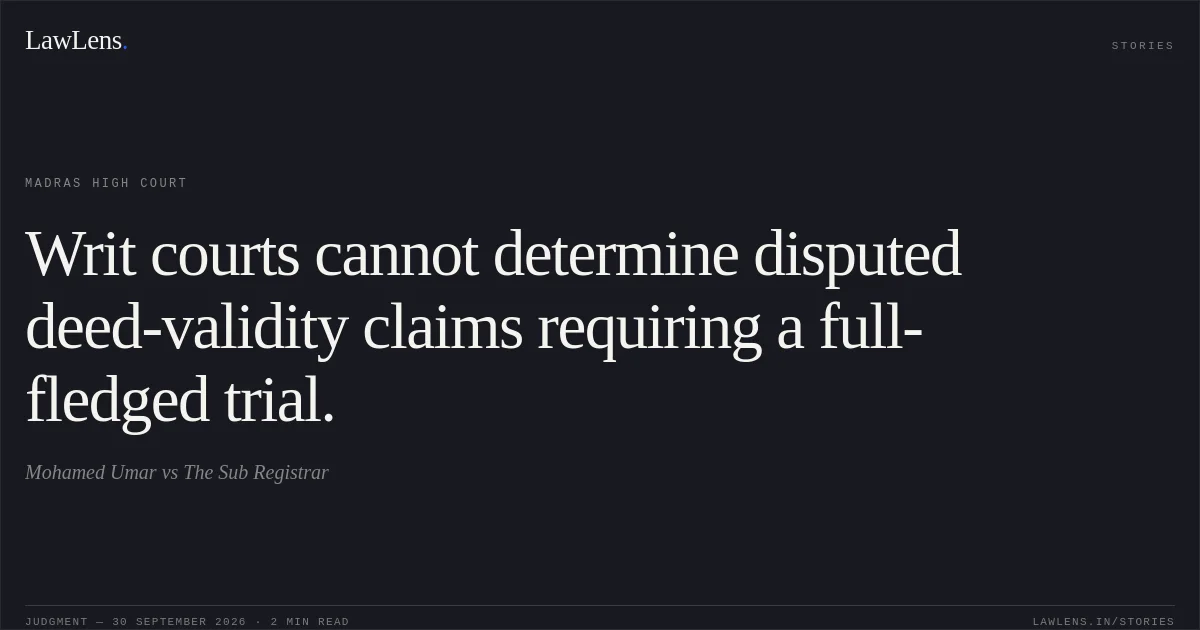
Article 226 empowers the High Court to review whether a registering authority performed its statutory duties lawfully; however, a challenge to the execution of a document or the executant’s title, seeking a declaration that the document is null and void, falls within the civil court’s domain.
Source reference: pp. 5–7Asset Reconstruction Company (India) Ltd. v. S.P. Velayutham, (2022) 8 SCC 210, distinguishes challenges to execution and title from challenges to the registering authority’s performance of its statutory role.
Source reference: pp. 5–7Where deciding the dispute requires resolving contested facts through evidence and a full-fledged trial, that exercise is not appropriate in writ jurisdiction.
Source reference: p. 8Reasoning
The Court considered the petitioners’ reliance on Asset Reconstruction Company and examined the property descriptions in the two deeds alongside the revenue records.
Source reference: pp. 5–8It found that the dispute raised several contested factual questions, including those concerning the property description and the alleged partition. Resolving them would require oral and documentary evidence and a full trial, rather than review of a discrete failure by the registering authority to perform a statutory duty.
Source reference: p. 8The Court therefore declined to determine the deed’s validity in writ proceedings.
Source reference: p. 8Holding
The Court dismissed the writ petition, without deciding the merits of the petitioners’ challenge to the settlement deed, and granted them liberty to pursue their remedy before the competent civil court in accordance with law.
No costs were awarded, and the connected miscellaneous petition was closed.
Source reference: p. 8Acts & Sections Cited
5 provisions across 2 statutes referred to in this judgment. Each provision opens on LawLens.
Code of Criminal Procedure, 19731
Registration Act, 19084
Original Court PDF
Mohamed UmarvsThe Sub Registrar
Click to open original judgment
Original judgment, available to read, download and summarize on LawLens.in