01Facts
The appellant, a partnership firm in water sports, was awarded a five-year work order on 07.09.2020 following a tender.
¶ 4.1The work order was issued on 26.09.2020 and would expire on 25.09.2025.
¶ 10Citing COVID-19 losses, the appellant sought extension, and on 12.12.2023 the Member Secretary (respondent No. 3), not the tender-inviting authority, granted an extension of five years.
¶ 4.2, 10A fresh tender notification was issued on 17.03.2026. The appellant participated, was unsuccessful, and challenged the process in W.P. No. 103209 of 2026.
¶ 4.3The learned Single Judge dismissed that petition on 21.04.2026, holding that the Member Secretary lacked authority to extend the contract, that the petitioner could not seek a writ after participating in the fresh tender, and that contractual disputes are not amenable to writ mandamus under Article 226.
¶ 10Liberty was reserved to approach the appropriate forum.
¶ 10The appellant in Dive Netrani challenged the tender notification dated 17.03.2026 in W.P. No. 102776 of 2026 on the ground that the 15-day bid submission period (last date 01.04.2026) violated Rule 17 of the Karnataka Transparency in Public Procurement Rules, 2000, and that certain conditions were impossible to comply with.
¶ 4.4, 6, 12The learned Single Judge dismissed the petition on 02.04.2026.
¶ 1202Issues
i.1. Whether the appellant in WA No. 100233 is entitled to continuation of the contract on the basis of the 12.12.2023 extension, and whether the Single Judge erred in declining relief given the subsequent tender and the appellant's participation in it.
¶ 11ii.2. Whether the 15-day bid submission period in the tender notification dated 17.03.2026 violates Rule 17 of the KTPP Rules, 2000, and renders the tender process vitiated.
¶ 6, 12iii.3. Whether the scope of judicial review in tender matters permits interference with the tender conditions in the present case.
¶ 13–1803Law Applied
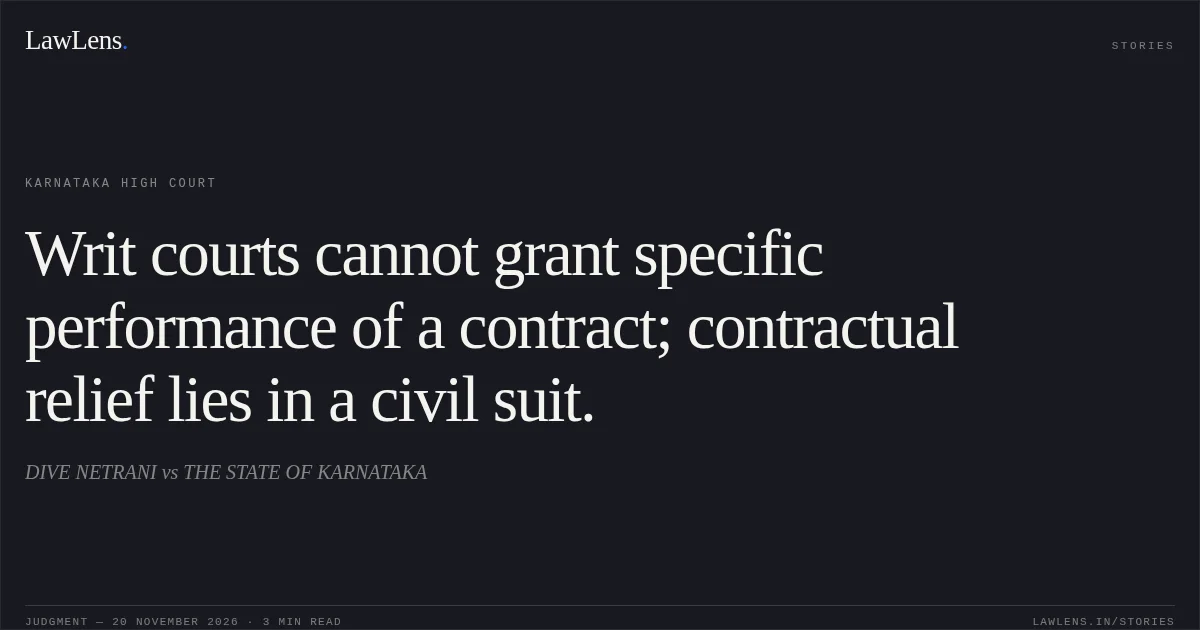
Article 226 of the Constitution, as limited in contractual and tender matters by Municipal Council, Gondia v. Divi Works and Suppliers, which holds that a writ court should not virtually grant specific performance of a work order and that the aggrieved party should instead file a civil suit for damages.
¶ 10The settled tender-review principles of Tata Cellular, Sterling Computers, Jagdish Mandal, Afcons Infrastructure, Agmatel India, Kimberley Club, and Vidarbha Irrigation, as consolidated in Micky Traders v. L.R.Y. Labour Contractor, 2026 SCC OnLine SC 1936: courts review the decision-making process for illegality, irrationality, mala fides, or procedural impropriety, not the merits.
¶ 13–19The tendering authority is the best judge of its requirements; its reading of the tender is ordinarily final if the words can bear it and it is not perverse or arbitrary, though a reading dehors the NIT or patently arbitrary may be set aside.
¶ 13–19Section 16 of the Karnataka Transparency in Public Procurement Act, 1999, which provides the statutory appellate remedy.
¶ 10Rule 17 of the KTPP Rules, 2000, treated as prescribing the 15-day bid period.
¶ 12Provisions in the judgment · 1 · Linked ones open on LawLens
KARNATAKA TRANSPARENCY IN PUBLIC PROCUREMENTS ACT, 1999 Section 16
04Reasoning
On WA No. 100233, the Court accepted the Single Judge's approach. It was admitted that a subsequent tender was issued for the same activity, that the appellant participated and lost, and that the Single Judge had considered the appellant's extension argument.
¶ 11Given the authority-based objection to the 12.12.2023 extension, and the appellant's conduct in participating in the fresh tender, the Court declined to interfere.
¶ 11On WA No. 100205, the Court held that the 15-day period was the period prescribed under Rule 17 and had been complied with, so the timeline challenge had no statutory foundation.
¶ 12The objection to onerous bid conditions was also rejected, since courts do not adjudicate the fairness of tender conditions absent arbitrariness, illegality, or statutory violation.
¶ 12Applying Micky Traders and the authorities it summarises, the Court found no basis to disturb the tendering authority's reading of its own notification.
¶ 13, 18–1905Holding
The Court held that no interference was warranted with the Single Judge's orders dated 21.04.2026 and 02.04.2026.
¶ 11, 12, 14Both writ appeals, WA No. 100233 of 2026 and WA No. 100205 of 2026, are rejected.
¶ 14The Court's holding leaves the appellants to pursue any remedy in the appropriate forum, consistent with the liberty reserved by the Single Judge and the Section 16 KTPP Act appellate route. No separate relief or directions were granted.
¶ 10Original Court PDF
DIVE NETRANIvsTHE STATE OF KARNATAKA
Click to open original judgment
Original judgment, available to read, download and summarize on LawLens.in