Facts
The petitioner was working as an Anganwadi Worker at Anganwadi Centre, Sarasdoli, District Mandla. Her services were terminated by the Project Officer on 2 September 2016 for allegedly facilitating benefits under the Ladli Laxmi Yojana to ineligible beneficiaries, remaining absent without prior intimation, and disobeying directions of superior authorities.
Source reference: para. 2Before termination, she was served with a show-cause notice dated 16 June 2016, and her reply dated 13 July 2016 was considered.
Source reference: para. 4Her appeal before the Collector was dismissed on 20 February 2017, and her second appeal before the Additional Commissioner, Jabalpur Division, was dismissed on 26 March 2018.
Source reference: para. 2The petitioner approached the High Court under Article 226 seeking quashing of the termination and appellate orders, reinstatement, and consequential service benefits.
Source reference: para. 3She contended that she had merely forwarded documents submitted by beneficiaries and lacked authority to sanction benefits under the scheme.
Source reference: para. 3The State argued that due opportunity had been granted and that the authorities’ findings were supported by the record.
Source reference: para. 4Issues
Whether the termination order and subsequent appellate orders were vitiated by violation of natural justice, lack of authority, or findings based on no evidence or perverse appreciation of the record.
Source reference: paras. 4, 7Whether the petitioner’s alleged misconduct—facilitating benefits for ineligible beneficiaries, unauthorized absence, and disobedience of official directions—was established on the material available before the authorities.
Source reference: para. 7Whether termination from service was shockingly disproportionate to the proved misconduct and therefore warranted interference under Article 226.
Source reference: paras. 8–9Law Applied
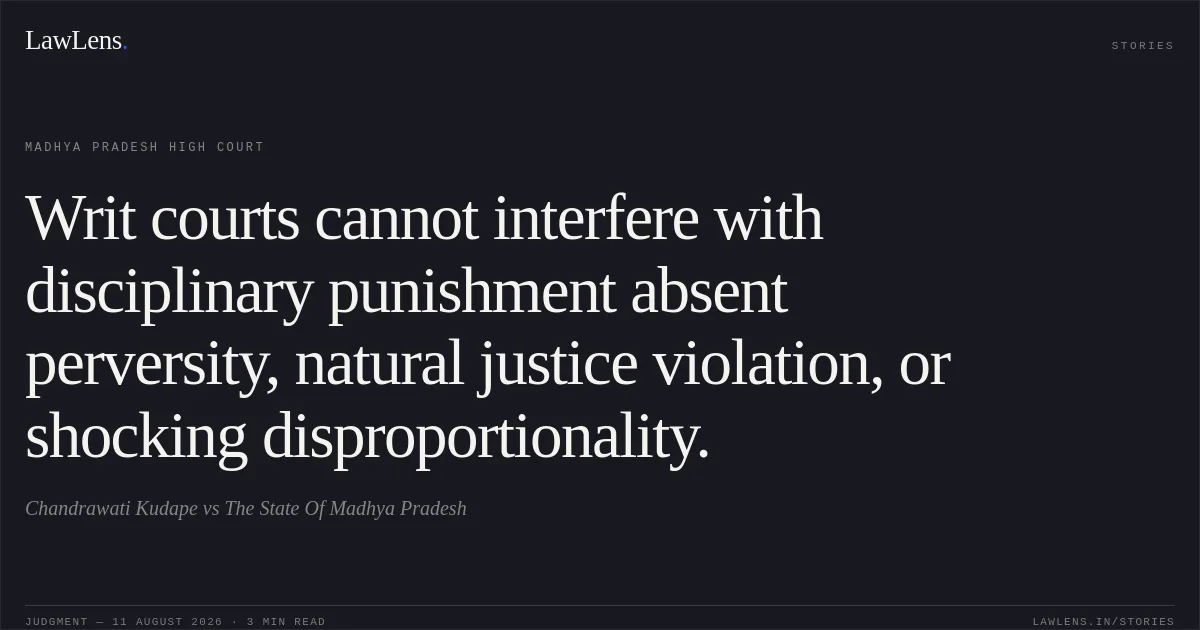
The Court applied the limited scope of judicial review under Article 226 in service and disciplinary matters, particularly the principles of natural justice, evidentiary sufficiency, and proportionality.
Source reference: para. 7Clause D(1) of the Government circular dated 10 July 2007 empowers the Project Officer to terminate an Anganwadi Worker after providing an opportunity of hearing.
Source reference: para. 7Under S.R. Tewari v. Union of India, (2013) 6 SCC 602, judicial review of punishment is ordinarily impermissible unless the penalty is so disproportionate as to shock the conscience of the Court; a finding is perverse where it is based on no evidence, ignores relevant material, or is irrational and contrary to the weight of evidence.
Source reference: para. 9The Court also relied on Ranjit Thakur v. Union of India, B.C. Chaturvedi v. Union of India, V. Ramana v. A.P.S.R.T.C., and State of Meghalaya v. Mecken Singh N. Marak for the principles governing proportionality and the limited power of courts to substitute or modify disciplinary punishment.
Source reference: para. 9The decision in Urekha Domaji Bele v. Executive Engineer, Testing Division, MSEDCL, 2026 SCC OnLine SC 1109, was held distinguishable on facts.
Source reference: para. 6Reasoning
The Court found that the petitioner had received a show-cause notice, submitted a reply, and was afforded an opportunity of hearing before termination; therefore, there was no violation of natural justice.
Source reference: para. 7It further held that Clause D(1) of the circular dated 10 July 2007 supplied the Project Officer with authority to terminate the petitioner after hearing her.
Source reference: para. 7The report of the Project Officer and applicable Government circulars constituted material supporting the finding that the beneficiaries were ineligible for the Ladli Laxmi Yojana, and the petitioner failed to show that the authorities had relied on no evidence or reached perverse conclusions.
Source reference: para. 7Since the appellate authorities independently affirmed the termination, and the misconduct included facilitating ineligible benefits along with unauthorized absence and disobedience, the punishment was not considered irrational or shockingly disproportionate under the principles in S.R. Tewari.
Source reference: paras. 7–9The Supreme Court decision cited by the petitioner was not applied because its factual circumstances were materially different.
Source reference: para. 6Holding
The High Court answered the issues against the petitioner. It upheld the termination order dated 2 September 2016 and the appellate orders dated 20 February 2017 and 26 March 2018, holding that the proceedings were not vitiated by lack of authority or denial of natural justice, that the findings were supported by material on record, and that the punishment was not shockingly disproportionate.
The writ petition was dismissed as meritless, with no direction for reinstatement or consequential service benefits.
Source reference: para. 10Original Court PDF
Chandrawati KudapevsThe State Of Madhya Pradesh
Click to open original judgment
Original judgment, available to read, download and summarize on LawLens.in