Facts
The petitioner, an In-charge of the Police Chowki at Government Hospital, Burhanpur, faced disciplinary proceedings on the charge that he was under the influence of alcohol while on duty during the night of 29–30 November 2019.
Source reference: paras. 1–4Following an enquiry, the disciplinary authority imposed stoppage of three annual increments with cumulative effect.
Source reference: paras. 1–4On appeal, the penalty was reduced to stoppage of one annual increment with cumulative effect.
Source reference: paras. 1–4The petitioner challenged both orders, alleging, among other things, a fabricated complaint, lack of mandatory laboratory testing, prejudice in the enquiry, and breach of natural justice.
Source reference: paras. 1–4The State maintained that the enquiry was fair and the findings were supported by evidence.
Source reference: paras. 1–4Issues
Whether the disciplinary and appellate orders warranted interference under Article 226 on grounds of procedural irregularity, breach of natural justice, or findings unsupported by evidence.
Source reference: paras. 6, 8–9Whether the High Court could reappreciate the evidence adduced in the departmental enquiry.
Source reference: paras. 4, 6–7Law Applied
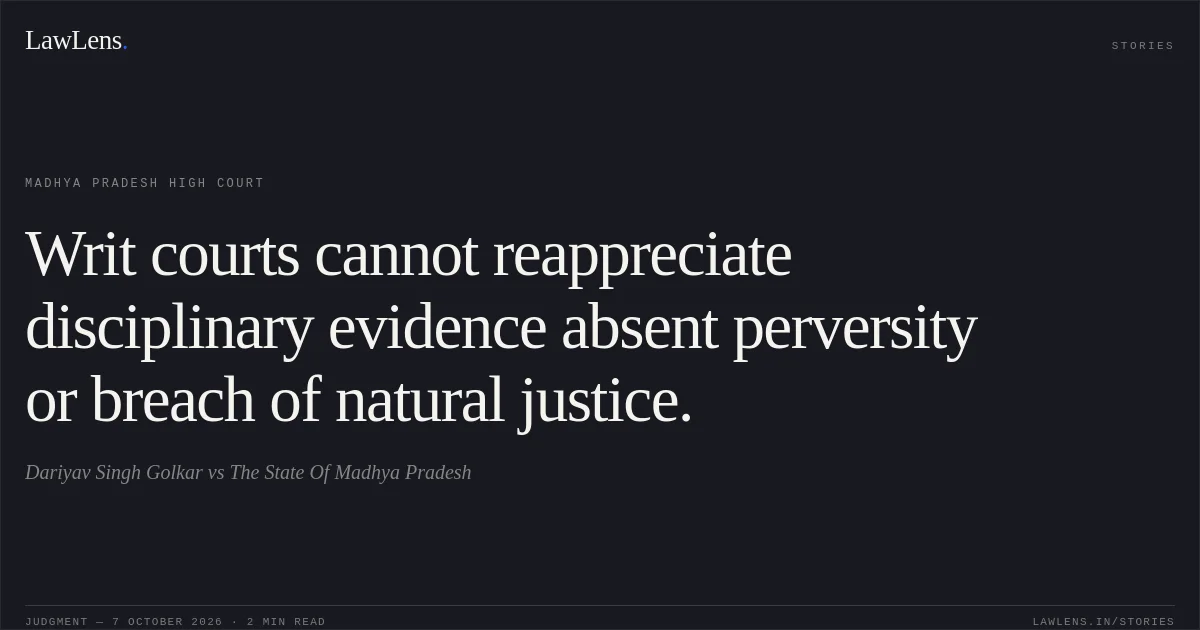
Under Article 226, a writ court does not act as an appellate authority to reweigh or reappreciate evidence in a departmental enquiry.
Source reference: paras. 6–7Judicial review is confined to the decision-making process, including whether the enquiry was conducted by a competent authority, complied with natural justice, and resulted in findings supported by “some evidence.”
Source reference: paras. 6–7Relying on Deputy General Manager (Appellate Authority) and Others v. Ajai Kumar Srivastava, (2021) 2 SCC 612, the Court stated that interference is warranted where findings are perverse or unsupported by evidence, or where the enquiry flagrantly violates statutory rules or natural justice; the adequacy, reliability, and sufficiency of evidence are for the departmental authorities.
Source reference: paras. 6–7Reasoning
The Court found that the petitioner had received a charge sheet, submitted a reply, and participated in the enquiry, where witnesses were examined and cross-examined in his presence.
Source reference: paras. 8–9The authorities relied on the material on record, including the preliminary report and medical observations, in finding misconduct.
Source reference: paras. 8–9The appellate authority had independently considered the matter and reduced the penalty.
Source reference: paras. 8–9Applying the limited scope of review under Article 226, the Court declined to reassess the evidence and found no procedural irregularity, breach of natural justice, or perversity warranting intervention.
Source reference: paras. 8–9Holding
The Court held that the petitioner had not established grounds for judicial interference under Article 226.
The writ petition was dismissed as devoid of merit, leaving in place the appellate order imposing stoppage of one annual increment with cumulative effect.
Source reference: para. 10Original Court PDF
Dariyav Singh GolkarvsThe State Of Madhya Pradesh
Click to open original judgment
Original judgment, available to read, download and summarize on LawLens.in