01Facts
The Karnataka (Licensing of Electrical Contractors, Special Wiring Permit and Grant of Certificates and Permits to Electrical Supervisors and Wiremen) Rules, 2012 classify electrical contractors into four grades: Super Grade, Class 1, Class 2 and Class 3. Super Grade licensees may undertake work at all voltage levels, including EHV, while Class 1 licensees are limited to voltages up to and including 33 kV.
¶ 2–3Rule 12(2)(a) prescribes additional requirements for a Super Grade licence.
¶ 4KPTCL's 2013 circular, which barred Class 1 contractors from 66 kV work, was challenged, and the writ petitions were disposed of in 2014 on KPTCL's memo that fresh tenders would be issued.
¶ 5A 2019 KPTCL circular required shift and maintenance work at sub-stations to be procured through manpower agencies under the KTPP Act and favoured Super Grade contractors. The petitioner's challenge (W.P. No. 10639/2019) was dismissed with liberty to members to bid as manpower service providers, and the writ appeal (W.A. No. 313/2020) was dismissed on 07.04.2022.
¶ 8, 17–19On the Chief Electrical Inspectorate's opinion that only Super Grade contractors could safely perform this work, the State directed KPTCL on 02.02.2024 to withhold tenders.
¶ 10(viii)The KPTCL Board, at its meeting on 07.03.2024, resolved to revise tender documents so that only Super Grade licensees with a valid manpower registration certificate could bid, with service charges between 5% and 10% and a 10% bank guarantee. That resolution is not under challenge.
¶ 10(viii), 19, 26By communication dated 07.02.2024 (Annexure-T), the Chief Engineer was directed to withhold tenders. By instructions dated 28.03.2024 (Annexure-U), all tender-inviting authorities were directed to revise tender documents accordingly.
¶ 1, 8The petitioner, comprising Class 1 contractors, challenged these instructions on grounds including arbitrariness, breach of earlier statements to the Court, Article 19 livelihood concerns, the lack of technical expertise needed for the work, monopoly, and the claim that the Board, not the Inspectorate, should decide eligibility.
¶ 9(i)–(xi)The respondents contended that the petitioner has no vested right to tender, that the employer alone prescribes eligibility, and that the decision rests on safety considerations arising from accidents caused by unqualified personnel.
¶ 10During the pendency of the petition, the Chief Electrical Inspectorate's opinion dated 27.01.2026 reaffirmed that only Super Grade contractors may undertake EHV sub-station work, and the State accepted it.
¶ 13, 14, 2702Issues
i.1. Whether the restriction of shift-duty and maintenance tenders for 220 kV, 110 kV and 66 kV sub-stations to Super Grade Electrical Contractors is arbitrary, discriminatory, monopolistic, or violative of Articles 14 and 19 of the Constitution.
¶ 9(i), (iii), (vi) · ¶ 28ii.2. Whether the Court may interfere with tender eligibility conditions framed by the employer, or whether that power rests with the tender-inviting authority.
¶ 10(ii)–(iii) · ¶ 23, 30iii.3. Whether the Chief Electrical Inspectorate, rather than the KPTCL Board, was competent to determine tender eligibility.
¶ 9(xi) · ¶ 25iv.4. Whether the impugned communications are sustainable given the statutory Rules of 2012, the earlier dismissed challenges, and the unchallenged Board resolution of 07.03.2024.
¶ 21, 2603Law Applied
Rules 11 and 12(2)(a) of the Karnataka Electrical Contractors Rules, 2012 create the four licence classes and the statutory eligibility limits for each, and the petitioner had not challenged them.
¶ 2–4, 21Michigan Rubber (India) Ltd. v. State of Karnataka (2012) 8 SCC 216 holds that the State has wide latitude in framing tender conditions, that restrictions are tested by public interest, and that courts interfere only where a condition is arbitrary, discriminatory, mala fide or biased.
¶ 11(i)Silppi Constructions Contractors v. Union of India (2020) 16 SCC 489, para. 20, holds that judicial restraint governs contract matters, that courts defer to expert opinion unless a decision is totally arbitrary or unreasonable, and that the tender author's interpretation prevails.
¶ 11(ii), 29N.G. Projects Ltd. v. Vinod Kumar Jain (2022) 6 SCC 127 holds that the Court should not substitute its judgment on technical terms and should examine only whether the decision-making process followed the tender conditions.
¶ 11(iii)The Court noted, without fully relying on, the single-bench orders in Geetha Electrical Stores and G S Management Services.
¶ 12The 2019 Circular and the dismissal of W.P. No. 10639/2019 and W.A. No. 313/2020 were treated as settling the petitioner's earlier challenge.
¶ 8, 18–1904Reasoning
The eligibility restriction rests on the statutory classification in the 2012 Rules, which is itself a reasonable classification, and is therefore not violative of Articles 14 or 19.
¶ 21, 28The petitioner did not challenge the Rules, so the consequential restriction to Super Grade contractors could not be faulted.
¶ 21The monopoly objection failed because the respondents stated that around 950 Super Grade licensees exist in the State.
¶ 22The petitioner has no vested right to obtain government contracts, and other permitted work remains open to it.
¶ 23–24On competence, the impugned communication followed the Board's resolution of 07.03.2024, and the Inspectorate's opinion of 27.01.2026 was the basis on which the petitioner's amendment request was rejected.
¶ 25The Board resolution was based on a consideration of safety and human life, which the Court treated as paramount.
¶ 20Because the Board resolution remained unchallenged, the consequential instructions could not be set aside at the petitioner's instance.
¶ 26Applying Silppi, the State's acceptance of the Inspectorate's opinion left no room for judicial intervention, and the Court declined to "tinker with the decision of the expert body".
¶ 27, 29–3005Holding
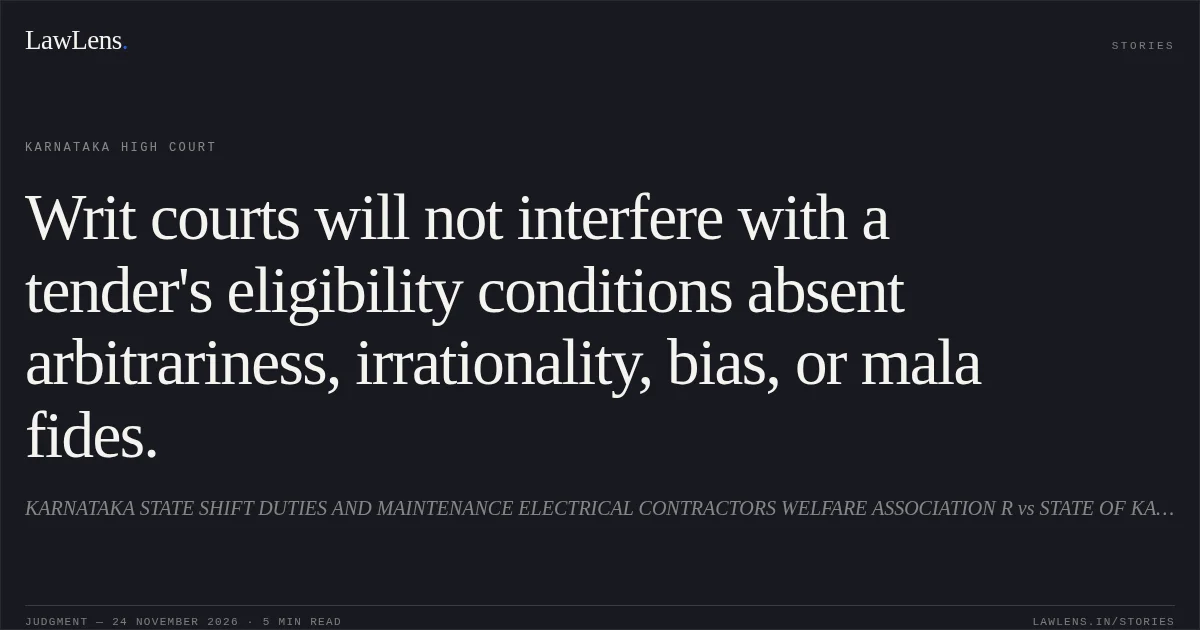
The eligibility condition restricting shift-duty and maintenance tenders for 220 kV, 110 kV and 66 kV sub-stations to Super Grade Electrical Contractors is not arbitrary, discriminatory or monopolistic, and is not violative of Articles 14 or 19.
¶ 27–28Tender eligibility is for the tender-inviting authority, and judicial review is limited to arbitrariness, irrationality, bias, mala fides or perversity.
¶ 23, 29–30The writ petition is dismissed as devoid of merits. The interim order is dissolved, and Interlocutory Applications Nos. 2, 3 and 4 of 2024 for impleadment are closed as no separate orders are required.
¶ 33Original Court PDF
KARNATAKA STATE SHIFT DUTIES AND MAINTENANCE ELECTRICAL CONTRACTORS WELFARE ASSOCIATION RvsSTATE OF KARNATAKA
Click to open original judgment
Original judgment, available to read, download and summarize on LawLens.in