Facts
The petitioner, Rajendra Singh, was appointed as Booth Level Officer for Booth No. 158, Magarda, District Harda, pursuant to an election-duty order dated 10 December 2013.
Source reference: para. 5On 23 April 2014, the Naib Tahsildar complained that the petitioner, while performing election-related duties, was found under the influence of alcohol and had misbehaved with her. A panchnama was prepared and he was medically examined; the medical report recorded that he was under the influence of alcohol.
Source reference: para. 6He was suspended and issued a charge-sheet dated 21 May 2014 alleging, inter alia, dereliction of election duties, intoxication, and misbehaviour with the Naib Tahsildar.
Source reference: paras. 6–7A departmental inquiry was conducted under Rule 14 of the M.P. Civil Services (Classification, Control and Appeal) Rules, 1966, during which witnesses were examined and the petitioner was permitted to participate and cross-examine them.
Source reference: para. 8The disciplinary authority imposed the penalty of withholding one annual increment with cumulative effect on 2 May 2015, and the appellate authority dismissed his appeal on 23 February 2017.
Source reference: para. 1Issues
Whether the departmental inquiry and consequential punishment were vitiated by violation of principles of natural justice or failure to follow the procedure prescribed under Rule 14 of the 1966 Rules?
Source reference: paras. 2, 8, 11, 14Whether the discrepancy in the reference to Booth Nos. 158 and 159 invalidated the charges or caused prejudice to the petitioner?
Source reference: paras. 2, 11Whether withholding one annual increment with cumulative effect was excessive, arbitrary, or disproportionate to the misconduct proved against the petitioner?
Source reference: paras. 12–15Law Applied
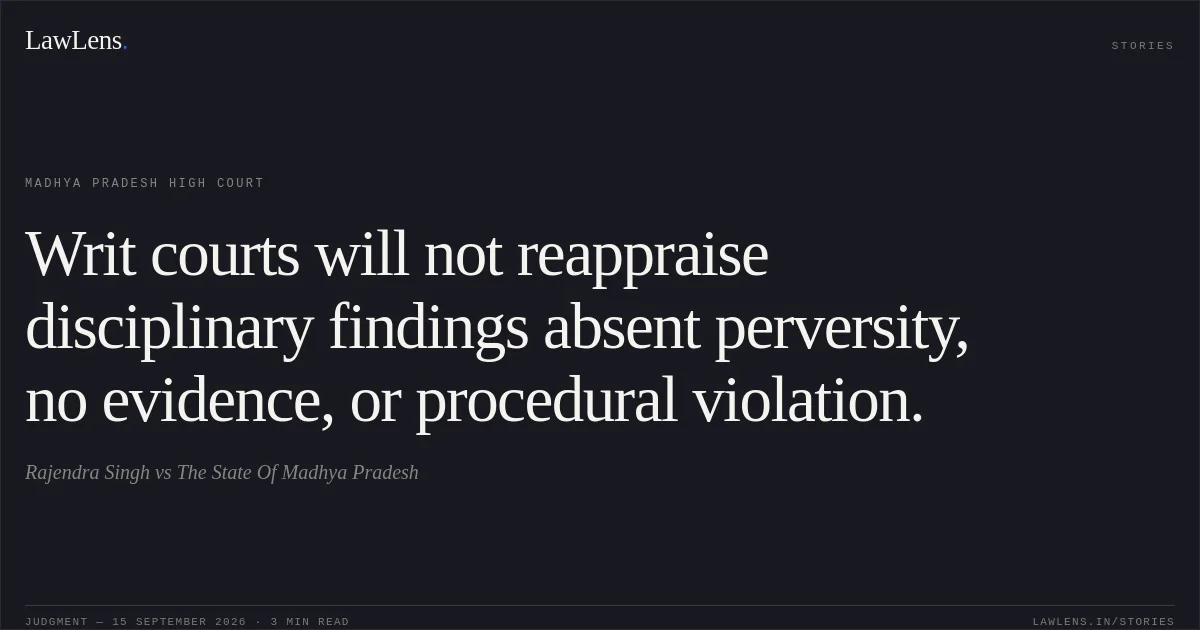
The Court applied Article 226 of the Constitution, under which judicial review of departmental proceedings is confined primarily to the legality of the decision-making process and not to re-appreciation of evidence as an appellate court.
Source reference: para. 13Interference is warranted where findings are based on no evidence, are perverse, or where statutory procedure or principles of natural justice have been violated.
Source reference: paras. 13–14The Court applied Rule 14 of the M.P. Civil Services (Classification, Control and Appeal) Rules, 1966, governing regular departmental inquiries, and Rule 10, which recognises withholding of an annual increment with cumulative effect as a permissible penalty.
Source reference: paras. 11–12A procedural discrepancy will not vitiate disciplinary proceedings in the absence of demonstrated prejudice to the delinquent employee.
Source reference: para. 11Reasoning
The Court found that the petitioner had been clearly informed of the charges, submitted a reply, participated in the regular inquiry, and was afforded an opportunity to cross-examine the departmental witnesses.
Source reference: paras. 8, 11The panchnama, medical report, witness testimony, apology letter, and the petitioner’s own statement seeking pardon constituted material supporting the findings of misconduct, including intoxication and misbehaviour while performing election duty.
Source reference: paras. 6–10The Court held that the reference to Booth No. 159, despite the petitioner’s appointment at Booth No. 158, did not establish prejudice or affect his ability to defend himself and therefore did not invalidate the proceedings.
Source reference: para. 11Given the seriousness of misconduct by a government servant engaged in election-related duties, the penalty authorised by Rule 10 was held neither excessive nor disproportionate.
Source reference: paras. 10, 12Since the petitioner failed to demonstrate absence of evidence, perversity, procedural illegality, or denial of natural justice, no ground for interference under Article 226 was made out.
Source reference: paras. 13–14Holding
The High Court held that the departmental inquiry was conducted in accordance with Rule 14 of the 1966 Rules, that the booth-number discrepancy caused no demonstrated prejudice, and that the penalty of withholding one annual increment with cumulative effect was lawful, proportionate, and commensurate with the proved misconduct.
The writ petition was accordingly dismissed, and the punishment order dated 2 May 2015 and appellate order dated 23 February 2017 were left undisturbed.
Source reference: para. 15No order as to costs was made.
Source reference: para. 15Original Court PDF
Rajendra SinghvsThe State Of Madhya Pradesh
Click to open original judgment
Original judgment, available to read, download and summarize on LawLens.in