Facts
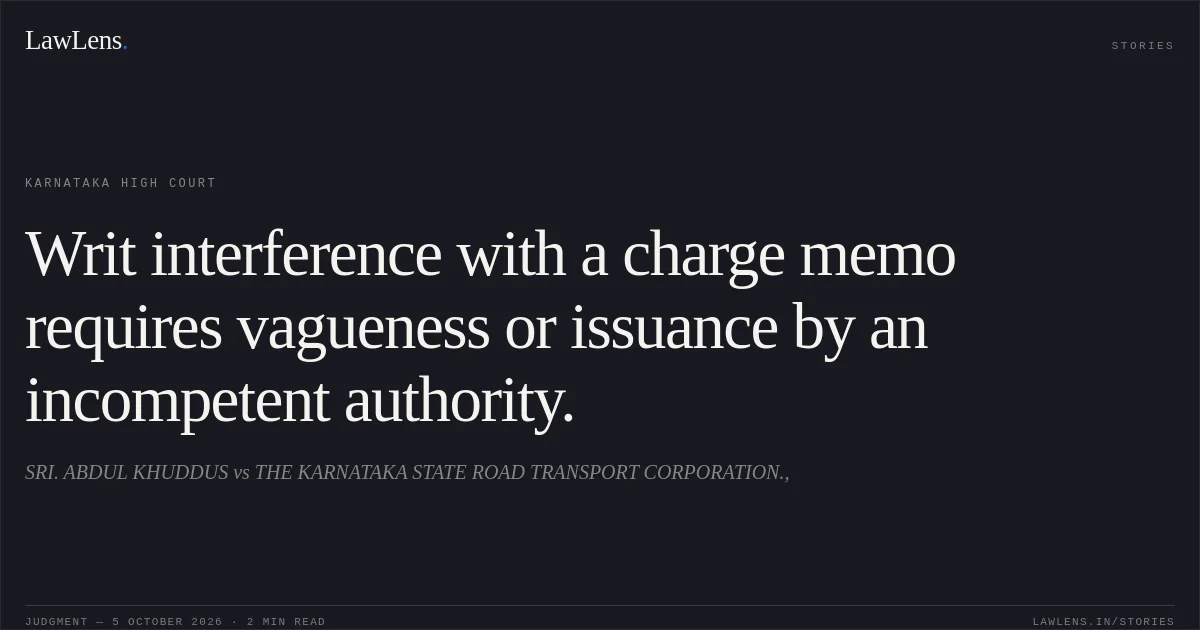
The petitioner, formerly Chief Accounts Officer and Financial Advisor, challenged a common charge memo dated 16 December 2024 issued against him and 27 other officials concerning alleged misappropriation of funds relating to credit notes.
Source reference: para. 2–4, 6He argued that he had previously reported the matter to senior management and was not involved in the alleged misconduct.
Source reference: para. 2–4, 6He also relied on the quashing of criminal proceedings against him.
Source reference: para. 2–4, 6The respondents maintained that he had signed documents relating to the credit notes and could present his defences in the departmental enquiry.
Source reference: para. 2–4, 6Issues
1. Whether the charge memo was liable to be quashed because the petitioner claimed he was uninvolved in the alleged misconduct and had earlier brought the matter to the authorities’ attention.
Source reference: para. 3, 82. Whether the charge memo could be challenged under Articles 226 and 227 where the petitioner did not establish that its allegations were vague or that it was issued by an incompetent authority.
Source reference: para. 4, 7–8Law Applied
The Court considered Articles 226 and 227 of the Constitution of India.
Source reference: para. 4, 7–8It applied the principle that judicial interference with departmental proceedings at the charge-memo stage is not warranted merely because the employee disputes the allegations; interference may be available where the charges are vague or the charge memo was issued by an incompetent authority.
Source reference: para. 4, 7–8Defences concerning the employee’s involvement and conduct are ordinarily to be raised before the Enquiry Officer.
Source reference: para. 4, 7–8Reasoning
The Court found that the charge memo set out the allegations against the employees in detail and that the petitioner did not contend that it had been issued by an incompetent authority.
Source reference: para. 7His assertions that he was uninvolved and had earlier reported the matter were factual defences for consideration in the departmental enquiry, not grounds to quash the charge memo at this stage.
Source reference: para. 8The quashing of the criminal proceedings did not preclude separate departmental proceedings.
Source reference: para. 4Holding
The Court dismissed the writ petition, declining to quash the charge memo.
It permitted the petitioner to seek relevant and available documents, directed the respondents to furnish them subject to relevance and availability, allowed him to submit an additional reply within two weeks, and directed that the enquiry be conducted in accordance with law after giving him an opportunity to be heard.
Source reference: para. 10–11Original Court PDF
SRI. ABDUL KHUDDUSvsTHE KARNATAKA STATE ROAD TRANSPORT CORPORATION.,
Click to open original judgment
Original judgment, available to read, download and summarize on LawLens.in