Facts
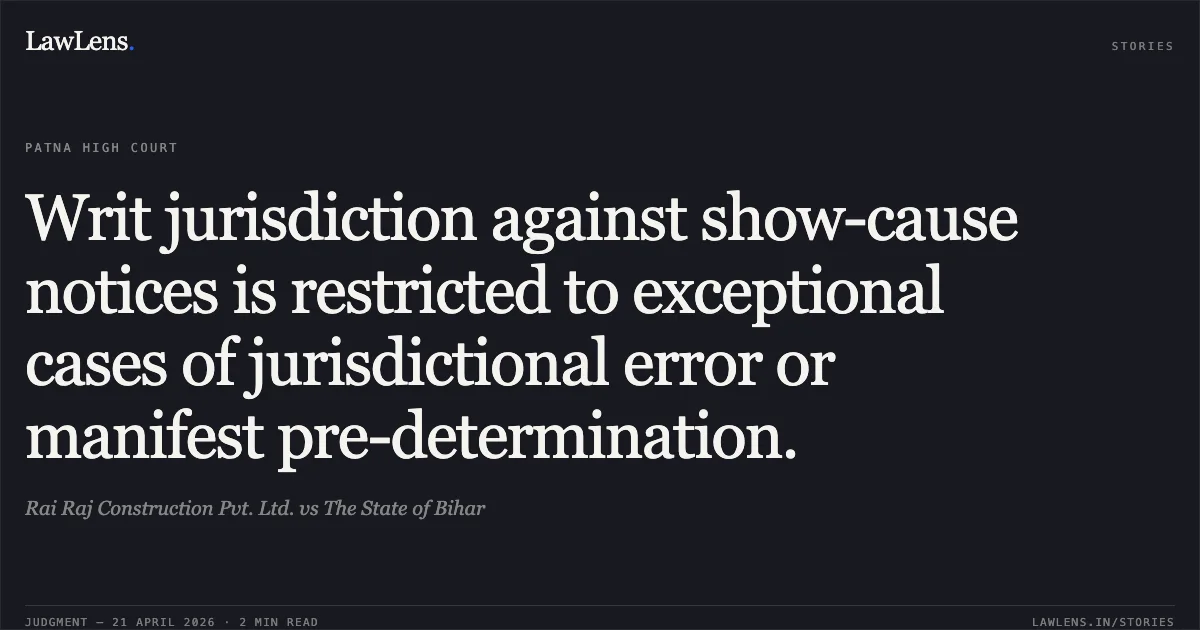
The Petitioner participated in a tender for road widening and strengthening issued by the Road Construction Department, Bihar
Source reference: para. 3Although initially declared the lowest bidder (L-1), a subsequent re-evaluation by the Technical Bid Evaluation Committee revealed that the Petitioner had furnished incorrect information regarding its existing commitments
Source reference: para. 3-4Consequently, the Petitioner's bid was declared non-responsive, and a Show Cause Notice ("SCN") dated 17.03.2026 was issued by the Engineer-in-Chief-cum-Registering Authority
Source reference: para. 4-5The SCN proposed blacklisting the Petitioner for ten years under Clause 11(d)(vii) of the Bihar Contractors Registration Rules, 2007
Source reference: para. 2(i)The Petitioner challenged the SCN under Article 226, contending it was vague, biased, and reflected a pre-determined mind
Source reference: para. 6Issues
Whether the impugned Show Cause Notice dated 17.03.2026 suffers from jurisdictional error, vagueness, or pre-determination sufficient to warrant interference at the pre-decisional stage under Article 226 of the Constitution of India?
Source reference: para. 10Law Applied
The court primarily applied the Bihar Contractors Registration Rules, 2007, which empower the Engineer-in-Chief as the Registering Authority to initiate blacklisting proceedings
Source reference: para. 12It relied on the Supreme Court decisions in Union of India v. Kunisetty Satyanarayana [(2006) 12 SCC 28] and Union of India v. Vicco Laboratories [(2007) 13 SCC 270], which established that writ courts should not ordinarily interfere at the SCN stage unless the notice is ex-facie without jurisdiction or an abuse of law
Source reference: para. 12-13It further applied Special Director v. Mohd. Ghulam Ghouse [(2004) 3 SCC 440], which deprecates the practice of stalling investigative inquiries through writ petitions
Source reference: para. 14It further applied J. Sri Nisha v. Special Director, which limits interference to exceptional circumstances like patent lack of jurisdiction or violation of natural justice
Source reference: para. 20Reasoning
The court determined the writ petition was premature because the Petitioner had not yet replied to the SCN
Source reference: para. 11On jurisdiction, the court held that since the 2007 Rules vest the Engineer-in-Chief with the power to blacklist, he is inherently competent to initiate the process via an SCN
Source reference: para. 12Regarding vagueness, the court found that the notice clearly identified the allegation (incorrect information on existing commitments), which provided sufficient notice for a reply
Source reference: para. 14The court dismissed the allegation of bias, noting that the decision to initiate action was a collective recommendation of a multi-member committee and that a prima facie opinion does not equate to pre-judgment
Source reference: para. 16-17Finally, the court held that mentioning a proposed ten-year blacklisting was a procedural necessity to inform the Petitioner of potential consequences and did not constitute a final determination of guilt
Source reference: para. 19Holding
The court dismissed the writ petition, finding no merit in the challenge against the SCN
It held that the notice did not suffer from jurisdictional infirmity or pre-determination
Source reference: para. 23The court granted the Petitioner liberty to submit a reply to the SCN and directed the competent authority to consider said reply in accordance with the law, without being prejudiced by the court’s observations
Source reference: para. 25Original Court PDF
Rai Raj Construction Pvt. Ltd.vsThe State of Bihar
Click to open original judgment
Original judgment, available to read, download and summarize on LawLens.in