Facts
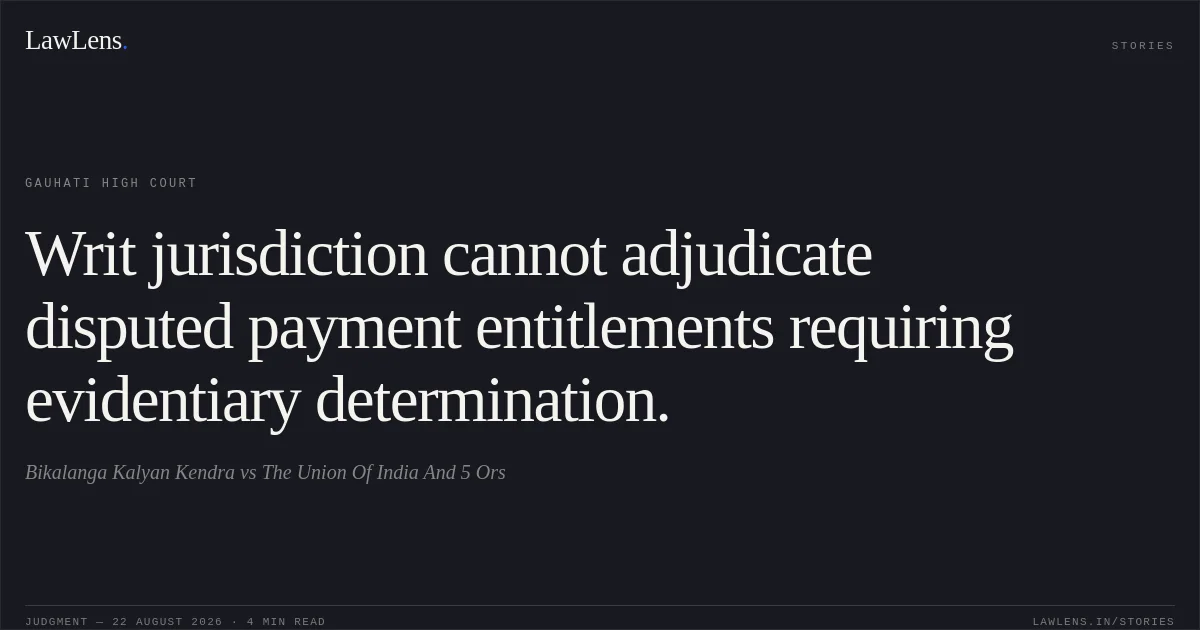
The petitioner, Bikalanga Kalyan Kendra, sought release of ₹42,29,100 allegedly payable under the Integrated Child Protection Scheme (ICPS) for the period from 1 July 2012 to 1 December 2014, along with directions for an enquiry concerning the existence and approval of two Children Homes operated in its name.
Source reference: p.3, para. 2During the proceedings, the Court noted that although the Central Government had sanctioned ICPS funds for Assam for 2013–14 and 2014–15, the State Government had released lesser amounts, and directed the Commissioner and Secretary, Social Welfare Department, to explain the non-utilisation or non-transfer of the sanctioned funds.
Source reference: p.3, para. 3The State subsequently stated that the petitioner had already received ₹3,92,250 for 1 July 2012–31 March 2013 and ₹6,90,750 for 1 April 2013–31 March 2014. It further stated that the petitioner had not submitted the reimbursement proposal, original bills, vouchers, Statement of Expenditure, and Utilisation Certificate required for the period 1 April 2014–30 November 2014, but assured that the claim would be considered upon submission of the necessary documents.
Source reference: pp.4–5, para. 4The petitioner disputed the adequacy of the amounts already paid and contended that, under the revised guidelines effective from 1 April 2014, submission of the original bills and vouchers was not necessary.
Source reference: p.6, para. 6Issues
1. Whether the petitioner could be directed, in writ jurisdiction, to receive further payment for the periods 1 July 2012–31 March 2013 and 1 April 2013–31 March 2014 when the petitioner disputed the amounts assessed by the authorities and the dispute required determination of entitlement and evidence.
Source reference: p.7, para. 7; p.8, para. 9(i)2. Whether the petitioner was entitled to have its reimbursement claim for 1 April 2014–30 November 2014 considered upon submission of the documents required under the applicable ICPS guidelines.
Source reference: pp.7–8, paras. 8–9(ii)3. Whether the period during which the petitioner had bona fide pursued the writ proceedings should be excluded while computing limitation for any civil claim concerning the earlier periods.
Source reference: p.8, para. 9(i)Law Applied
The Court applied the principle that disputed monetary entitlement involving factual examination, production of documents, and the leading of evidence is ordinarily not appropriate for adjudication in writ jurisdiction and must be pursued before a competent Civil Court.
Source reference: p.7, para. 7; p.8, para. 9(i)It further applied the administrative-law principle that an authority may be directed to consider and decide a pending claim in accordance with the governing scheme or guidelines, particularly where the authority has expressly undertaken to examine the claim upon submission of the requisite documents.
Source reference: pp.5, 7–8, paras. 5, 8–9(ii)The Court also exercised its equitable discretion to exclude the period of bona fide writ proceedings while computing limitation for a subsequent civil action.
Source reference: p.8, para. 9(i)Reasoning
The Court held that the petitioner’s challenge to the amounts of ₹3,92,250 and ₹6,90,750 was not a simple question of enforcement of an admitted liability. Since the petitioner claimed additional amounts and disputed the authorities’ assessment, determination would require examination of the applicable guidelines, expenditure records, reimbursement documents, and other evidence, which could not appropriately be undertaken in the writ petition.
Source reference: p.7, para. 7; p.8, para. 9(i)In contrast, for the period 1 April 2014–30 November 2014, the State had not rejected the claim on merits but had stated that it would consider the claim if the required documents were submitted.
Source reference: pp.4–5, para. 4The Court therefore confined the relief to permitting submission of the complete documents and requiring the authorities to verify and decide the claim within the stipulated period.
Source reference: p.7, para. 8; p.8, para. 9(ii)–(iii)Because the petitioner had pursued the matter bona fide before the High Court, the Court also directed that the period from 22 March 2016 until the date of judgment be excluded for limitation purposes in any civil proceedings.
Source reference: p.8, para. 9(i)Holding
The writ petition was disposed of. The Court declined to direct any further payment for the periods 1 July 2012–31 March 2013 and 1 April 2013–31 March 2014, leaving the petitioner at liberty to approach the competent Civil Court and directing exclusion of the period from 22 March 2016 until the date of judgment for limitation purposes.
For the period 1 April 2014–30 November 2014, the petitioner was permitted to submit the complete documents, along with a certified copy of the judgment, to Respondent No. 2. The authority was directed to determine the petitioner’s entitlement and, if payment was found due, release the admissible amount within three months of submission of the complete documents. If the claim was rejected or only partly allowed, a reasoned communication regarding the entitlement was to be issued within the same period.
Source reference: pp.8–9, paras. 9(ii)–(iii)Original Court PDF
Bikalanga Kalyan KendravsThe Union Of India And 5 Ors
Click to open original judgment
Original judgment, available to read, download and summarize on LawLens.in